
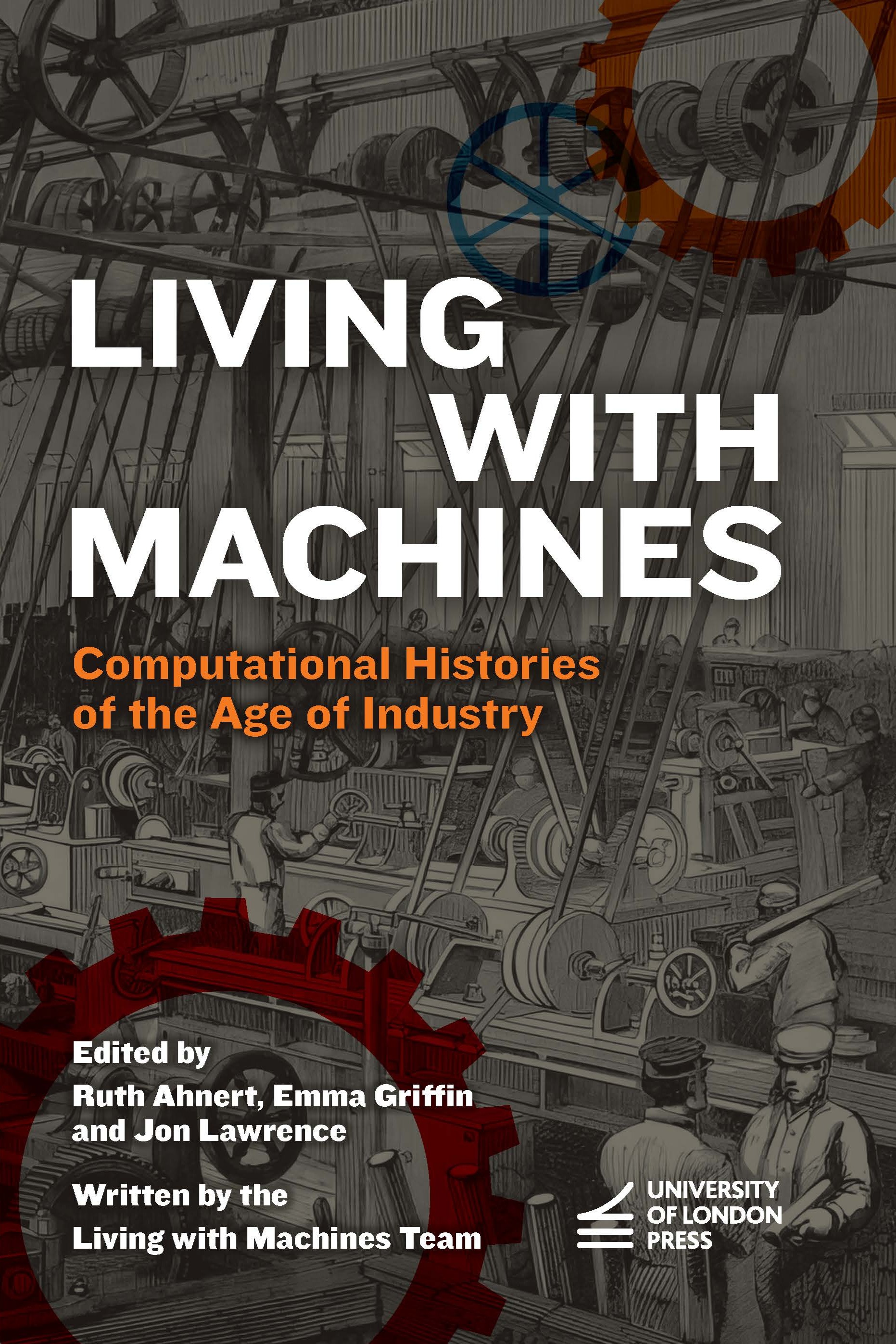
Living with Machines: Computational Histories of the Age of Industry
- Ruth Ahnert(editor)
- Emma Griffin(editor)
- Jon Lawrence(editor)
- The Living with Machines Team (author)
| Title | Living with Machines |
|---|---|
| Subtitle | Computational Histories of the Age of Industry |
| Contributor | Ruth Ahnert(editor) |
| Emma Griffin(editor) | |
| Jon Lawrence(editor) | |
| The Living with Machines Team (author) | |
| DOI | https://doi.org/10.14296/xdyp6338 |
| Landing page | https://uolpress.co.uk/book/living-with-machines/ |
| License | https://creativecommons.org/licenses/by-nc-nd/4.0/ |
| Copyright | Authors |
| Publisher | University of London Press |
| Publication place | London |
| Published on | 2026-11-12 |
| ISBN | 978-1-914477-64-5 (Paperback) |
| 978-1-914477-63-8 (Hardback) | |
| 978-1-914477-66-9 (PDF) | |
| Short abstract | Living with Machines is a data-driven history of the coming of the machine age in Britain in the long nineteenth century. Featuring an enhanced open access edition, it harnesses digitised historical collections and computational analytical tools to examine the ways in which technology altered the very fabric of human existence. |
| Long abstract | Living with Machines is a data-driven history of the coming of the machine age in the long nineteenth century, arising from one of the largest interdisciplinary projects undertaken in the humanities. The world’s first industrial revolution in Britain resulted in an explosion in the creation and collection of documentary sources. This book harnesses the combined power of massive digitised historical collections – from maps and census returns to newspapers – and computational analytical tools to examine the ways in which technology altered the very fabric of human existence on a hitherto unprecedented scale. Collaboratively written, and developed through open community review, the book features an innovative open access edition enhanced with interactive maps, datasets and visualisations, digital notebooks, and multimedia content including video, audio and images. Its experimental approach uses easily reproducible methods based on open source code and linked to publicly available datasets. Historians will find in this book a wealth of accessible material illuminating the human, social and cultural consequences of this historical moment. For digital humanists, cultural heritage professionals, librarians and archivists it is a rich example of the potential and methods of making collections available for digital scholarship. At once an exploration of the extraordinary impact of technology on humanity in the age of industry and a powerful digital artefact itself, this book is an essential text at the cutting edge of digital history. |
| Print length | 396 pages |
| Language | English (Original) |
| Dimensions | 140 x 216 mm | 5.5" x 8.5" (Paperback) |
| 144 x 220 mm | 5.6875" x 8.6875" (Hardback) | |
| THEMA |
|
| BISAC |
|
| Keywords |
|
| Funding |
Contributors
Ruth Ahnert
(editor)Ruth Ahnert is Professor of Literary History and Digital Humanities at Queen Mary University of London, UK. She has a background as an early modernist, with a particular interest in book history and epistolary culture, and her current research interests include applications of data science to humanistic inquiry. She is author of several books including, The Rise of Prison Literature in the Sixteenth Century (2013), The Network Turn: Changing Perspectives in the Humanities (2020, co-authored with Sebastian E. Ahnert, Catherine N. Coleman, and Scott B. Weingart), and Collaborative Historical Research in the Age of Big Data: Lessons from an interdisciplinary project (2023, co-authored with Emma Griffin, Mia Ridge & Giorgia Tolfo). She was Principal Investigator on the Living with Machines project and is co-series editor of the Text Technologies series.
Emma Griffin
(editor)Emma Griffin is Professor of British History and Head of School at Queen Mary University of London, UK. She specialises in the social and economic history of Britain during the period 1700–1914. She has written five books, most recently Bread Winner: An Intimate History of the Victorian Economy (2020) and is currently writing a global history of industrialisation. She was President of the Royal Historical Society, 2020–24 and has spent many years engaged in editorial work, serving as editor for History; Historical Journal; Cultural and Social History and the Camden Series.
Jon Lawrence
(editor)Jon Lawrence is Professor Emeritus at Exeter University. He works on British social, political and cultural history from the mid-nineteenth century to the present. He has published extensively on political language and the culture of public politics and his book Me, Me, Me? The Search for Community in post-war England was published in 2019. He has also worked extensively on the world of popular party politics, playing a prominent role in the development of the so-called 'new political history' with its emphasis on the systematic study of political language. Between 2019 and 2024 he was Co-Investigator on the Living with Machines project.
The Living with Machines Team
(author)Ruth Ahnert, Kaspar Beelen, Arianna Ciula, Emma Griffin, Timothy Hobson, Kasra Hosseini, Katherine McDonough, Barbara McGillivray, Jon Lawrence, Sherman Lo, Tiffany Ong, Nilo Pedrazzini, Joshua Rhodes, Mia Ridge, Guy Solomon, Daniel van Strien, Miguel Vieira, Valeria Vitale, Kalle Westerling, Daniel C.S. Wilson and Rosie Wood.