
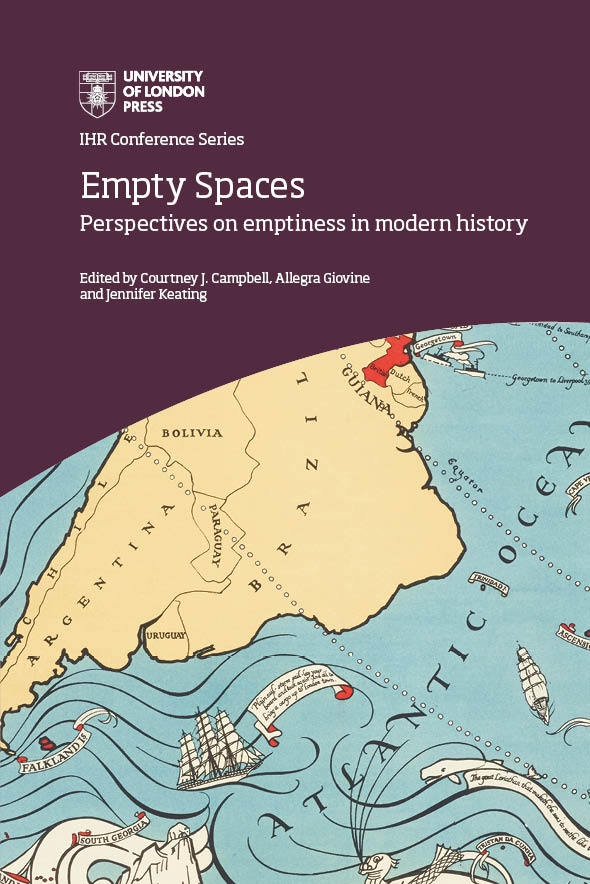
Empty Spaces: perspectives on emptiness in modern history: Perspectives on emptiness in modern history
- Courtney J. Campbell (editor)
- Allegra Giovine (editor)
- Jennifer Keating (editor)
| Title | Empty Spaces: perspectives on emptiness in modern history |
|---|---|
| Subtitle | Perspectives on emptiness in modern history |
| Contributor | Courtney J. Campbell (editor) |
| Allegra Giovine (editor) | |
| Jennifer Keating (editor) | |
| DOI | https://doi.org/10.14296/919.9781909646520 |
| Landing page | https://uolpress.co.uk/book/empty-spaces-perspectives-on-emptiness-in-modern-history/ |
| License | https://creativecommons.org/licenses/by-nc-nd/4.0/ |
| Copyright | Authors |
| Publisher | University of London Press |
| Publication place | London, GB |
| Published on | 2019-09-02 |
| ISBN | 978-1-909646-49-0 (Hardback) |
| 978-1-909646-52-0 (PDF) | |
| 978-1-909646-50-6 (EPUB) | |
| Short abstract | How is emptiness made and what historical purpose does it serve? What cultural, material and natural work goes into maintaining ‘nothingness’? This volume draws together contributions from authors working on landscapes and rurality, along with national and imperial narratives, and seeks to foreground the importance of emptiness as a productive prism through which to interrogate a variety of imperial, national, cultural and urban histories. |
| Long abstract | How is emptiness made and what historical purpose does it serve? What cultural, material and natural work goes into maintaining ‘nothingness’? Why have a variety of historical actors, from colonial powers to artists and urban dwellers, sought to construct, control and maintain (physically and discursively) empty space, and by which processes is emptiness discovered, visualised and reimagined? This volume draws together contributions from authors working on landscapes and rurality, along with national and imperial narratives, from Brazil to Russia and Ireland. It considers the visual, including the art of Edward Hopper and the work of the British Empire Marketing Board, while concluding with a section that examines constructions of emptiness in relation to capitalism, development and the (re)appropriation of urban space. In doing so, it foregrounds the importance of emptiness as a productive prism through which to interrogate a variety of imperial, national, cultural and urban history. |
| Print length | 226 pages |
| Language | English (Original) |
| Dimensions | 163 x 245 mm | 6.4375" x 9.625" (Hardback) |
| Media | 42 illustrations |
| THEMA |
|
| BIC |
|
| BISAC |
|
| Keywords |
|