
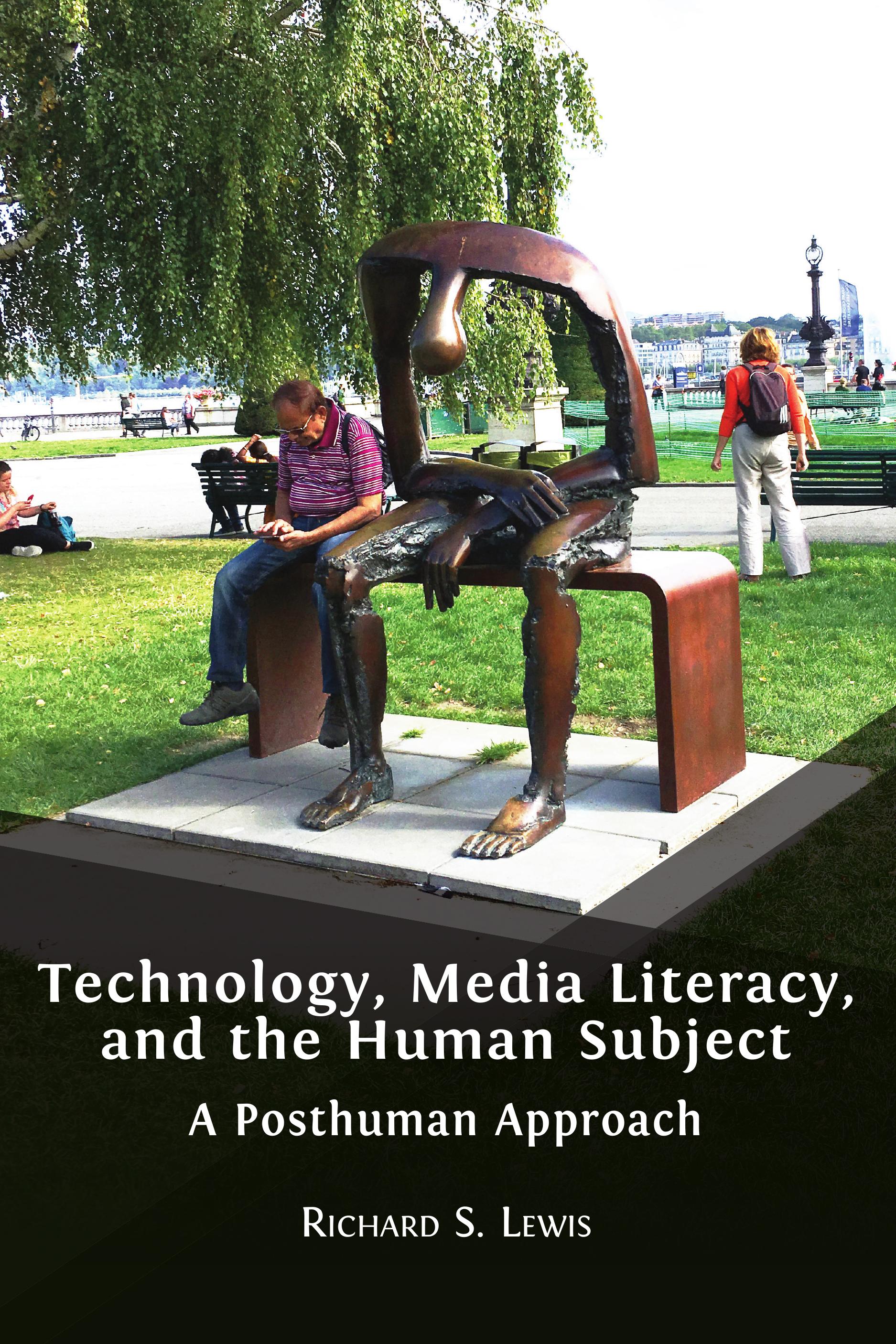
Technology, Media Literacy, and the Human Subject: A Posthuman Approach
- Richard S. Lewis(author)
| Title | Technology, Media Literacy, and the Human Subject |
|---|---|
| Subtitle | A Posthuman Approach |
| Contributor | Richard S. Lewis(author) |
| DOI | https://doi.org/10.11647/OBP.0253 |
| Landing page | https://www.openbookpublishers.com/books/10.11647/obp.0253 |
| License | https://creativecommons.org/licenses/by/4.0/ |
| Copyright | Richard S. Lewis |
| Publisher | Open Book Publishers |
| Publication place | Cambridge, UK |
| Published on | 2021-06-03 |
| ISBN | 978-1-80064-182-2 (Paperback) |
| 978-1-80064-183-9 (Hardback) | |
| 978-1-80064-184-6 (PDF) | |
| 978-1-80064-648-3 (HTML) | |
| 978-1-80064-187-7 (XML) | |
| 978-1-80064-185-3 (EPUB) | |
| 978-1-80064-186-0 (MOBI) | |
| Short abstract | This book addresses these issues by providing a transdisciplinary method that allows for both practical and theoretical analyses of media investigations. Informed by postphenomenology, media ecology, philosophical posthumanism, and complexity theory the author proposes both a framework and a pragmatic instrument for understanding the multiplicity of relations that all contribute to how we affect—and are affected by—our relations with media technology. |
| Long abstract | What does it mean to be media literate in today’s world? How are we transformed by the many media infrastructures around us? We are immersed in a world mediated by information and communication technologies (ICTs). From hardware like smartphones, smartwatches, and home assistants to software like Facebook, Instagram, Twitter, and Snapchat, our lives have become a complex, interconnected network of relations. Scholarship on media literacy has tended to focus on developing the skills to access, analyze, evaluate, and create media messages without considering or weighing the impact of the technological medium—how it enables and constrains both messages and media users. Additionally, there is often little attention paid to the broader context of interrelations which affect our engagement with media technologies. This book addresses these issues by providing a transdisciplinary method that allows for both practical and theoretical analyses of media investigations. Informed by postphenomenology, media ecology, philosophical posthumanism, and complexity theory the author proposes both a framework and a pragmatic instrument for understanding the multiplicity of relations that all contribute to how we affect—and are affected by—our relations with media technology. The author argues persuasively that the increased awareness provided by this posthuman approach affords us a greater chance for reclaiming some of our agency and provides a sound foundation upon which we can then judge our media relations. This book will be an indispensable tool for educators in media literacy and media studies, as well as academics in philosophy of technology, media and communication studies, and the post-humanities. |
| Print length | 264 pages (xii+252) |
| Language | English (Original) |
| Dimensions | 156 x 18 x 234 mm | 6.14" x 0.72" x 9.21" (Paperback) |
| 156 x 22 x 234 mm | 6.14" x 0.88" x 9.21" (Hardback) | |
| Weight | 1118g | 39.44oz (Paperback) |
| 1506g | 53.12oz (Hardback) | |
| Media | 20 illustrations |
| 4 tables | |
| OCLC Number | 1256260600 |
| BIC |
|
| BISAC |
|
| LCC |
|
| Keywords |
|
| Funding | |
Contents
- Richard S. Lewis
(pp. 31–58)- Situating Media Literacy
- Richard S. Lewis
- Richard S. Lewis
- Richard S. Lewis
(pp. 131–170)- Developing the Intrasubjective Mediating Framework
- Richard S. Lewis
(pp. 171–206)- Developing an Instrument to Leverage the Framework
- Richard S. Lewis
(pp. 201–212)- Conclusion
- Richard S. Lewis