
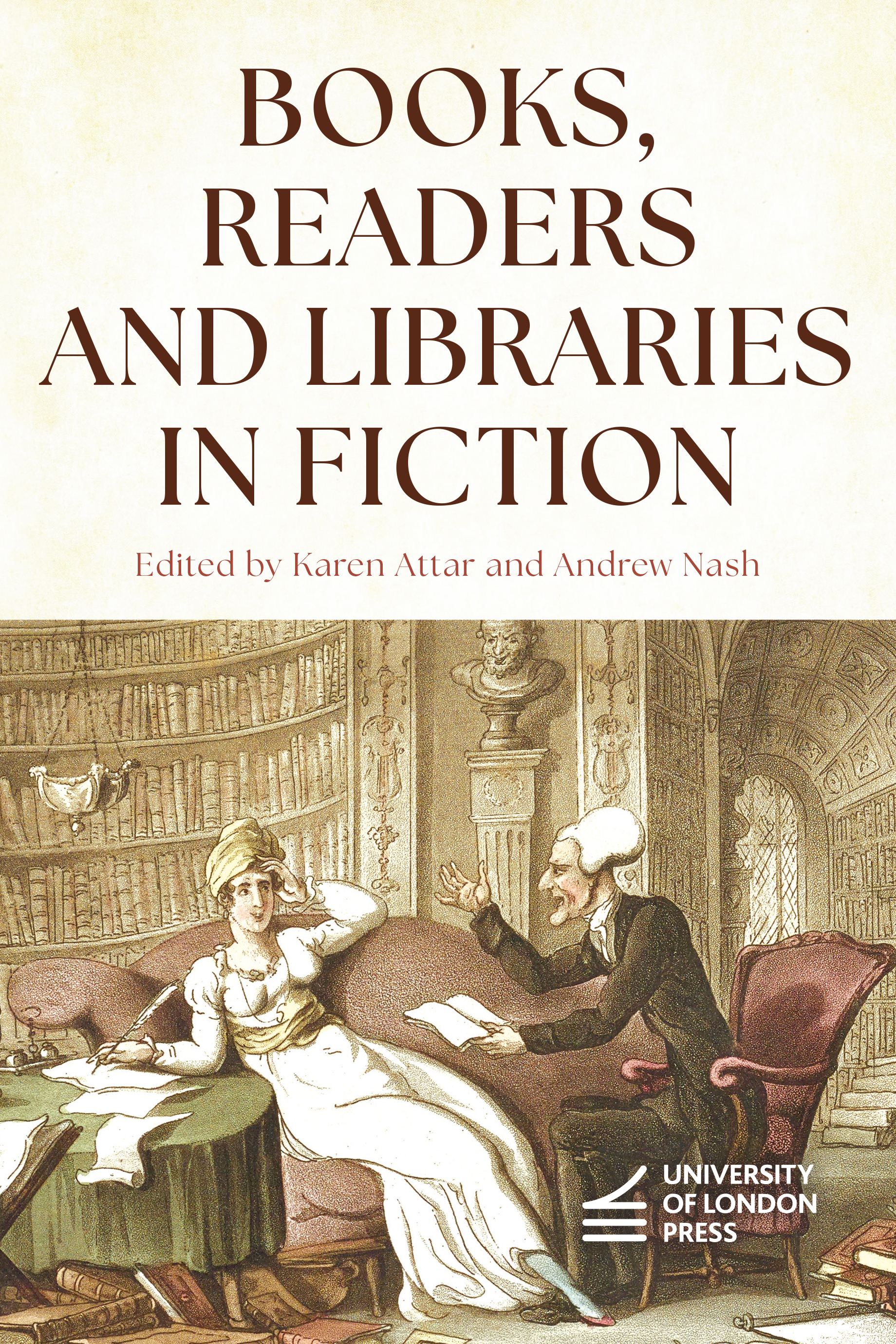
Books, Readers and Libraries in Fiction
- Karen Attar(editor)
- Andrew Nash(editor)
| Title | Books, Readers and Libraries in Fiction |
|---|---|
| Contributor | Karen Attar(editor) |
| Andrew Nash(editor) | |
| DOI | https://doi.org/10.14296/ufnt1799 |
| Landing page | https://uolpress.co.uk/book/books-readers-and-libraries-in-fiction/ |
| License | https://creativecommons.org/licenses/by-nc-nd/4.0/ |
| Copyright | Authors |
| Publisher | University of London Press |
| Publication place | London, GB |
| Published on | 2025-01-30 |
| ISBN | 978-1-913739-03-4 (Paperback) |
| 978-1-913739-02-7 (Hardback) | |
| 978-1-913739-04-1 (PDF) | |
| 978-1-913739-10-2 (HTML) | |
| 978-1-913739-05-8 (EPUB) | |
| Short abstract | This volume explores the depiction of books, libraries and reading in fiction from the medieval period to the present. Its varied case studies address common themes such as gender, genre and the relation between reading and writing itself and examine what fictional representations of reading tell us about changing cultural attitudes to different reading practices. |
| Long abstract | It is easy to find books and libraries within fiction from the earliest times onwards in works for all age groups, in canonical literature and in books that form part of popular culture. From Don Quixote to Louisa M. Alcott’s March girls and Terry Pratchett’s Unseen University wizards, the reading material of fictional personae is part of their characterisation; we are often reading readers. This volume breaks new ground in offering a chronological range of essays exploring the depiction of books, libraries and reading specifically in fiction from the medieval period to the present. Through detailed case studies from primarily British fiction that address common themes such as gender, genre and the relation between reading and writing itself, the collection examines the ways in which authors of fiction mediate and interpret books, libraries, and the act of reading to their own readers. Fiction enables writers to teach readers how to read, but it can also portray subversive acts of reading that engage with contemporary cultural anxieties or moral debates. The volume draws on approaches from literary studies, book history, library history, and theories and histories of reading, to examine what fictional representations of reading tell us about changing cultural attitudes to different reading practices, and the use (and abuse) of books beyond actual reading, both in the context of specific works and about the reception of books more widely. |
| Language | English (Original) |
| Dimensions | 156 x 234 mm | 6.14" x 9.21" (Paperback) |
| 160 x 240 mm | 6.3125" x 9.4375" (Hardback) | |
| Media | 8 illustrations |
| THEMA |
|
| BIC |
|
| BISAC |
|
| Keywords |
|
Contributors
Karen Attar
(editor)Karen Attar is the Curator of Rare Books and University Art at Senate House Library, University of London, and a former Research Fellow at the Institute of English Studies, University of London. She is the reviews editor for Library & Information History, and edited among other works the third edition of the Directory of Rare Book and Special Collections in the United Kingdom and Republic of Ireland (Facet, 2016). She has published widely on aspects of library history.
Andrew Nash
(editor)Andrew Nash is Reader in Book History and Director of the London Rare Books School, Institute of English Studies, University of London. In addition to over fifty scholarly articles and chapters, he has written, edited or co-edited eight books on various aspects of the history of the book, the history of the novel, Victorian literature, and Scottish literature. His most recent major publication is The Cambridge History of the Book in Britain, Volume 7 (2019), co-edited with Claire Squires and Ian Willison. He was an editor of The Review of English Studies from 2011–2020.