
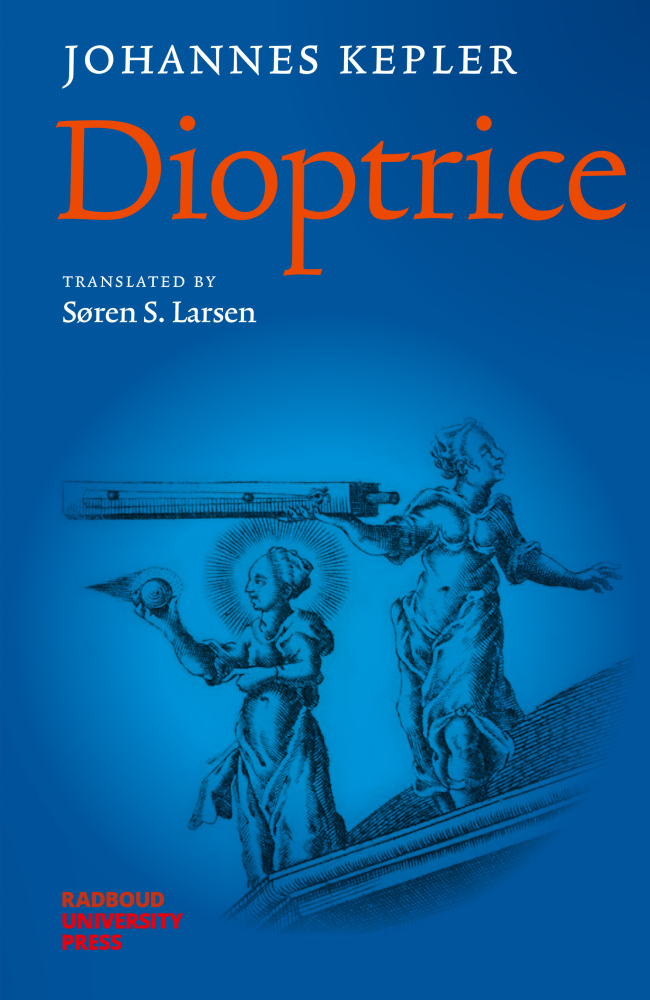
| Title | Dioptrice |
|---|---|
| Contributor | Søren S. Larsen(translator) |
| DOI | https://doi.org/10.54195/LAGG8615 |
| Landing page | https://books.radbouduniversitypress.nl/index.php/rup/catalog/book/dioptrice |
| License | https://creativecommons.org/licenses/by-nc-nd/4.0/ |
| Copyright | Johannes Kepler, Søren Larsen |
| Publisher | Radboud University Press |
| Published on | 2025-05-19 |
| ISBN | 978-94-6515-070-3 (Hardback) |
| 978-94-6515-070-3 (PDF) | |
| Short abstract | Kepler's Dioptrice, published in 1611 in response to Galileo's revolutionary discoveries, contained the first theory of the telescope and laid the foundation for the development of modern optics. |
| Long abstract | One day in March 1610, the imperial mathematician, Johannes Kepler, received a visitor at his home in Prague. The visitor brought exciting news from Italy, so urgent in fact that he did not even allow himself time to get down from his horse carriage before delivering it: Galileo Galilei had discovered four new planets, using an optical instrument known as the perspicillum, recently invented by spectacle makers in the Netherlands. As Kepler would soon learn, the four new planets were actually satellites of the planet Jupiter, a discovery with profound implications. The Earth was clearly not the centre of movement in the Universe, a fact which provided strong support for the Copernican system with the Sun at the centre of the world. As important as these new discoveries were, however, Galileo provided only a very rudimentary description of the new instrument, the telescope, with which they had been made. Kepler was uniquely qualified to provide a complete optical theory for the instrument. Some years earlier, he had published his first ground-breaking work on Optics, in which he had demonstrated how an inverted image is formed on the retina at the back of the eye, at the focus of the lens. He immediately understood that the geometrical principles, based on which he had developed his theory of optics, could also be applied to the telescope. Over the coming months, Kepler developed the theory of the telescope, explaining not only how the combination of a concave and a convex lens used in the Dutch/Galilean telescope can magnify distant objects, but also showing that the same effect can be achieved with two convex lenses. The latter design, in fact, has several advantages over the Dutch/Galilean variety, and became known as the astronomical or, indeed, the Keplerian telescope. Kepler’s theory of the telescope forms the main theme of the Dioptrice. In addition to providing the first theory for the telescope, the Dioptrice also includes a preface in which Kepler gives us a glimpse into the rudimentary state of the field of optics prior to his work. In a commentary on a text by the French mathematician Jean Pena, Kepler discusses such topics as the existence of solid spheres filling the space between the planets, the motion of the Earth, the planets, and comets, evidence of refraction by the atmosphere, and whether vision takes place by intromission or extramission of light rays. He then goes on to discuss Galileo's telescopic discoveries, first those announced by Galileo in his Sidereus Nuncius, and then the subsequent observations of Saturn and the phases of Venus communicated by Galileo in letters transmitted to Kepler by the Tuscan ambassador in Prague. Kepler can hardly hide his excitement when commenting on these discoveries. The *Dioptrice *is available here in a complete translation into English for the first time. Kepler's text is annotated with numerous notes, referencing Kepler's own letters and other sources. The translation is preceded by an introduction that links the book to Kepler's other work and discusses its conception and impact on the subsequent development of the astronomical telescope. |
| Print length | 176 pages (nulla+176+nulla) |
| Language | English (Original) |
| OCLC Number | 1521588445 |
| THEMA |
|
| BISAC |
|
| Keywords |
|
Contributors
Søren S. Larsen
(translator)Søren Larsen was born in the Danish town of Næstved. Growing up in the countryside, he became fascinated by the night sky at a young age and started exploring it, first with binoculars and then through increasingly advanced telescopes. He studied physics and astronomy at the University of Copenhagen where he obtained his Master’s degree in 1996 and his PhD in 1999. He worked as a postdoctoral researcher at the University of California, Santa Cruz, from 2000-2002, and then moved to the headquarters of the European Southern Observatory in Garching, Germany, where he worked first as a research fellow and then as an instrument scientist for the Hubble Space Telescope. In 2006 he took up a position as an assistant professor at Utrecht University, the Netherlands, and since 2012 he has been part of the Department of Astrophysics at the Radboud University where he is an associate professor. Throughout his professional career, he has been using telescopes such as the Keck Telescopes, the ESO Very Large Telescope, the Hubble Space Telescope, and more recently ESA’s Euclid space telescope, to study nearby galaxies and stellar clusters. The results of this work are published in more than 150 peer-reviewed scientific articles that he has authored or co-authored.