
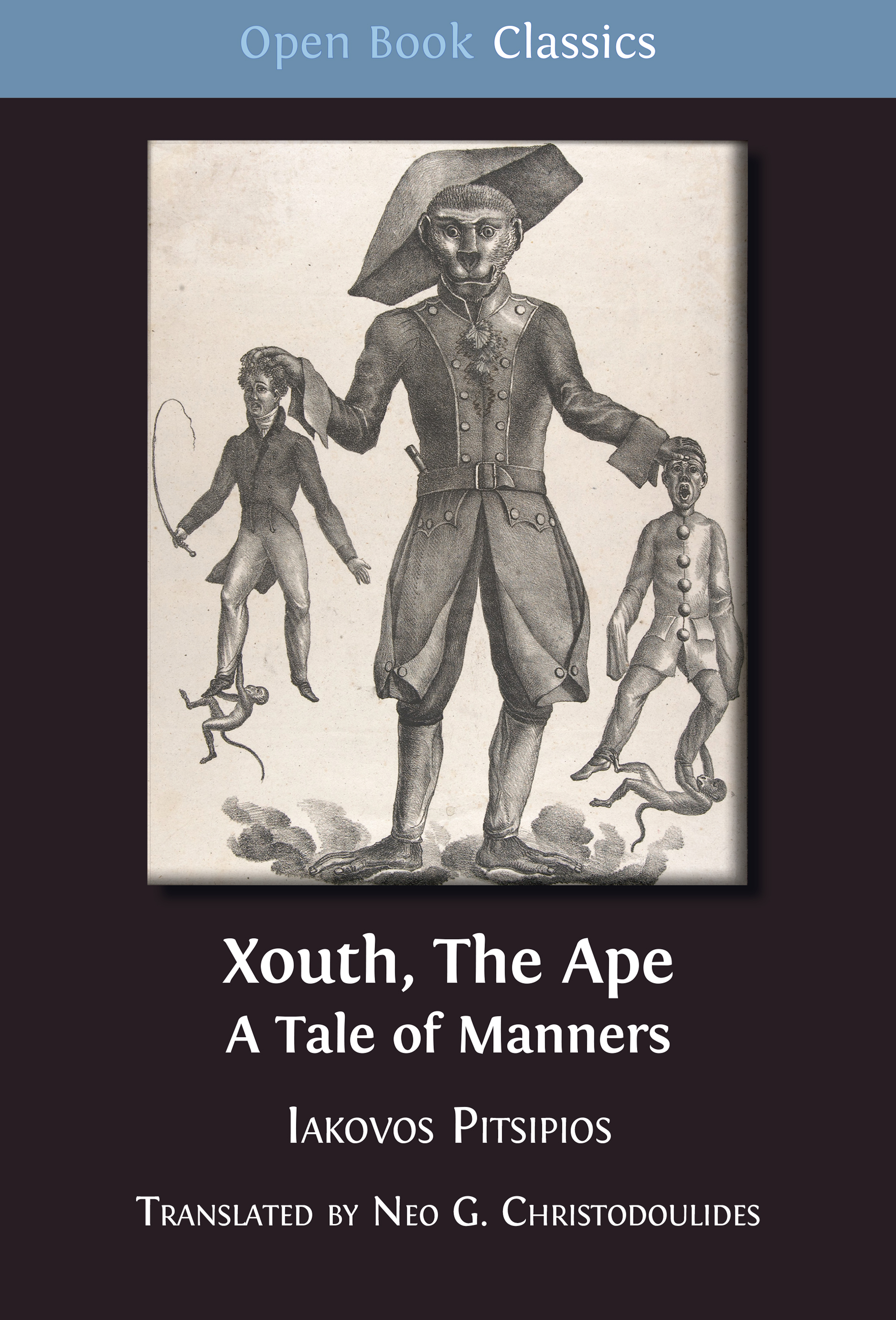
Xouth, The Ape: A Tale of Manners
- Iakovos Pitsipios (author)
- Neo G. Christodoulides (translator)
| Title | Xouth, The Ape |
|---|---|
| Subtitle | A Tale of Manners |
| Contributor | Iakovos Pitsipios (author) |
| Neo G. Christodoulides (translator) | |
| DOI | https://doi.org/10.11647/OBP.0493 |
| Landing page | https://www.openbookpublishers.com/books/10.11647/OBP.0493 |
| License | http://creativecommons.org/licenses/by/4.0/ |
| Copyright | Iakovos Pitsipios; Neo G. Christodoulides; |
| Publisher | Open Book Publishers |
| Publication place | Cambridge, UK |
| Published on | 2025-10-28 |
| Series |
|
| ISBN | 978-1-80511-717-9 (Paperback) |
| 978-1-80511-718-6 (Hardback) | |
| 978-1-80511-719-3 (PDF) | |
| 978-1-80511-721-6 (HTML) | |
| 978-1-80511-720-9 (EPUB) | |
| Short abstract | 'Xouth, the Ape', published in 1848 by Iakovos Pitsipios is a pioneering and satirical Greek novel that deftly blends humour, cultural critique, and biting social commentary. The novel is set in the aftermath of the Greek War of Independence. The story follows a young Greek man, desperate to present himself as a European aristocrat, who finds himself entangled with Xouth—an ape who is, in fact, a German travel writer transformed as punishment for his vanity and prejudices. |
| Long abstract | 'Xouth, the Ape', published in 1848 by Iakovos Pitsipios is a pioneering and satirical Greek novel that deftly blends humour, cultural critique, and biting social commentary. The novel is set in the aftermath of the Greek War of Independence. The story follows a young Greek man, desperate to present himself as a European aristocrat, who finds himself entangled with Xouth—an ape who is, in fact, a German travel writer transformed as punishment for his vanity and prejudices. Through the interactions between the protagonist and the ape-valet, Pitsipios skewers the pretensions of Greece’s newly minted elites, exposing the often comical efforts to mimic Western manners and ideals. The novel lampoons the wave of Western travel writers who ‘discovered’ Greece, poking fun at their colonial attitudes and superficial observations. The figure of Xouth serves as both a mirror and a caricature, reflecting the absurdities of identity, authenticity, and cultural imitation in a society striving to define itself between East and West. Translated in English for the first time, with an expansive Introduction by Neo G. Christodoulides, the novel explores themes of national identity, the pitfalls of mimicry, and the complexities of cultural exchange. Rich with allusions to both Greek and European literary traditions, Pitsipios draws sharp parallels between his characters’ quests for legitimacy and the real historical debates around language, class, and belonging in 19th-century Greece. The novel’s polyglossic style—a blend of archaic, official, and colloquial Greek—further emphasises the layered and fractured nature of Greek identity at the time. Despite its initial obscurity, the novel’s relevance endures: its sharp satire and insightful social analysis make it not just a humorous adventure, but a revealing document of post-revolutionary Greece and its ongoing negotiations with modernity, Western influence, and self-perception. 'Xouth, the Ape' is a hidden gem that deserves renewed attention from readers, scholars, and anyone fascinated by the crossroads of cultures. |
| Print length | 102 pages (x+92) |
| Language | English (Original) |
| Dimensions | 156 x 5 x 234 mm | 6.14" x 0.2" x 9.21" (Paperback) |
| 156 x 8 x 234 mm | 6.14" x 0.31" x 9.21" (Hardback) | |
| Weight | 159g | 5.61oz (Paperback) |
| 327g | 11.53oz (Hardback) | |
| OCLC Number | 1547601092 |
| LCCN | 2025465570 |
| THEMA |
|
| BISAC |
|
| LCC |
|
| Keywords |
|
Contents
- Iakovos Pitsipios
- Neo Gereon Christodoulides
(pp. 9–18)- Kallistratos Evgenides and Xouth, the Ape
- Iakovos Pitsipios
- Neo Gereon Christodoulides
(pp. 19–24)- The Journey
- Iakovos Pitsipios
- Neo Gereon Christodoulides
(pp. 25–30)- The Recognition
- Iakovos Pitsipios
- Neo Gereon Christodoulides
(pp. 31–32)- The Release
- Iakovos Pitsipios
- Neo Gereon Christodoulides
(pp. 33–36)- The Crime
- Iakovos Pitsipios
- Neo Gereon Christodoulides
(pp. 37–40)- Divine Justice
- Iakovos Pitsipios
- Neo Gereon Christodoulides
(pp. 41–42)- The Wilderness
- Iakovos Pitsipios
- Neo Gereon Christodoulides
(pp. 43–44)- The Captivity
- Iakovos Pitsipios
- Neo Gereon Christodoulides
(pp. 45–50)- Ligarides
- Iakovos Pitsipios
- Neo Gereon Christodoulides
(pp. 51–52)- The Return
- Iakovos Pitsipios
- Neo Gereon Christodoulides
(pp. 53–58)- The Sweet Little Soultana
- Iakovos Pitsipios
- Neo Gereon Christodoulides
- Iakovos Pitsipios
- Neo Gereon Christodoulides
- Iakovos Pitsipios
- Neo Gereon Christodoulides
- Iakovos Pitsipios
- Neo Gereon Christodoulides
- Iakovos Pitsipios
- Neo Gereon Christodoulides
- Iakovos Pitsipios
- Neo Gereon Christodoulides
(pp. 83–86)- The Malady
- Iakovos Pitsipios
- Neo Gereon Christodoulides
Contributors
Iakovos Pitsipios
(author)Neo G. Christodoulides
(translator)Neo Gereon Christodoulides has served in the German Army's Mountain Division in Bavaria since 2022. He has been co-teaching Roman law at University College, London, since 2022. His work appeared in the Brussels Review. He holds an MSc and a PhD in law from the University of Edinburgh, an MA in Classics from the University of California, Irvine, a BA in Classics from King's College, London and a law degree (Staatsexamen) from the University of Frankfurt, Germany. He was raised in Cyprus and the United Kingdom, where he was a boarder at Ampleforth College, York.
References
- Pitzipios, J. G. (1855). L’Eglise Oriental, première partie. Imprimerie de la propagande.
- Pitsipios, I. (1848). ‘Xouth, the Ape’. Αποθήκη των Τερπνών και Ωφελίμων Γνώσεων [The Storehouse of Delightful and Useful Knowledge].
- Defoe, D. (2009) [1722]. Moll Flanders. Oxford World’s Classics.
- Dickens, C. (with Slater, M.). (1991) [1849–50]. David Copperfield. Everyman’s Library Classics Series.
- Fielding, H. (with Rawson, C.). (1991) [1749]. Tom Jones. Everyman’s Library Classics Series.
- Achilles Tatius (with Morales, H.). (2002). Leucippe and Clitophon, translated with notes by T. Whitmarsh. Oxford University Press.
- Pitsipios, I. (1995) [1848]. Η ορφανή της Χίου ή ο θριαμβος της αρετής – Ο Πιθηκος Ξούθ ή τα ήθη του αιώνος [The Orphan of Chios or the Triumph of Virtue – Xouth, the Ape, or the Morals of the Century] (D. Tziovas, ed.). Ουρανή.
- Pitsipios, I. (1995) [1848]. Ο πίθηκος Ξουθ ή τα ήθη του αιώνος [Xouth, the Ape, or the Morals of the Century] (N. Vagenas, ed.). Νεφέλη.
- Pitsipios, I. (2020) [1848]. πίθηκος Ξουθ ή Τα ήθη του αιώνος [Xouth, the Ape, or the Morals of the Century]. Ανοικτή Βιβλιοθήκη [Open Library]. https://www.openbook.gr/o-pithikos-xoyth/; https://doi.org/10.11647/OBP.0493#resources
- Goethe, J. W. v. (2009) [1795–96]. Wilhelm Meisters Lehrjahre. Suhrcamp.
- Schiller, F. (1993) [1795]. ‘Über naive und sentimentalische Dichtung, Sämtliche Werke (G. Fricke & H.t G. Göpfert, eds). Hauser.
- Sterne, L. (1768). A Sentimental Journey through France and Italy. T. Becket and P.A. De Hondt.
- Voltaire, François-Marie Arouet, de (1759). Candide ou L’Optimisme. Cramer.
- Apuleius (2008). The Golden Ass, translated by P.G. Walsh. Penguin.
- Bakhtin, M.M. (1981). The Dialogic Imagination, translated by C. Emerson & M. Holquist (M. Holquist, Ed.) University of Texas Press.
- Bakhtin, M.M. (1986). Speech Genres and Other Essays, translated by Vern W. McGee (C. Emerson and M. Holquist, eds). University of Texas Press.
- Borghart, P. and De Temmerman, K. (2010). ‘From Novelistic Romance to Romantic Novel: The Revival of the Ancient Adventure Chronotope in Byzantine and Modern Greek Literature’. Journal of Mediterranean Studies, 19(1), 43–68.
- Fairey, J. (2013). ‘Failed Nations and Usable Pasts: Byzantium as Transcendence in the Writings of Iakovos Pitsipios Bey’. In O. Delouis, A. Couderc and P. Guran (eds), Héritages de Byzance en Europe du Sud-Est à l’époque moderne et contemporaine. Ecole française d’Athènes. (pp. 23–44). https://doi.org/10.4000/books.efa.9340(opens in new tab)
- Iatrou, M. (2017). ‘Human Apes and the Dual Self: Notes on the Intertext of Ο Πίθηκος Ξουθ (Xouth the Ape) by Iakovos Pitsipios’. Neogreca Bohemica, 17, 9–29.
- O’Neill, K.L. (2003). ‘The Unfinished Ape: Mediation and Modern Greek Identity in Iakovos Pitsipios’s Ο Πίθηκος Ξούθ’. Journal of Modern Greek Studies, 21(1), 67–111. https://doi.org/10.1353/mgs.2003.0007(opens in new tab)
- Reardon, B.P. (with Morgan, J.R.). (2019). Collected Ancient Greek Novels. University of California Press.
- Rebig, G. (1972). Der Halbbruder des Dichters. Athenäum.
- Roilos, P. (2003). ‘The Poetics of Mimicry: Pitzipios’ O Πίθηκος Ξούθ and the Beginnings of the Modern Greek Novel’. In A. Stathakopoulou and G. Nagy (eds), Modern Greek Literature: Critical Essays (pp. 62–78). Routledge.
- Σέρβου, M. (1997). Oι εξομολογήσεις ενός πιθήκου και ο Iάκωβος Πιτζιπιός. [The Confessions of an Ape and Iakovos Pitsipios] N. Βαγενάς (επιμ), [N. Vagensas, ed.] ΑΠΟ ΤΟΝ ΛΕΑΝΔΡΟ ΣΤΟΝ ΛΟΥΚΗ ΛΑΡΑ Μελέτες για την πεζογραφία της περιόδου 1830-1880 (pp. 93–102). [From Leandros to Loukis Laras. Studies on the Prosa of the Period 1830-1880] Πανεπιστημιακές Εκδόσεις Κρήτης [University of Crete Press]
- Τζιόβας, Δ. (2003). Ο αποσυνάγωγος Ιάκωβος Γ. Πιτζιπίος: ηθική και μεταμόρφωση. [The Pariah Iakovos Pitsipios: Morals and Transformation] In Δ. Τζιόβας (επιμ.), [D. Tziovas, ed.] Κοσμοπολίτες και αποσυνάγωγοι. Μελέτες για την ελληνική πεζογραφία και κριτική (1830–1930) [Cosmopolitans and Pariahs. Studies in Greek Prose and Criticism (1830–1930)] (pp. 21–109). Μεταίχμιο.