
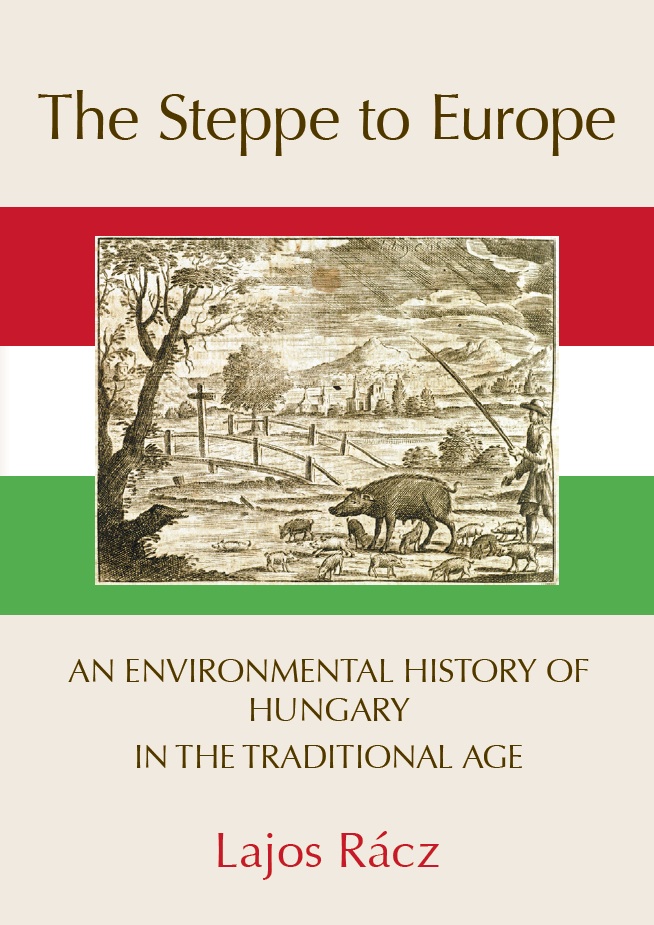
The Steppe to Europe: An Environmental History of Hungary in the Traditional Age
- Lajos Rácz (author)
- Alan Campbell (translator)
| Title | The Steppe to Europe |
|---|---|
| Subtitle | An Environmental History of Hungary in the Traditional Age |
| Contributor | Lajos Rácz (author) |
| Alan Campbell (translator) | |
| Landing page | https://www.whpress.co.uk/publications/2013/07/15/the-steppe-to-europe/ |
| Copyright | The White Horse Press |
| Publisher | The White Horse Press |
| Publication place | Winwick, UK |
| Published on | 2013-07-15 |
| ISBN | 978-1-874267-76-8 (Hardback) |
| 978-1-912186-39-6 (PDF) | |
| Short abstract | This book, a much-augmented translation of the author’s original Hungarian version, is an account of Hungary’s past from the perspective of environmental history, incorporating a wide range of environmentally-relevant research findings |
| Long abstract | A history of Hungary’s people and their environment from earliest times to the late eighteenth century. This book, a much-augmented translation of the author’s original Hungarian version, is an account of Hungary’s past from the perspective of environmental history, incorporating a wide range of environmentally-relevant research findings. Data on climate, agriculture, mining, hunting, urban development and political administration are synthesised to create a rich account of a people in the environment, and the processes of adaptation, exploitation and co-existence required for survival. Importantly, it offers anglophone readers access to a considerable digest of important scholarship previously only available in Hungarian. Until now, there has been no environmental history in English of Hungary and the wider region from which the present country crystallised. The book covers the environmental history of Hungary prior to the Industrial Revolution. It begins with the prehistory of the two protagonists in this environmental story, the Carpathian Basin and the Hungarians; and traces the transformation of the Hungarians, under environmental, social and economic forces, from nomadic tribes to a settled society in the Middle Ages. The environmental developments of the later Middle Ages, a period of relative stability, are explored before the story turns to a long era of war with the Ottoman Empire, during which the key to survival lay in finding adaptive forms of settlement and subsistence systems. Finally, the book chronicles the age of reconstruction following the Ottoman wars and the challenges posed as the country’s population more than doubled, a growth unmatched by agricultural or industrial development. The present volumes leaves Hungary at the dawn of the Industrial Age, a country displaying symptoms of over-population and environmental over-exploitation. |
| Print length | 268 pages |
| Language | English (Translated into) |
| Dimensions | 170 x 15 x 244 mm | 6.69" x 0.59" x 9.61" (Hardback) |
| Weight | 628g | 22.15oz (Hardback) |
| Media | 63 illustrations |
| BIC |
|
| BISAC |
|
| Keywords |
|
Contributors
Lajos Rácz
(author)Lajos Rácz is a professor at Szeged University and visiting professor at the Central European University in Budapest. His research area is climate and environmental history, specialising in the climate history and environmental crises of the Carpathian Basin in the Early Modern and Modern periods. He has researched at the Historical Institute of Bern University, Masaryk University (Brno), the Netherlands Institute for Advanced Studies and the Rachel Carson Center in Munich. In 2004 he was awarded the title of doctorat of Hungarian Academy of Sciences. Rácz was a founding member of the European Society for Environmental History (2001) and the International Society for Historical Climatology (2012).