
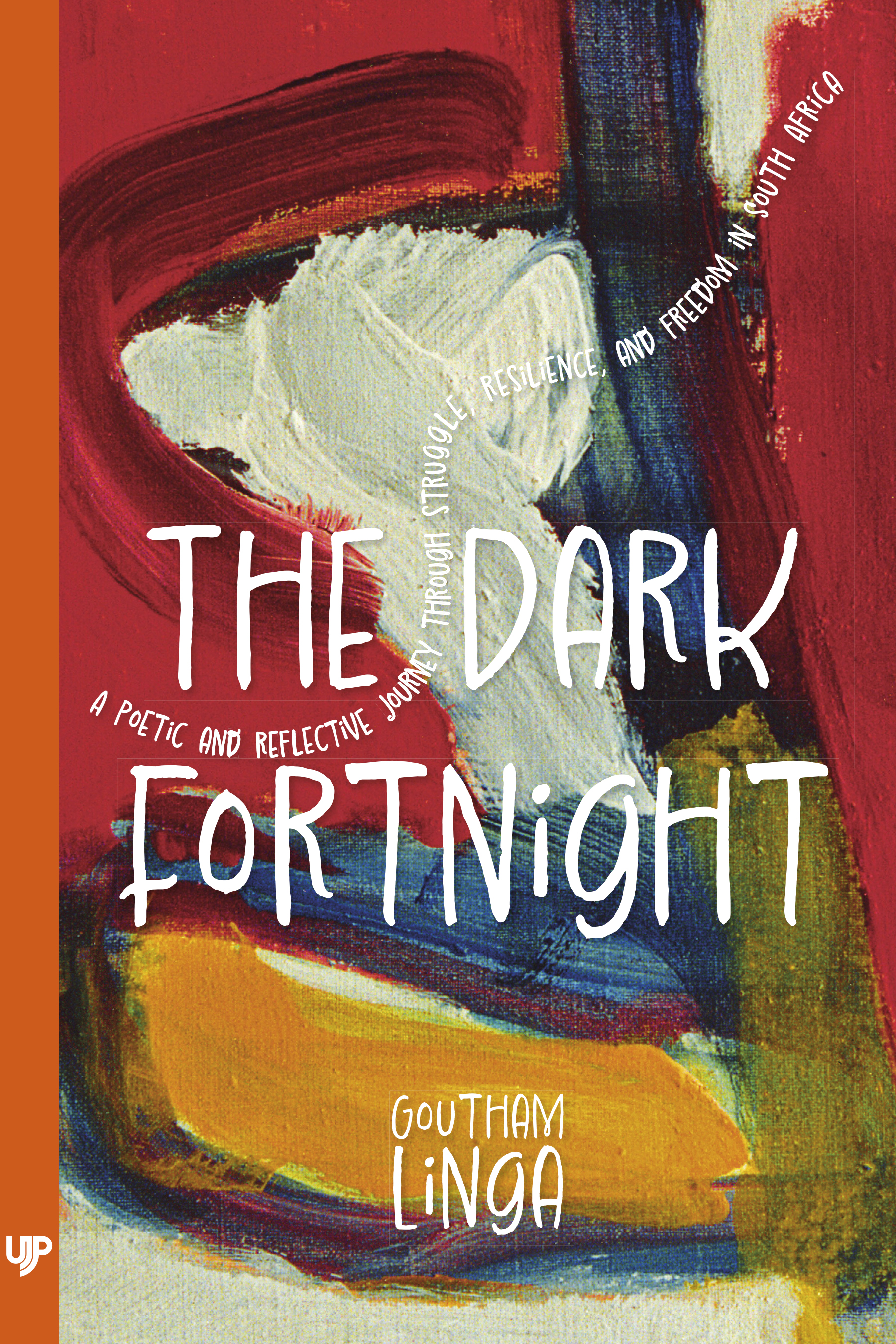
The Dark Fortnight: A poetic and reflective journey through struggle, resilience, and freedom in South Africa
- Goutham Linga(author)
| Title | The Dark Fortnight |
|---|---|
| Subtitle | A poetic and reflective journey through struggle, resilience, and freedom in South Africa |
| Contributor | Goutham Linga(author) |
| DOI | https://doi.org/10.64449/9781997499855 |
| Landing page | https://ujonlinepress.uj.ac.za/index.php/ujp/catalog/book/474 |
| License | https://creativecommons.org/licenses/by/4.0 |
| Copyright | Goutham Linga |
| Publisher | UJ Press |
| Publication place | Johannesburg |
| Published on | 2026-10-01 |
| ISBN | 978-1-997499-84-8 (Paperback) |
| 978-1-997499-85-5 (PDF) | |
| Long abstract | In a land where history still walks barefoot, and the wind carries home the names of the fallen, The Dark Fortnight holds its lantern to the dark. Fourteen nights, the title insists — long enough to feel eternal, yet bounded all the same, already gestating its own light. From Soweto’s burning noon to the locked stone quiet of Robben Island, Goutham Linga — who arrived in South Africa a visitor and stayed long enough to become its listener — gathers the footsteps of a people who would not disappear. Poetic meditation, historical memory, reflective witness: three registers folded into one, so that these pages breathe like verse and testify like a courtroom. A schoolbag becomes a banner. A woman struck becomes a rock no baton can break. A cell built to cage a body fails, cell by cell, to cage a mind. These are not stories told from a distance. They are footsteps still audible, if you know how to listen — children marching, mothers refusing, a nation learning, one clenched fist at a time, that dignity is not negotiable. The Dark Fortnight braids memory with fire until the past becomes music that has not stopped playing. It does not ask to be read quickly. Read it the way the struggle itself was lived: slowly, and all the way through. Goutham Linga writes from the confluence of two lives that were never meant to share one heart: the Telugu verses of his childhood, and the South African soil he has walked, listened to, and loved for more than a decade. Born in India, shaped by his adopted land, he has spent his life standing at that meeting point — between memory and landscape, between history and song — and finding that the two speak the same language after all. His literary path began in Telugu poetry and has widened ever since: the acclaimed collection Anarghya (2020), then, in 2025, Krishnapaksham — the dark lunar fortnight — whose very title already carried, in Telugu, the shadow this book would carry into English. His essays and poems have travelled through newspapers and magazines on two continents, always doing the same patient work: turning what is lived into what can be felt. The Dark Fortnight is his most ambitious work yet — the place where the historian’s patience and the poet’s ear finally share a single page, vivid and historically grounded, reverent of the ordinary people who carried a nation’s freedom on their backs. His is a voice recognised for its clarity, its cadence, and its refusal to treat dignity as negotiable. By day, he is a senior software engineer — a discipline of precision that, far from competing with the poet in him, has only sharpened it. He lives in South Africa with his family, two homelands folded into one chest, still giving voice to those the record forgot to keep. This book is his work of witness. |
| Print length | 98 pages |
| Language | English (Original) |
| BISAC |
|
| Keywords |
|
Contents
Dreaming Awake
(pp. 1–2)Soweto — Where People Sing Fire
(pp. 3–5)Women’s Dawn
(pp. 15–17)Winnie Madikizela-Mandela
(pp. 19–21)Sharpeville: A Massacre
(pp. 23–25)Poetry
(pp. 27–29)Steve Biko
(pp. 31–33)Rivonia: When a Voice Indicted the State
(pp. 35–37)Robben Island
(pp. 39–41)Soweto Uprising
(pp. 43–44)Chris Hani
(pp. 45–46)Emergency
(pp. 47–49)Footprints
(pp. 51–52)Four Fists (The Cradock Four)
(pp. 53–54)Mother of the Nation: Albertina Sisulu
(pp. 55–56)The Emerald Country
(pp. 57–59)Waves of a Movement
(pp. 61–63)Demolition — District Six
(pp. 65–67)Release — 11 February 1990
(pp. 69–71)In the Light After the Dark
(pp. 73–74)Song of Freedom
(pp. 75–77)What South Africa Taught Me
(pp. 79–80)
Contributors
Goutham Linga
(author)References
- Mandela, Nelson. Long Walk to Freedom. Little, Brown and Company, 1994.
- Biko, Steve. I Write What I Like. University of Chicago Press, 2002.
- Pogrund, Benjamin. How Can Man Die Better: The Life of Robert Sobukwe. Jonathan Ball, 1990.
- Tutu, Desmond. No Future Without Forgiveness. Doubleday, 1999.
- South African History Online (SAHO).
- Truth and Reconciliation Commission of South Africa Report, 1998.
- Dubow, Saul. Apartheid, 1948–1994. Oxford University Press, 2014.
- Clark, Nancy L., and William H. Worger. South Africa: The Rise and Fall of Apartheid. Routledge, 2016.