
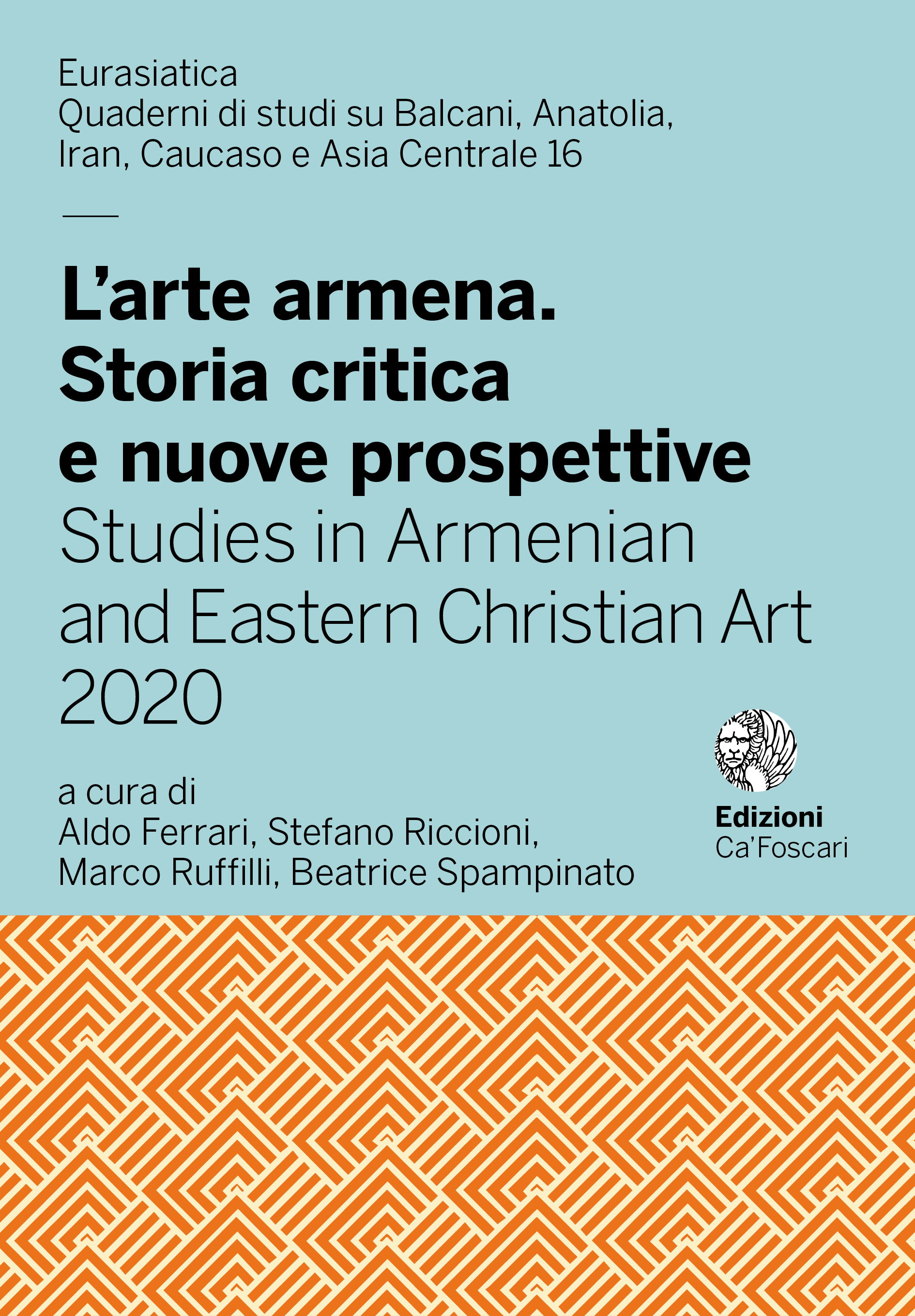
Armenian Art. Critical History and New Perspectives: Studies in Armenian and Eastern Christian Art 2020
- Aldo Ferrari(editor)
- Stefano Riccioni(editor)
- Marco Ruffilli (editor)
- Beatrice Spampinato (editor)
| Title | Armenian Art. Critical History and New Perspectives |
|---|---|
| Subtitle | Studies in Armenian and Eastern Christian Art 2020 |
| Contributor | Aldo Ferrari(editor) |
| Stefano Riccioni(editor) | |
| Marco Ruffilli (editor) | |
| Beatrice Spampinato (editor) | |
| DOI | https://doi.org/10.30687/978-88-6969-469-1 |
| Landing page | https://edizionicafoscari.it/en/edizioni4/libri/978-88-6969-469-1/ |
| License | https://creativecommons.org/licenses/by/4.0/ |
| Copyright | Beatrice Spampinato, Stefano Riccioni, Marco Ruffilli, Aldo Ferrari |
| Publisher | Edizioni Ca’ Foscari – Venice University Press |
| Publication place | Venice, Italy |
| Published on | 2020-12-21 |
| Series |
|
| ISBN | 978-88-6969-469-1 (PDF) |
| Short abstract | The exploration of Armenian art began in the 19th century thanks to French, Russian, German, Finnish, Austrian and Armenian art historians, and continued in the 20th century mainly with Russian, Armenian, Ukrainian, American and Italian scholars. Thanks to them, the general public, not just researchers, had the chance to discover the artistic heritage of a territory extending beyond the borders of present-day Armenia, and encompassing an area defined as Subcaucasia, a term by which is meant the territory that runs from the Southern Caucasus into the Iranian and Anatolian highlands. Interest in Armenian art, from illuminated manuscripts to khachkars and architecture, has grown in the last twenty years, giving these testimonies a global dimension. The volume illustrates the characteristics, themes and methods of the various research paths emerging from the different historiographical traditions, thus tracing a map that helps to orient oneself among the artistic and cultural phenomena of this complex territory, providing different keys to understanding them and useful reasoning for future scientific investigations. |
| Long abstract | The exploration of Armenian art began in the 19th century thanks to French, Russian, German, Finnish, Austrian and Armenian art historians, and continued in the 20th century mainly with Russian, Armenian, Ukrainian, American and Italian scholars. Thanks to them, the general public, not just researchers, had the chance to discover the artistic heritage of a territory extending beyond the borders of present-day Armenia, and encompassing an area defined as Subcaucasia, a term by which is meant the territory that runs from the Southern Caucasus into the Iranian and Anatolian highlands. Interest in Armenian art, from illuminated manuscripts to khachkars and architecture, has grown in the last twenty years, giving these testimonies a global dimension. The volume illustrates the characteristics, themes and methods of the various research paths emerging from the different historiographical traditions, thus tracing a map that helps to orient oneself among the artistic and cultural phenomena of this complex territory, providing different keys to understanding them and useful reasoning for future scientific investigations. |
| Language | Italian (Original) |
| THEMA |
|
| BISAC |
|
| Keywords |
|