
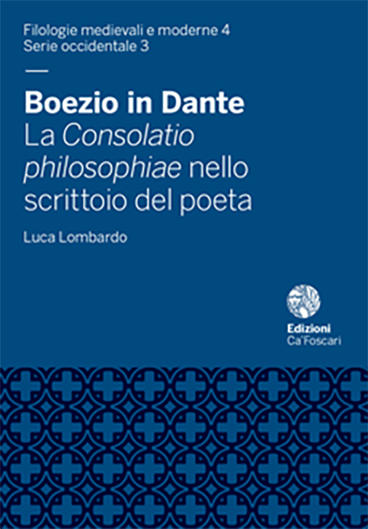
Boethius in Dante: The Consolatio philosophiae in the Poet’s Desk
- Luca Lombardo (author)
| Title | Boethius in Dante |
|---|---|
| Subtitle | The Consolatio philosophiae in the Poet’s Desk |
| Contributor | Luca Lombardo (author) |
| DOI | https://doi.org/10.14277/978-88-97735-51-9 |
| Landing page | https://edizionicafoscari.it/en/edizioni4/libri/978-88-97735-51-9/ |
| License | https://creativecommons.org/licenses/by/4.0/ |
| Copyright | Luca Lombardo |
| Publisher | Edizioni Ca’ Foscari – Venice University Press |
| Publication place | Venice, Italy |
| Published on | 2013-12-31 |
| Series |
|
| ISBN | 978-88-97735-51-9 (PDF) |
| Short abstract | Boethius’ Consolatio philosophiae exerted its influence on Dante’s work, particularly as a poetic paradigm. Indications of Boethius’ reminiscence emerge from the per loci examination of Dante’s writings, conducted through a contrastive intertextual approach. The assiduous comparison of the ancient commentators of the Commedia and the recourse to the medieval exegesis of the Consolatio make it possible to understand the extent of Dante’s actual reception of the Boetian prosimeter and the systematic borrowing of narrative, morphosyntactic and rhetorical-stylistic elements from his model. |
| Long abstract | Boethius’ Consolatio philosophiae exerted its influence on Dante’s work, particularly as a poetic paradigm. Indications of Boethius’ reminiscence emerge from the per loci examination of Dante’s writings, conducted through a contrastive intertextual approach. The assiduous comparison of the ancient commentators of the Commedia and the recourse to the medieval exegesis of the Consolatio make it possible to understand the extent of Dante’s actual reception of the Boetian prosimeter and the systematic borrowing of narrative, morphosyntactic and rhetorical-stylistic elements from his model. |
| Language | Italian (Original) |
| THEMA |
|
| BISAC |
|
| Keywords |
|