
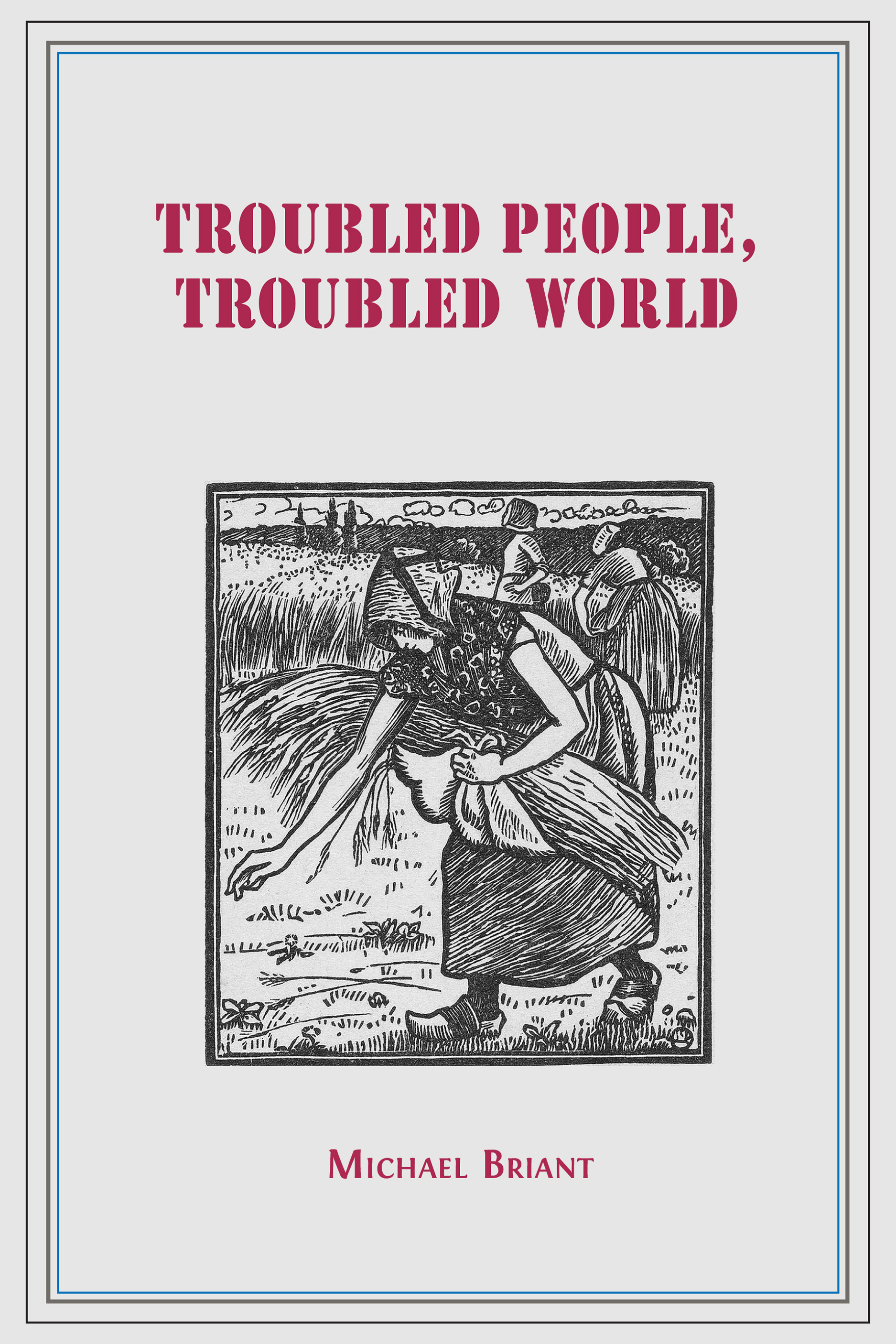
Troubled People, Troubled World: Psychotherapy, Ethics and Society
- Michael Briant (author)
| Title | Troubled People, Troubled World |
|---|---|
| Subtitle | Psychotherapy, Ethics and Society |
| Contributor | Michael Briant (author) |
| DOI | https://doi.org/10.11647/OBP.0416 |
| Landing page | https://www.openbookpublishers.com/books/10.11647/OBP.0416 |
| License | https://creativecommons.org/licenses/by-nc-nd/4.0/ |
| Copyright | Michael Briant; |
| Publisher | Open Book Publishers |
| Publication place | Cambridge, UK |
| Published on | 2025-03-04 |
| ISBN | 978-1-80511-356-0 (Paperback) |
| 978-1-80511-357-7 (Hardback) | |
| 978-1-80511-358-4 (PDF) | |
| 978-1-80511-360-7 (HTML) | |
| 978-1-80511-359-1 (EPUB) | |
| Short abstract | Therapists endeavour to be non-judgemental and, indeed, are no more qualified to pass judgement on others than anyone else; do they nevertheless learn anything about ethics from their disciplined listening? The same question was asked after the war about the persecution of the Jews and other minorities, and it’s a very live issue again, faced as we are by movements like ISIS, or Putinism in Russia, that cause great suffering in the name of religious or moral regeneration - a bewildering paradox that David Astor, former editor of The Observer called ‘the scourge’. Can psychotherapy throw any light on it, or contribute any ideas as to how we might contain, if not prevent, the barbarism it sanctions? Can it offer any insights into a different, more inclusive kind of ethics, and if so, can we glean any guidance from it as to how we might further it? These are the questions the author explores, drawing on psychoanalytic thinking on these issues for over a century and illustrated by his work with individuals over four decades. |
| Long abstract | Ethical issues are the stuff of psychotherapy, and in fact Freud envisaged the process as one in which an unexamined, irrational and oppressive conscience gives way to one more benignly rooted in reason. Therapists endeavour to be non-judgemental and, indeed, are no more qualified to pass judgement on others than anyone else; do they nevertheless learn anything about ethics from their disciplined listening? The same question was asked after the war about the persecution of the Jews and other minorities, and it’s a very live issue again, faced as we are by movements like ISIS, or Putinism in Russia, that cause great suffering in the name of religious or moral regeneration - a bewildering paradox that David Astor, former editor of The Observer called ‘the scourge’. Can psychotherapy throw any light on it, or contribute any ideas as to how we might contain, if not prevent, the barbarism it sanctions? Can it offer any insights into a different, more inclusive kind of ethics, and if so, can we glean any guidance from it as to how we might further it? These are the questions the author explores, drawing on psychoanalytic thinking on these issues for over a century and illustrated by his work with individuals over four decades. |
| Print length | 218 pages (xvi+202) |
| Language | English (Original) |
| Dimensions | 156 x 12 x 234 mm | 6.14" x 0.47" x 9.21" (Paperback) |
| 156 x 15 x 234 mm | 6.14" x 0.59" x 9.21" (Hardback) | |
| Weight | 317g | 11.18oz (Paperback) |
| 489g | 17.25oz (Hardback) | |
| Media | 1 illustration |
| OCLC Number | 1505909923 |
| THEMA |
|
| BISAC |
|
| Keywords |
|
Contents
Foreword
(pp. xiii–xiv)- Rowan Williams
Introduction
(pp. 1–20)- Michael Briant
(pp. 21–56)- Psychotherapy and Ethics
- Michael Briant
(pp. 57–66)- Instincts or Relationship: An Historic Divide
- Michael Briant
(pp. 67–80)- Of Dark Materials and their Weaving
- Michael Briant
(pp. 81–96)- Pascal’s Paradox
- Michael Briant
(pp. 97–120)- Guilt and Shame
- Michael Briant
(pp. 121–144)- Only Connect
- Michael Briant
(pp. 145–168)- Conclusion
- Michael Briant
Appendix A: Psychoanalysis and Democracy
(pp. 169–176)- Michael Briant
Appendix B: Psychoanalysis and Science
(pp. 177–184)- Michael Briant
Postscript
(pp. 185–188)- Michael Briant
Contributors
Michael Briant
(author)Michael Briant is a member of the Guild of Psychotherapists and an Associate member of the Cambridge Society for Psychotherapy. After graduating from the University of Cambridge he worked for the British Council, where, amongst other things he was involved in the cultural exchange agreements which, it was hoped, would further understanding between Britain and the former Soviet Union. He left to pursue post-graduate studies at the L.S.E., where, as a pupil of Ernest Gellner, he wrote a doctoral thesis on psychoanalysis. His experience has mostly been in various parts of the education system, for the last 36 years within the University of Cambridge, where he also directed a postgraduate diploma in psychodynamic studies, run jointly by the University Counselling Service and the Department of Continuing Education. Michael has contributed to leading journals in the field of psychotherapy and psychoanalysis and is the author of 'Psychotherapy, Ethics, and Society: Another Kind of Conversation’ (2018), of which this book is a new, revised and expanded edition.
References
- Alderdice, John, Lord, “Understanding Terrorism: The Inner Word and the Wider World”, British Journal of Psychotherapy 21 (4), 2005, http://dx.doi.org/10.1111/j.1752-0118.2005.tb00247.x(opens in new tab)
- Aristotle, The Nicomachean Ethics, translated by H. Rackham (Cambridge: Harvard University Press, 1968).
- Astor, David, ‘Towards a Study of the Scourge’, Encounter, August 1962.
- Baron-Cohen, Simon Zero Degrees of Empathy: A New Theory of Human Cruelty (London: Allen Lane, 2011), https://doi.org/10.1192/bjp.bp.111.098434(opens in new tab)
- Blundell, Susanne, “Fatherless Sons”, in The Importance of Fathers: A Psychoanalytic Re-evaluation, ed. Judith Trowell and Alicia Etchegoyan (Hove: Brunner-Routledge, 2002), https://doi.org/10.4324/9780203013946(opens in new tab)
- Briant, M.G. Fact and Value in Psychoanalysis. Unpublished Ph.D. thesis. London University, 1973.
- Camus, Albert, The Plague, translated by Stuart Gilbert (London: Penguin Books, 1960).
- Clark, Christopher, The Sleepwalkers. How Europe Went to War in 1914 (London: Allen Lane, 2012).
- Cohn, Norman, Europe’s Inner Demons (London: Pimlico, 1993).
- —, The Pursuit of the Millennium (London: Pimlico, 2004).
- —, Warrant for Genocide (London: Serif, 2005).
- Dante, The Divine Comedy, translated by Clive James (London: Picador, 2013).
- Dicks, H.V., “In Search of Our Proper Ethic”, Human Relations 23 (1 & 2), 1950.
- —, Licensed Mass Murder (London: Heinemann for Sussex University Press, 1972).
- —, Marital Tensions (London: Karnac, 1993).
- —, “Personality Traits and National Socialist Ideology: A War-Time Study of German Prisoners of War”, Human Relations 3, 1950.
- Eliot, T.S., Collected Poems, 1909-62 (London: Faber & Faber, 1963).
- Erikson, Erik, Childhood and Society (London: Penguin, 1965).
- Evans, Richard J., The Coming of the Third Reich (London: Allen Lane, 2003).
- Fairbairn, W.R.D., Psychoanalytic Studies of the Personality (London: Routledge and Kegan Paul, 1952).
- —, From Instinct to Self: Selected Papers of W.R.D. Fairbairn, Vol. 11. Applications and Early Contributions, ed. Eleanor Birtles Fairbairn and David Scharff (New York: Jason Aronson Inc., 1994).
- Farmer, Paul, Pathologies of Power: Health, Human Rights, and the New War on the Poor (London: University of California Press, 2003).
- Farrington, David P. and West, Donald J., The Cambridge Study in Delinquent Development: Long-Term Follow Up: Final Report to the Home Office (Cambridge: Institute of Criminology, University of Cambridge, 1988).
- Ferrari, Lorenzo, Norman Cohn e Il Lato Oscuro della Storia (Milan: Franco Angeli, Biblioteca della Storia, 2023).
- Ffytche, Matt and Pick, Daniel, Psychoanalysis in the Age of Totalitarianism (Abingdon: Routledge, 2016), https://doi.org/10.4324/9781315760773(opens in new tab)
- Fink, Bruce, A Clinical Introduction to Lacanian Psychoanalysis (London: Harvard University Press, 1999).
- Forrester, J., The Seductions of Psychoanalysis: Freud, Lacan and Derrida (Cambridge: Cambridge University Press, 1990).
- Freud, Sigmund, An Autobiographical Study, (1935), Standard Edition of the Collected Works, Vol. 20 (London: The Hogarth Press, 1959).
- —, Civilisation and its Discontents, (1930), Standard Edition of the Collected Works, Vol. 21 (London: The Hogarth Press, 1964).
- —, Civilised Sexual Morality and Modern Nervous Illness (1908), Standard Edition of the Collected Works, Vol. 9 (London: The Hogarth Press, 1959).
- —, The Economic Problem of Masochism (1924), Standard Edition of the Collected Works, Vol. 19 (London: The Hogarth Press, 1961).
- —, The Ego and the Id (1923), Standard Edition of the Collected Works, Vol. 19 (London: The Hogarth Press, 1961).
- —, An Outline of Psychoanalysis (1938), Standard Edition of the Collected Works, Vol. 23 (London: The Hogarth Press, 1964).
- —, Why War? Reply to letter from Albert Einstein (1932), Standard Edition of the Collected Works, Vol. 22 (London: The Hogarth Press, 1960).
- Fromm, Erich, The Fear of Freedom (London: Routledge and Kegan Paul, 1960).
- —, The Sane Society (London: Routledge, 1963).
- Gay, Peter, Freud, A Life for Our Time (London: Dent, 1988).
- Gellner, Ernest, The Psychoanalytic Movement (London: Paladin, 1985).
- Gilligan, James, Preventing Violence (London: Thames and Hudson, 2001).
- Gray, John, Black Mass: Apocalyptic Religion and the Death of Utopia (London: Allen Lane, 2007).
- Guntrip, H.J.S., “What Does Psychoanalytic Therapy Really Accomplish? My Experience of Analysis with Fairbairn and Winnicott”, International Review of Pycho-analysis 2, 1975.
- Hadar, Uri, Psychoanalysis and Social Involvement: Interpretation and Action (London: Palgrave Macmillan, 2013), https://doi.org/10.1057/9781137301093(opens in new tab)
- Hampshire Stuart, Spinoza (London: Penguin Books, 1953).
- Hobson, R.F., Forms of Feeling: The Heart of Psychotherapy (Abingdon: Routledge, 1985).
- Jones, Ernest, Sigmund Freud, Life and Work (London: The Hogarth Press, 1955).
- Jung, Carl Gustav, Memories, Dreams and Reflections (London: Collins and Routledge and Kegan Paul, 1963).
- —, The Practice of Psychotherapy (London: Routledge and Kegan Paul, 1966).
- Kant, Immanuel, Groundwork for the Metaphysics of Morals (1785), translated by Allen W. Wood (New Haven: Yale University Press, 2002).
- Lacan, Jacques, The Ethics of Psychoanalysis, 1959–1960; The Seminar of Jacques Lacan: Book VII, translated by Dennis Porter (London: Routledge, 1992).
- Laing, R.D., The Divided Self (London: Penguin, 1960).
- Langer, Walter, The Mind of Adolf Hitler (New York: Basic Books Inc., 1972).
- Leonardo da Vinci, Notebooks (Oxford: Oxford University Press, 1980).
- Machin, Stephen, and Meghir, Costas, “Does Crime Pay Better?”, CentrePiece, The Magazine of Economic Performance 4(3), 1999, 25–27.
- Malan, David, Individual Psychotherapy and the Science of Psychodynamics (London: Butterworths, 1979).
- Marcuse, Herbert, One Dimensional Man: Studies in the Ideology of Advanced Industrial Society (Boston: Beacon, 1964).
- Marmot, Sir Michael, Fair Society, Healthy Lives: Strategic Review of Health Inequalities in England Post 2010 (London: Institute of Health Equity, 2010).
- Miller, James, The Passion of Michel Foucault (London: Harper Collins, 1993).
- Milton, John, Paradise Lost. Oxford World Classics (Oxford: Oxford University Press, 2004).
- Mollon, Phil, Shame and Jealousy: The Hidden Turmoils (London: Karnac, 2002), https://doi.org/10.4324/9780429480102(opens in new tab)
- Money-Kyrle, Roger, Man’s Picture of His World (New York: International Universities Press, 1961).
- —, “Psychoanalysis and Ethics” in New Directions in Psychoanalysis, ed. Melanie Klein, Paula Heimann and Roger Money-Kyrle (London: Tavistock Publications, 1977).
- Muller, Knuth, “Psychoanalysis and American Intelligence since 1940” in Psychoanalysis in the Age of Totalitarianism, ed. Matt Ffytche and Daniel Pick (Abingdon: Routledge, 2016), https://doi.org/10.4324/9781315760773(opens in new tab)
- Menzies Lyth, I.E.P., “Social Systems as a Defence against Anxiety: An Empirical Study of the Nursing Service of a General Hospital” in Trist, E. and Murray, H. (eds.) The Social Engagement of Social Science, Volume 1: The Socio-Psychological Perspective (London: Free Association Books, 1990).
- Nadler, Steven, Spinoza, A Life (Cambridge: Cambridge University Press, 1999).
- Nietzsche, Friedrich, The Genealogy of Morals, translated by Francis Golffing (New York: Doubleday, 1956).
- Ormerod, Paul, “You Pays Your Money: Models of Capitalism” in The Politics of Attachment, ed. Sebastian Kramer and Jane Roberts (London: Free Association Books, 1996).
- Pascal, Blaise, Pensées, ed. Leon Braunscvig (Paris: Editions Cluny, 1934).
- Pick, Daniel, The Pursuit of the Nazi Mind, Hitler Hess and the Analysts (Oxford: Oxford University Press, 2012).
- Popper, Karl R., in British Philosophy in the Mid-Century, edited by C. A. Mace (New York: The Macmillan Company, 1957).
- Raworth, Kate, Doughnut Economics: Seven Ways to Think like a 21st-Century Economist (London: Random House Business Books, 2017).
- Rees, Jonathan, The Case of Rudolf Hess: A Problem in Diagnosis and Forensic Psychiatry (London: Heinemann, 1947).
- Reich, Wilhelm, The Mass Psychology of Fascism (New York: Farrar, Strauss and Giroux, 1969).
- Rieff, Philip, Freud, The Mind of a Moralist (New York: Viking Press, 1961).
- Rose, Steven, The 21st-Century Brain: Explaining, Mending and Manipulating the Mind (London: Jonathan Cape, 2005).
- Roudinesco, Elizabeth, Jacques Lacan: Outline of a Life, History of a System of Thought, translated by Barbara Bray (New York: Columbia University Press, 1997).
- Rycroft, Charles, A Critical Dictionary of Psychoanalysis (London: Nelson, 1968).
- Saint Augustine, Confessions (Harmondsworth: Penguin, 1961).
- Sands, Phillippe, East West Street (London: Weidenfeld and Nicholson, 2016).
- Schaverien, Joy, The Boarding School Syndrome (London: Routledge, 2015).
- Schumacher, E.F., Small is Beautiful: A Study of Economics as if People Mattered (London: Blond and Briggs, 1973).
- Schweitzer, Albert, The Quest of the Historical Jesus (London: A. & C. Black, 1910).
- Sen, Amartya, “Universal Health Care: The Affordable Dream”, The Guardian, 6 January 2015.
- Sereny, Gita, Into That Darkness (London: Pimlico, 1995).
- Shakespeare, William, King Lear (London: The Arden Shakespeare, Routledge, 1991).
- —, The Tempest (London: The Arden Shakespeare, Methuen, 1954).
- —, King Richard III (London: The Arden Shakespeare, Methuen, 1987).
- Solms, Mark Leonard, “The Neurobiological Underpinnings of Psychoanalytic Theory and Therapy”, Frontiers in Behavioural Neuroscience, December 2018, https://doi.org/10.3389/fnbeh.2018.00294(opens in new tab)
- Spinoza, Benedictus de, Ethics (London: Dent, 1993).
- Stewart, Matthew, The Courtier and the Heretic: Leibniz, Spinoza, and the Fate of God in the Modern World (London: Yale University Press, 2005).
- Stuckler, David and Basu, Sanjay, The Body Economic: Why Austerity Kills (London: Allen Lane, 2013).
- Symington, Neville, The Analytic Experience (New York: St. Martin’s Press, 1986).
- Victoria, Brian Daizen, Zen at War (New York: Weatherill, 1997).
- Varoufakis, Y., And The Weak Suffer What They Must? Europe, Austerity and the Threat to Global Stability (London: Vintage, 2016).
- Webb, Robert, How Not to be a Boy (Edinburgh: Canongate, 2017).
- Wilkinson, Richard G., The Impact of Inequality: How to Make Sick Societies Healthier (Abingdon: Routledge, 2005).
- Wilkinson, R. and Picket, K., The Spirit Level (London: Allen Lane, 2009).
- Williams, Arthur Hyatt, Cruelty, Violence and Murder: Understanding the Criminal Mind (London: Karnac Books, 1998).
- Williams, Bernard, Shame and Necessity (London: University of California Press, 1994).
- Winnicott, D.W., Home is Where We Start From (London: Penguin Books, 1990).
- —, The Maturational Processes and the Facilitating Environment (London: The Hogarth Press, 1965).