
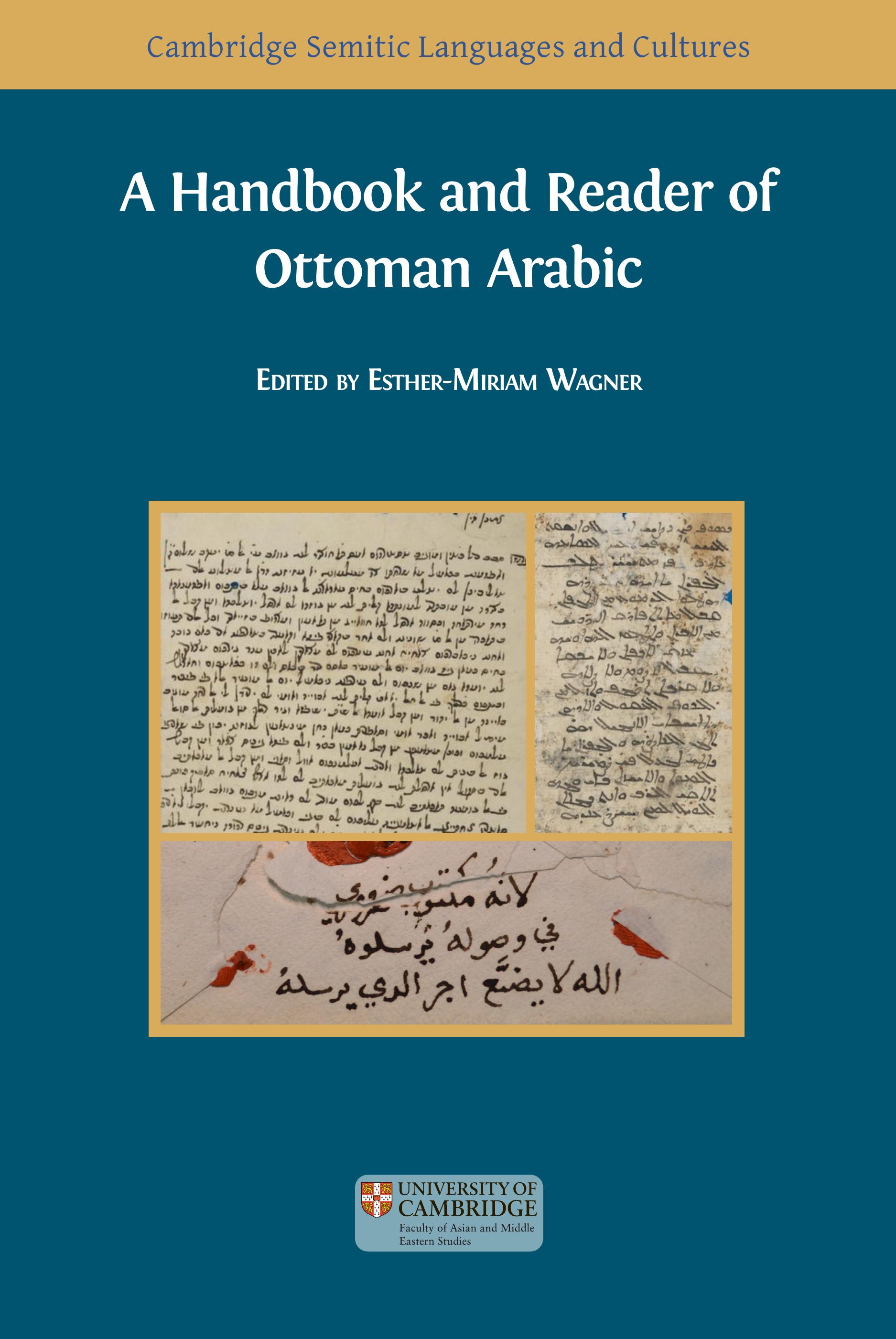
A Handbook and Reader of Ottoman Arabic
- Esther-Miriam Wagner (editor)
| Title | A Handbook and Reader of Ottoman Arabic |
|---|---|
| Contributor | Esther-Miriam Wagner (editor) |
| DOI | https://doi.org/10.11647/OBP.0208 |
| Landing page | https://www.openbookpublishers.com/books/10.11647/obp.0208 |
| License | https://creativecommons.org/licenses/by/4.0/ |
| Copyright | Esther-Miriam Wagner |
| Publisher | Open Book Publishers |
| Publication place | Cambridge, UK |
| Published on | 2021-09-10 |
| Series |
|
| ISBN | 978-1-78374-941-6 (Paperback) |
| 978-1-78374-942-3 (Hardback) | |
| 978-1-78374-943-0 (PDF) | |
| Short abstract | This volume is the first linguistic work to focus exclusively on varieties of Christian, Jewish and Muslim Arabic in the Ottoman Empire of the 15th to the 20th centuries, and present Ottoman Arabic material in a didactic and easily accessible way. |
| Long abstract | Written forms of Arabic composed during the era of the Ottoman Empire present an immensely fruitful linguistic topic. Extant texts display a proximity to the vernacular that cannot be encountered in any other surviving historical Arabic material, and thus provide unprecedented access to Arabic language history. This rich material remains very little explored. Traditionally, scholarship on Arabic has focussed overwhelmingly on the literature of the various Golden Ages between the 8th and 13th centuries, whereas texts from the 15th century onwards have often been viewed as corrupted and not worthy of study. The lack of interest in Ottoman Arabic culture and literacy left these sources almost completely neglected in university courses. This volume is the first linguistic work to focus exclusively on varieties of Christian, Jewish and Muslim Arabic in the Ottoman Empire of the 15th to the 20th centuries, and present Ottoman Arabic material in a didactic and easily accessible way. Split into a Handbook and a Reader section, the book provides a historical introduction to Ottoman literacy, translation studies, vernacularisation processes, language policy and linguistic pluralism. The second part contains excerpts from more than forty sources, edited and translated by a diverse network of scholars. The material presented includes a large number of yet unedited texts, such as Christian Arabic letters from the Prize Paper collections, mercantile correspondence and notebooks found in the Library of Gotha, and Garshuni texts from archives of Syriac patriarchs. |
| Print length | 488 pages (xxii+466) |
| Language | English (Original) |
| Dimensions | 156 x 25 x 234 mm | 6.14" x 0.99" x 9.21" (Paperback) |
| 156 x 38 x 234 mm | 6.14" x 1.5" x 9.21" (Hardback) | |
| Weight | 1503g | 53.02oz (Paperback) |
| 2431g | 85.75oz (Hardback) | |
| Media | 4 illustrations |
| OCLC Number | 1268361369 |
| LCCN | 2020416931 |
| BIC |
|
| BISAC |
|
| LCC |
|
| Keywords |
|
Contents
Introduction
(pp. xi–xxii)- Esther-Miriam Wagner
- Michiel Leezenberg
- Necmettin Kızılkaya
- Guy Burak
- Guy Burak
- Christopher D. Bahl
(pp. 87–140)- Bastards and Arabs
- E. Khayyat
- Dotan Arad
- Esther-Miriam Wagner
(pp. 149–154)- The Purim Scroll of the Cairene Jewish Community
- Benjamin Hary
- Dotan Arad
(pp. 161–172)- Aharon Garish, Metsaḥ Aharon
- Naḥem Ilan
(pp. 173–192)- Kitāb Hazz al-Quḥūf (1600s)
- Humphrey Taman Davies
(pp. 193–196)- A Weaver’s Notebook from Aleppo (10th/16th century)
- Boris Liebrenz
- Kristina Richardson
- Michael Erdman
- Liesbeth Zack
(pp. 227–232)- Lebanon: Chronicle of al-Ṣafadī (early 17th century [?])
- Jérôme Lentin
(pp. 233–236)- A Jew’s Testimony Regarding a Statement Made in His Presence by a Muslim, Testified on Monday 20th Kislev 5418 (1657)
- Werner Diem
- Werner Diem
- Omer Shafran
(pp. 242–250)- Qahwa ‘Coffee’ (16th–17th centuries)
- Ghayde Ghraowi
- Jérôme Lentin
(pp. 255–260)- Matenadaran Collection MS No.1751: A Medical Work (1726)
- Ani Avetisyan
- Esther-Miriam Wagner
- Mohamed Ahmed
- Esther-Miriam Wagner
- Mohamed Ahmed
- Feras Krimsti
(pp. 283–288)- Syria 1: Chronicle of Ibn al-Ṣiddīq (1768)
- Jérôme Lentin
(pp. 289–292)- A Letter Transmitted by Ambassador Hajj Mahdī Bargash from Sultan Muḥammad Bin ʿAbdallah to Sultan Abdul Ḥamīd (1789 CE)
- Ahmed Ech-Charfi
- Boris Liebrenz
- Matthew Dudley
- Olav Ørum
(pp. 333–348)- A 19th-Century Judaeo-Arabic Folk Narrative
- Magdalen M. Connolly
(pp. 349–352)- Libya 1: Ḥasan al-Faqīh Ḥasan’s Chronicle Al-Yawmiyyāt al-Lībiyya (early 19th century)
- Jérôme Lentin
(pp. 353–358)- Libya 2: Letter from Ġūma al-Maḥmūdī (1795–1858) to ʿAzmī Bēk, Daftardār of the ʾIyāla (Province) of Tripoli (undated)
- Jérôme Lentin
(pp. 359–364)- T-S NS 99.38 (1809)
- Geoffrey Khan
- Esther-Miriam Wagner
(pp. 365–370)- Rylands Genizah Collection A 803 (1825)
- Esther-Miriam Wagner
- Mohamed Ahmed
- Jérôme Lentin
- Jérôme Lentin
- Liesbeth Zack
(pp. 399–414)- A Disgruntled Bishop: A Garshūnī Letter from Bishop Dinḥā of Midyat to Patriarch Peter III
- George Kiraz
- Alex Bellem
- G. Rex Smith
(pp. 427–430)- Ora ve-Simḥa (1917)
- Esther-Miriam Wagner
- Charles Häberl
(pp. 441–444)- An Anecdote about Juḥā (1920s)
- Tania María García-Arévalo