
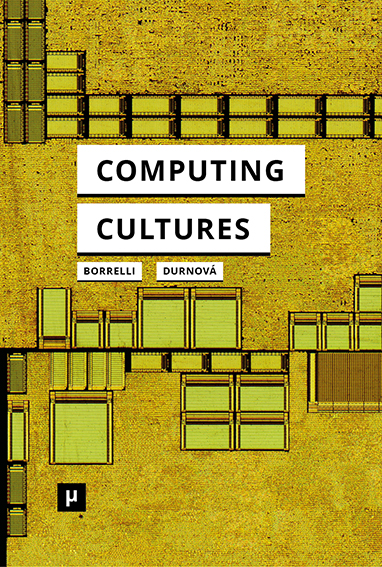
Computing Cultures: Knowledges and Practices (1940–1990)
- Arianna Borrelli (editor)
- Helena Durnová(editor)
- Troy Kaighin Astarte(author)
- Nathalie Bredella(author)
- Marie-José Durand-Richard (author)
- Edgar Lejeune (author)
- Jacqueline Léon(author)
- Elisabetta Mori(author)
- Mark Priestley (author)
| Title | Computing Cultures |
|---|---|
| Subtitle | Knowledges and Practices (1940–1990) |
| Contributor | Arianna Borrelli (editor) |
| Helena Durnová(editor) | |
| DOI | https://doi.org/10.14619/2737 |
| Landing page | https://meson.press/books/computing-cultures/ |
| License | https://creativecommons.org/licenses/by-sa/4.0/ |
| Copyright | Arianna Borrelli and Helena Durnová |
| Publisher | meson press |
| Published on | 2025-12-29 |
| ISBN | 978-3-95796-273-7 (Paperback) |
| 978-3-95796-274-4 (PDF) | |
| Long abstract | Highlighting the diverse and fragmentary nature of the so-called “digital turn,” this volume offers a glimpse into the landscape of different computing cultures which emerged side by side between the 1940s and the 1990s, at times sharing some features, yet remaining essentially independent from each other. Some of these cultures disappeared, some thrive until today, but understanding all through their knowledges and practices, interconnections and broader historical context, is essential to deal critically with the visions and dreams, fears and tensions characterizing digital practices in today’s knowledge societies. |
| Print length | 284 pages (nulla+284+nulla) |
| Language | English (Original) |
| Dimensions | 156 x 234 mm | 6.141732283464568" x 9.212598425196852" (Paperback) |
| THEMA |
|
| Keywords |
|
Contents
- Arianna Borrelli
- Helena Durnová
- Mark Priestley
- Jacqueline Léon
- Arianna Borrelli
- Marie-José Durand-Richard
- Edgar Lejeune
- Troy Kaighin Astarte
Contributors
Arianna Borrelli
(editor)Arianna Borrelli is a historian and philosopher of natural philosophy and modern science working at the Käte-Hamburger-Kolleg “Cultures of Research,” RWTH Aachen, where her research focuses on reconstructing the variety of cultures of computer-aided research. She has a special interest for the interplay of scientific knowing and the tools mediating it and has worked on medieval mathematical cosmology, early modern meteorology and mechanics, as well as quantum theories from their early days up to the present. She is currently President of the DHST/DLMPST Commission for History and Philosophy of Computing (HaPoC) and her recent publications include: A. Hocquet, F. Wieber, G. Gramelsberger, A. Borrelli et al. 2024. Software in science is ubiquitous yet overlooked. Nature Computational Science 4: 465–8; A. Borrelli. 2023. Aristotelianism, Chymistry and Mechanics in Early Seventeenth-century Europe. In: D. Verardi (ed.). Aristotelianism and Magic in Early Modern Europe, Bloomsbury, 105–44.
Helena Durnová
(editor)Helena Durnová teaches history of mathematics and computing as well as a course on history of science and technology at Masaryk University in Brno, Czechia. She has written on history of computing in Czechoslovakia in the 1950s and 1960s, including early programming practices there. She is interested in the intimate connections at the intersection of computing, mathematics, and language. She is also working on history of mathematics education in Czechoslovakia and together with Petra Antošová, Danny Beckers, Snezana Lawrence, is preparing the book A History of Mathematics Education in Czechoslovakia. Ideologies and Practices. to be published in the Springer series History of Mathematics Education.
Troy Kaighin Astarte
(author)Troy Kaighin Astarte is a lecturer in computer science at Swansea University. Troy graduated with a degree in computer science and a PhD in history of computer science from Newcastle University. Their research is in the history of computing and computer science, with previous work on the history of programming language semantics and concurrency. Troy’s teaching is in various areas of computing with a focus on shaping a more socially-aware generation of graduates. Troy is the Editor-in-Chief of IEEE Annals of the History of Computing, a member of the IEEE CS History Committee, and ACM History Committee.
Nathalie Bredella
(author)Nathalie Bredella is Chair of Architectural Theory at Leibniz Universität Hannover and currently Anna Boyksen Fellow at TUM, Institute for Advanced Study. Her research focuses on the history and theory of architecture at the nexus of media and technology studies. Her recent publications include: G. Bailey, N. Bredella, C. Steinitz. 2025. Is That a Computer Program? Carl Steinitz on the Early Years of Harvard’s Laboratory for Computer Graphics and Spatial Analysis. Dimensions. Journal of Architectural Knowledge 4 (7): 77–29; N. Bredella. 2024. Theorie medialer Architekturen. In E. Christoph et al. (eds.). Handbuch Medientheorien im 21. Jahrhundert. Springer, 1–18; N. Bredella. 2022. The Architectural Imagination at the Digital Turn, Routledge.
Marie-José Durand-Richard
(author)Marie-José Durand-Richard is a historian of mathematics. She has long taught at the University of Paris VIII Vincennes Saint-Denis and she is now Associate Researcher of the laboratory SPHERE, UMR 7219 CNRS & Université Paris Cité. Her special fields of interest are English algebraists and logicians of the first half of the 19th century, historiography of algebra and arithmetic, the history of cryptography, the mechanization of calculus and its applications (planimeters, differential analyzer, computers). She is primarily concerned with the production of mathematical notations and their role in the meaning of mathematics, for both their designers and their users.
Edgar Lejeune
(author)Edgar Lejeune is a historian of science, currently a postdoctoral researcher at the CEREdI’s Chaire d’Excellence en Édition Numérique (Université Rouen Normandie, France) and associate researcher at SPHERE (CNRS, Université Paris Cité, France). His research focuses on the history of digital humanities and the social sciences, with a special interest in the history of history and historiography. He is notably interested in how computer science and digital tools transform textual cultures in the sciences. Since 2016, he has been a pre- and post-doctoral fellow at the Max Planck Institute for the History of Science, at the École Française de Rome, at the Vossius Center in Amsterdam, at the EHESS and at the University of Angers. His recent publications include E. Lejeune. 2024. ‘Open’ or ‘Close’ Research Instruments? Conflicting Rationales in the Organization of Early Digital Medieval History in Europe, Digital Humanities Quarterly 18 (2); E. Lejeune. 2022. Objectifs et stratégie d’un bulletin de liaison; Le Médiéviste et l’Ordinateur (1979-1989). Humanités numériques [online] 6; E. Lejeune. 2023. Textométrie, histoire et ordinateurs dans les années 1970. Le cas du programme Aline. In L. Dumont, O. Julien, S. Lamassé (eds.). Histoires de mots. Éditions de la Sorbonne, 179–97.
Jacqueline Léon
(author)Jacqueline Léon is a senior researcher emeritus at the Histoire des Théories Linguistiques research unit, Centre National de la Recherche Scientifique, Université Paris Cité. Her researches, in the field of history and epistemology of contemporary language sciences, focuses on the history of automating linguistics- machine translation, computational linguistics, natural language processing- the history of structuralism and of American and British linguistics of the 20th century. She is particularly interested in the transfer of scientific and technical knowledge and its application. She has built up an archive on the history of automatic language processing (HTAL), comprising around 1,000 classified and archived documents. Recent works include: J. Léon. 2015. Histoire de l’automatisation des sciences du langage. ENS Editions; J. Léon, S. Loiseau (eds.). 2017. Quantitative Linguistics in France. RAM Verlag; J. Léon. 2021. Automating Linguistics. Springer.
Elisabetta Mori
(author)Elisabetta Mori is a historian of science and technology. She is Juan de la Cierva postdoctoral research fellow (2024-2026), Universitat Pompeu Fabra, Barcelona. The focus of her academic research is the history of computing in Europe, with a special interest in the 1950s and 1960s. She is an associate editor of the IEEE Annals of the History of Computing; a Senior Research Fellow at The UK’s National Museum of Computing (TNMOC); a member of the IEEE CS History Committee. She has published her research in a variety of venues: peer-reviewed journals and books, in the Oxford Dictionary of National Biography; and in newspapers like The Guardian. In 2020 she was guest editor of the IEEE Annals of the History of Computing Special Issue Interface Architects: The Evolution of Human-Computer Interaction. She is also a professional oral history interviewer, with collaborations in several projects in the UK, Italy, France and the US.
Mark Priestley
(author)Mark Priestley writes on the history and philosophy of computing and is currently Senior Research Fellow at the UK’s National Museum of Computing. His interests include the early history of computing in the UK, the development of programming techniques and languages, and the work of John von Neumann. He has published numerous articles and books on the history of computing, including M. Priestley. 2011. A Science of Operations: Machines, Logic and the Invention of Programming. Springer; T. Haigh, M. Priestley, C. Rope. 2016. ENIAC in Action: Making and Remaking the Modern Computer. MIT Press; 2018. Routines of Substitution: John von Neumann’s Work on Software Development, 1945-1948. Springer. His most recent publication is M. Priestley. 2024. Working in the Scientific State: John Womersley’s Early Career. IEEE Annals of the History of Computing 46(3): 86–93.