
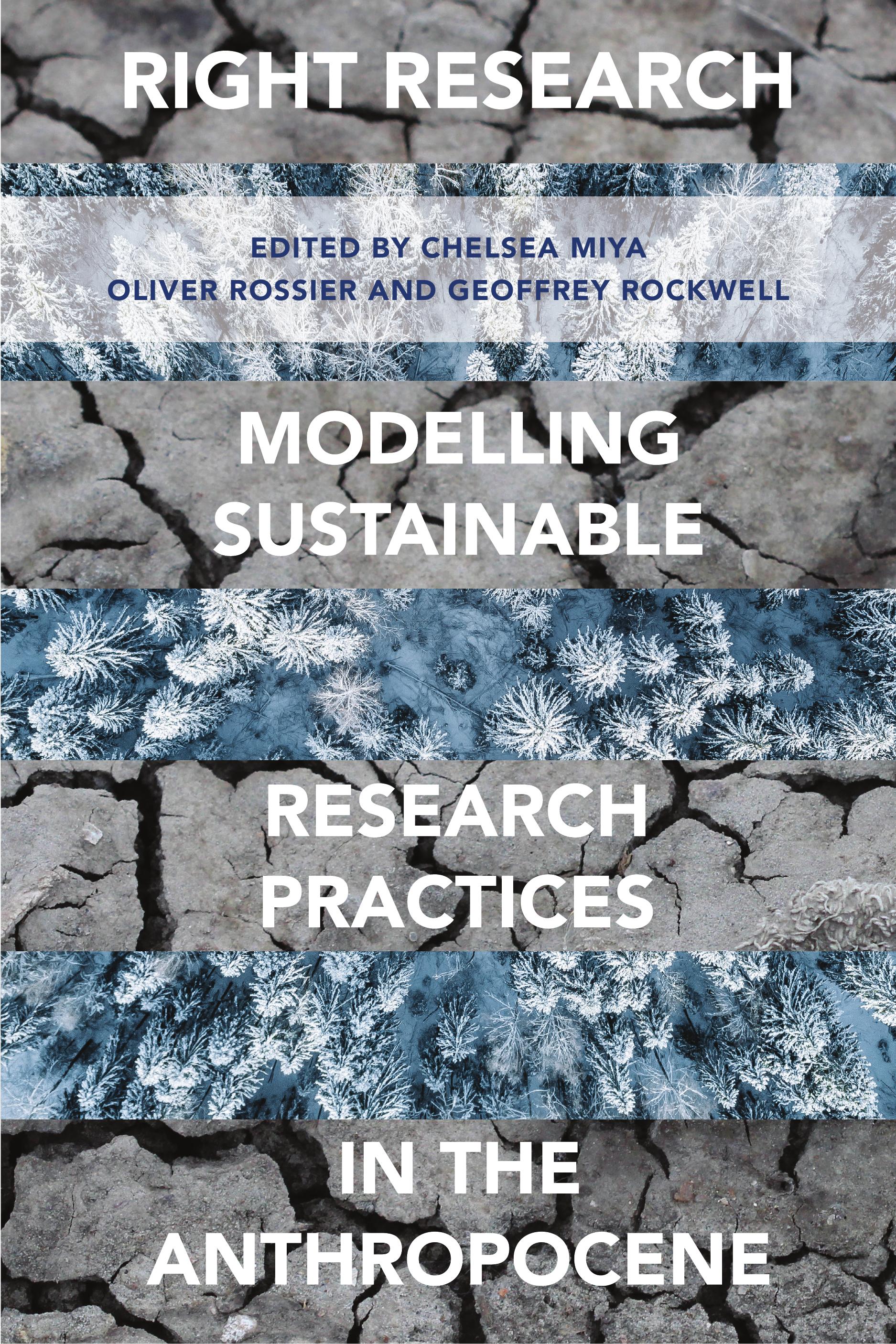
Right Research: Modelling Sustainable Research Practices in the Anthropocene
- Chelsea Miya(editor)
- Oliver Rossier(editor)
- Geoffrey Rockwell(editor)
| Title | Right Research |
|---|---|
| Subtitle | Modelling Sustainable Research Practices in the Anthropocene |
| Contributor | Chelsea Miya(editor) |
| Oliver Rossier(editor) | |
| Geoffrey Rockwell(editor) | |
| DOI | https://doi.org/10.11647/OBP.0213 |
| Landing page | https://www.openbookpublishers.com/books/10.11647/obp.0213 |
| License | http://creativecommons.org/licenses/by/4.0/ |
| Copyright | Chelsea Miya; Oliver Rossier; Geoffrey Rockwell |
| Publisher | Open Book Publishers |
| Publication place | Cambridge, UK |
| Published on | 2021-04-29 |
| ISBN | 978-1-78374-961-4 (Paperback) |
| 978-1-78374-962-1 (Hardback) | |
| 978-1-78374-963-8 (PDF) | |
| 978-1-80064-619-3 (HTML) | |
| 978-1-78374-966-9 (XML) | |
| 978-1-78374-964-5 (EPUB) | |
| 978-1-78374-965-2 (MOBI) | |
| Short abstract | The essays in this volume critically examine scholarly research practices in the age of the Anthropocene, and ask what accountability educators and researchers have in ‘righting’ their relationship to the environment. |
| Long abstract | Educational institutions play an instrumental role in social and political change, and are responsible for the environmental and social ethics of their institutional practices. The essays in this volume critically examine scholarly research practices in the age of the Anthropocene, and ask what accountability educators and researchers have in ‘righting’ their relationship to the environment. The volume further calls attention to the geographical, financial, legal and political barriers that might limit scholarly dialogue by excluding researchers from participating in traditional modes of scholarly conversation. As such, Right Research is a bold invitation to the academic community to rigorous self-reflection on what their research looks like, how it is conducted, and how it might be developed so as to increase accessibility and sustainability, and decrease carbon footprint. The volume follows a three-part structure that bridges conceptual and practical concerns: the first section challenges our assumptions about how sustainability is defined, measured and practiced; the second section showcases artist-researchers whose work engages with the impact of humans on our environment; while the third section investigates how academic spaces can model eco-conscious behaviour. This timely volume responds to an increased demand for environmentally sustainable research, and is outstanding not only in its interdisciplinarity, but its embrace of non-traditional formats, spanning academic articles, creative acts, personal reflections and dialogues. Right Research will be a valuable resource for educators and researchers interested in developing and hybridizing their scholarly communication formats in the face of the current climate crisis. |
| Print length | 558 pages (xxvi+532) |
| Language | English (Original) |
| Dimensions | 156 x 39 x 234 mm | 6.14" x 1.52" x 9.21" (Paperback) |
| 156 x 43 x 234 mm | 6.14" x 1.69" x 9.21" (Hardback) | |
| Weight | 2308g | 81.41oz (Paperback) |
| 2720g | 95.95oz (Hardback) | |
| Media | 96 illustrations |
| OCLC Number | 1250577094 |
| LCCN | 2020447278 |
| BIC |
|
| BISAC |
|
| LCC |
|
| Keywords |
|
| Funding |
Contents
Editors’ Preface
(pp. xxiii–xxvi)- Oliver Rossier
- Chelsea Miya
- Geoffrey Rockwell
- Howard Nye
- Petra Dolata
- Kristine Kowalchuk
(pp. 93–110)- Kitting the Digital Humanities for the Anthropocene: Digital Metabolism and Eco-Critical DH
- Amanda Starling Gould
- Doug Barlage
- Gem Shoute
(pp. 133–152)- Sustainable DNA: In Conversation
- Mél Hogan
- Deb Verhoeven
- Eric Benson
- Priscilla Ferronato
(pp. 173–216)- Inspiration from Goethe’s Tender Empiricism: How to be the Person Collecting, Analyzing and Visualizing Data
- Joshua Korenblat
(pp. 217–256)- Solidarity Seeds: Situated Knowledges in Bishan Village, Wang Chau Village and Aarey Forest
- Michael Leung
(pp. 257–274)- e-Waste Peep Show: A Research-Creation Project on the (In)visibility of Technological Waste
- Lai-Tze Fan
Art and/in the Anthropocene
(pp. 277–279)- Natalie Loveless
The Aesthetics of Hidden Ecologies
(pp. 280–284)- Andrew S. Yang
R.A.W. Arts of Barnyard Becomings
(pp. 285–287)- Karin Bolender
From Repulsion to Care
(pp. 288–290)- Leanne Olson
Nurture/Future/Sculpture
(pp. 291–293)- Christa Donner
Thoughts on an Unfinished Composition…
(pp. 294–297)- Scott Smallwood
- Jessie Beier
Aesthetic Attunements
(pp. 302–306)- Natalie Loveless
- Ted Dawson
- Allison Paradise
- Hart Cohen
- Francesca Sidoti
- Alison Gill
- Abby Mellick Lopes
- Maryella Hatfield
- Jonathon Allen
- Abby Mellick Lopes
- Jonathon Allen
- Maryella Hatfield
- Alison Gill
- Abby Mellick Lopes
- Francesca Sidoti
Coda
(pp. 392–394)- Hart Cohen
(pp. 399–420)- An Intro to Econferences
- Geoffrey Rockwell
- Oliver Rossier
- Chelsea Miya
(pp. 421–434)- Econferences Are Not the Same, but Are They Good Enough?
- Terry Anderson
(pp. 435–462)- Online Conferences: Some History, Methods and Benefits
- Nick Byrd
(pp. 463–510)- ‘Greening’ Academic Gatherings: A Case for Econferences
- Oliver Rossier
- Chelsea Miya
- Geoffrey Rockwell
Contributors
Chelsea Miya
(editor)Chelsea Miya is a PhD Candidate and CGS SSHRC fellow in English and Film Studies at the University of Alberta where her work focuses on the cultural history of data. She is a researcher and podcaster with the SpokenWeb, a multi-institutional interdisciplinary project dedicated to the discovery, preservation, and analysis of sonic artifacts.
Oliver Rossier
(editor)Oliver Rossier has a BA in History and Political Science, and an MA in Communications and Technology, both from the University of Alberta. He has over twenty years of post-secondary administrative experience, facilitating collaborative research projects and strategic initiatives. He is committed to helping research teams find the right tools and techniques to navigate transitions caused by the tandem tsunamis of COVID-19 and significant budget reductions.
Geoffrey Rockwell
(editor)Geoffrey Rockwell is a Professor of Philosophy and Digital Humanities, Director of the Kule Institute for Advanced Study and Associate Director of the AI for Society signature area at the University of Alberta. He publishes on textual visualization, text analysis, ethics of technology and on digital humanities including a co-authored book, Hermeneutica, from MIT Press (2016). He is co-developer of Voyant Tools www.voyant-tools.org(opens in new tab), an award-winning suite of text analysis tools.