
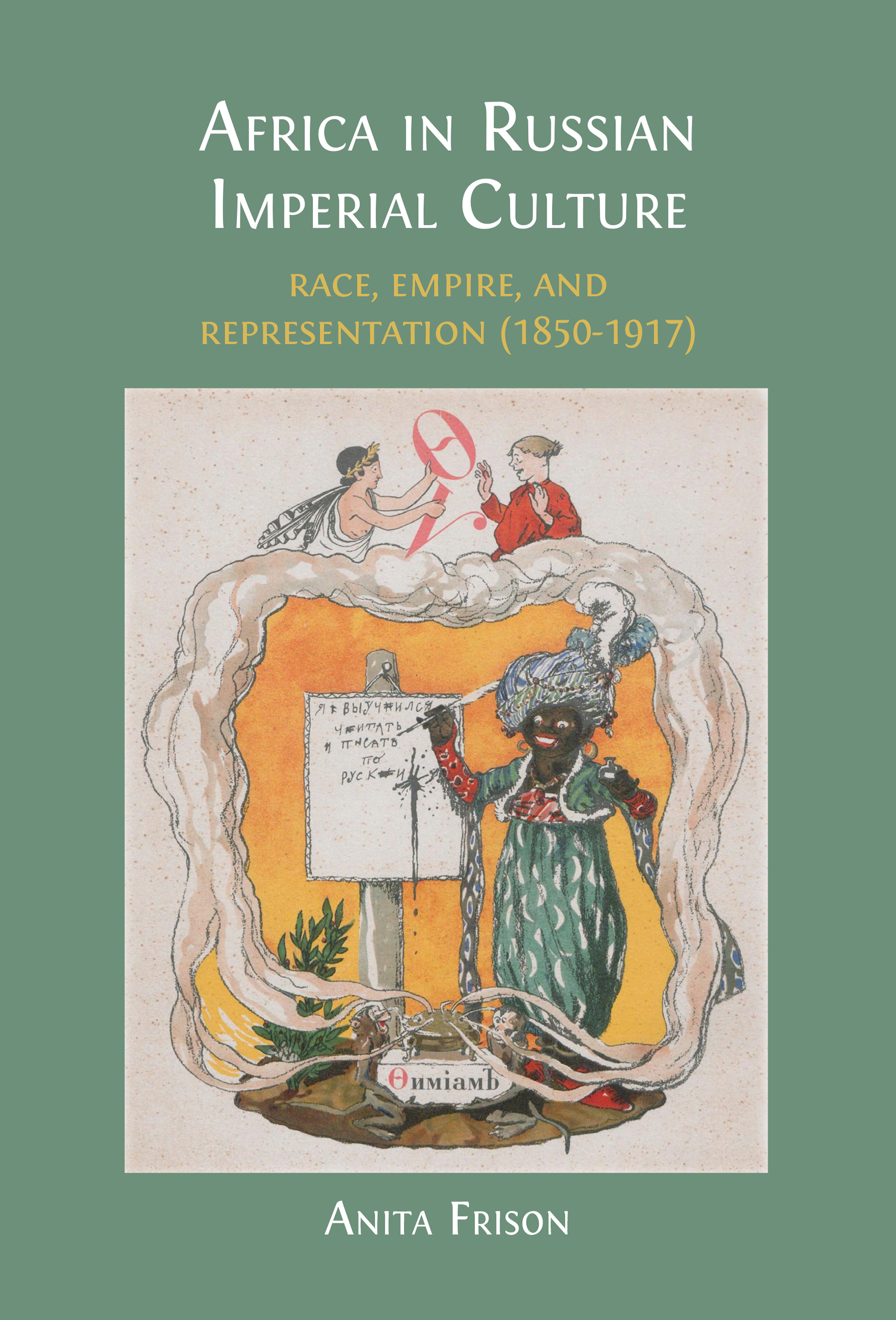
Africa in Russian Imperial Culture: Race, Empire, and Representation (1850-1917)
- Anita Frison(author)
| Title | Africa in Russian Imperial Culture |
|---|---|
| Subtitle | Race, Empire, and Representation (1850-1917) |
| Contributor | Anita Frison(author) |
| DOI | https://doi.org/10.11647/OBP.0504 |
| Landing page | https://www.openbookpublishers.com/books/10.11647/OBP.0504 |
| License | https://creativecommons.org/licenses/by-nc/4.0/ |
| Copyright | Anita Frison |
| Publisher | Open Book Publishers |
| Publication place | Cambridge, UK |
| Published on | 2026-02-19 |
| ISBN | 978-1-80511-766-7 (Paperback) |
| 978-1-80511-767-4 (Hardback) | |
| 978-1-80511-768-1 (PDF) | |
| 978-1-80511-770-4 (HTML) | |
| 978-1-80511-769-8 (EPUB) | |
| Short abstract | This volume uncovers how Sub-Saharan Africa was imagined in Russian culture from 1850 to 1917. Drawing on travelogues, ethnographic studies, fiction, and museum collections, Anita Frison reveals how Russia—though lacking formal colonies in Africa—nonetheless engaged deeply with Western colonial discourse. |
| Long abstract | This volume uncovers how Sub-Saharan Africa was imagined in Russian culture from 1850 to 1917. Drawing on travelogues, ethnographic studies, fiction, and museum collections, Anita Frison reveals how Russia—though lacking formal colonies in Africa—nonetheless engaged deeply with Western colonial discourse. Organized around themes of Strangers, Lands, Bodies, Collectors, and Disguises, the book explores how Russians represented African peoples, landscapes, and artifacts to negotiate questions of race, empire, and national identity. Challenging the notion of Russian ‘exceptionalism’, this book demonstrates that imperial attitudes toward Africa often prefigured Soviet anticolonial rhetoric, whilst simultaneously relying on the colonial paradigm. Richly documented and interdisciplinary, this study offers fresh insights for scholars of history, literature, and postcolonial studies, while remaining accessible to curious general readers. |
| Print length | 364 pages (xii+352) |
| Language | English (Original) |
| Dimensions | 156 x 25 x 234 mm | 6.14" x 0.98" x 9.21" (Paperback) |
| 156 x 29 x 234 mm | 6.14" x 1.14" x 9.21" (Hardback) | |
| Weight | 690g | 24.34oz (Paperback) |
| 870g | 30.69oz (Hardback) | |
| Media | 20 illustrations |
| OCLC Number | 1574660843 |
| LCCN | 2025432284 |
| THEMA |
|
| BISAC |
|
| LCC |
|
| Keywords |
|
| Funding |
Contents
Introduction
(pp. 1–10)- Anita Frison
(pp. 11–64)- Strangers. Russians Discover Black Africa
- Anita Frison
- Anita Frison
(pp. 113–186)- Bodies. Black People under Russian Scrutiny
- Anita Frison
(pp. 187–244)- Collectors. African Material Culture on Display
- Anita Frison
(pp. 245–300)- Disguises. Black Africa at the Service of the Arts
- Anita Frison
Conclusion
(pp. 301–306)- Anita Frison
Contributors
Anita Frison
(author)Anita Frison holds a PhD in Linguistic, Philological and Literary Studies from the University of Padua. She has since taught Russian literature at the universities of Urbino, Macerata, Venice and Padua, publishing scientific articles and edited volumes As the PI of a Stars@Unipd grant (https://www.unipd.it/en/stars(opens in new tab)), she led the project ‘AfTeR – The African Text: Representing Africa in Imperial Russia (1850-1917)’. Her research interests include Russian literature and culture (19th-early 20th century), Russo-African relations, the Russian Empire and its entanglements, Semiotics, Postcolonial Theory, and Cultural Studies. She is the co-editor-in-chief of the peer-reviewed journal eSamizdat (www.esamizdat.it(opens in new tab)). Orcid id: https://orcid.org/0000-0003-1712-3341(opens in new tab)