
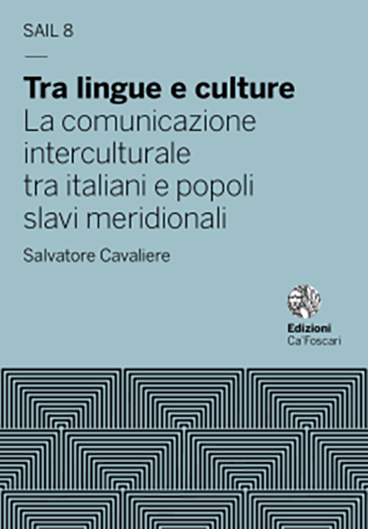
Between Languages and Cultures: Intercultural Communication Between Italians and South Slavic Peoples
- Salvatore Cavaliere(author)
| Title | Between Languages and Cultures |
|---|---|
| Subtitle | Intercultural Communication Between Italians and South Slavic Peoples |
| Contributor | Salvatore Cavaliere(author) |
| DOI | https://doi.org/10.14277/978-88-6969-120-1 |
| Landing page | https://edizionicafoscari.it/en/edizioni4/libri/978-88-6969-121-8/ |
| License | https://creativecommons.org/licenses/by/4.0/ |
| Copyright | Salvatore Cavaliere |
| Publisher | Edizioni Ca’ Foscari – Venice University Press |
| Publication place | Venice, Italy |
| Published on | 2016-11-04 |
| Series |
|
| ISBN | 978-88-6969-120-1 (PDF) |
| Short abstract | To communicate effectively in intercultural contexts, knowing the language of the interlocutor, or a common lingua franca, is often considered sufficient. However, there are many other aspects which can influence the success of communication in contexts in which speakers do not share the same mother culture. This book deals with intercultural communication between Italians and South Slavs. More specifically, it focuses on factors that play an important role in interaction, such as the values guiding the speakers in communication, the use of verbal and non-verbal language, and the way in which some communicative events are perceived. Because these aspects may differ considerably in the cultures here discussed, understanding how they affect intercultural communication is essential to avoid communicative mistakes that could compromise successful interaction. |
| Long abstract | The aim of this work is to illustrate the main intercultural communicative problems which could arise in the interactions between Italians on the one side and Bosnians, Croatians, Montenegrins and Serbs (who will also be referred to as South Slavs or Slavs from the South) on the other. The general field of research of this study – the intercultural communication – allows us to shed light on aspects which could influence more than morphological or syntactic errors the success of interactions between speakers who do not share the same mother tongue and culture. The communications involving interlocutors belonging to different ‘worlds’ can lead, as a matter of fact, to negative consequences on the interaction and on the relationship between the speakers, if and when they do not take sufficiently into account certain cultural aspects, such as the values guiding the speakers in the communication, the use of verbal and non-verbal languages, and the way in which some cultural traits are conceived. Therefore, it is necessary for each speaker to consider and analise carefully the main aspects which could give rise to intercultural communicative misunderstandings or even conflicts with their interlocutor so as to reduce the risks of the above-mentioned situations arising. |
| Language | Italian (Original) |
| THEMA |
|
| BISAC |
|
| Keywords |
|