
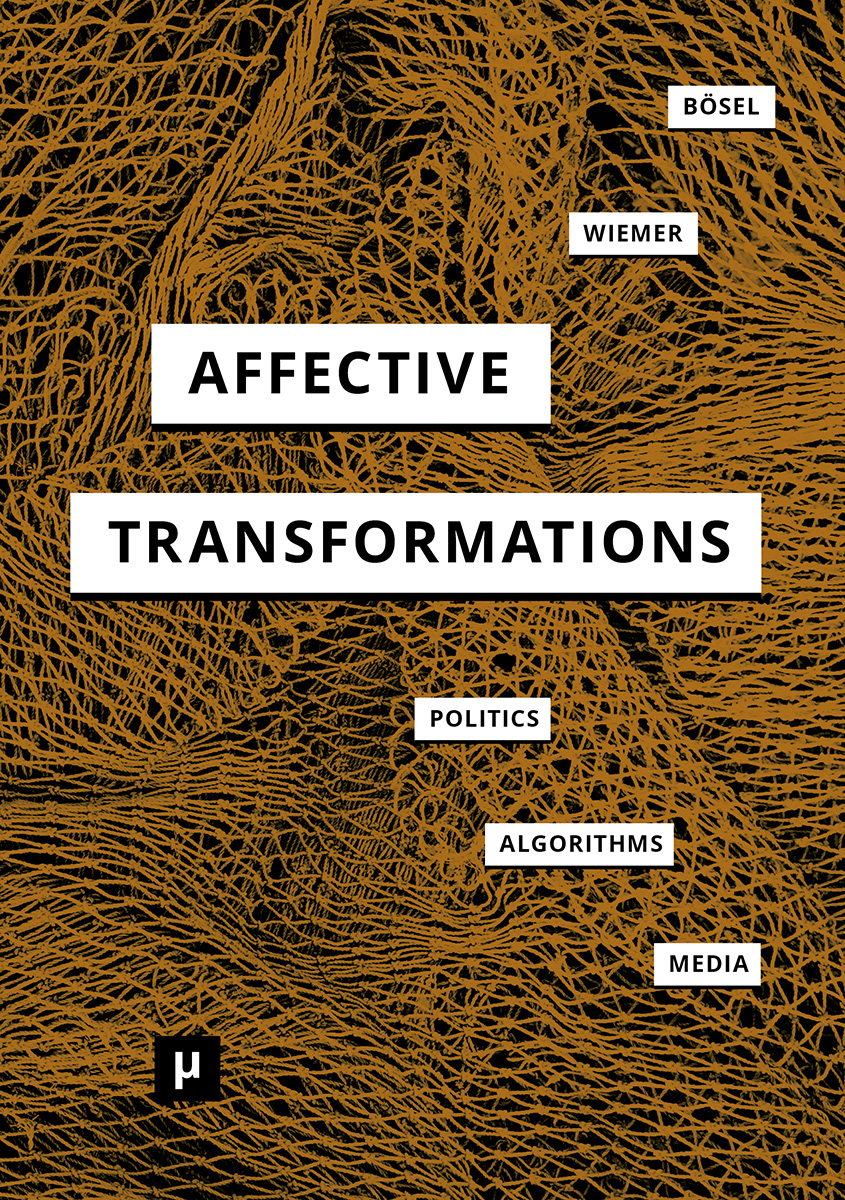
Affective Transformations: Politics – Algorithms – Media
- Bernd Bösel (editor)
- Serjoscha Wiemer (editor)
- Marie-Luise Angerer(author)
- Pierre Cassou-Noguès(author)
- Jean Clam (author)
- Mathias Fuchs(author)
- Gabriele Gramelsberger (author)
- Irina Kaldrack (author)
- Dawid Kasprowicz (author)
- Oliver Leistert(author)
- Michaela Ott (author)
- Markus Rautzenberg (author)
- Andrew Ross (author)
- Paul Stenner(author)
| Title | Affective Transformations |
|---|---|
| Subtitle | Politics – Algorithms – Media |
| Contributor | Bernd Bösel (editor) |
| Serjoscha Wiemer (editor) | |
| DOI | https://doi.org/10.14619/1655 |
| Landing page | https://meson.press/books/affective-transformations |
| License | https://creativecommons.org/licenses/by-sa/4.0/ |
| Copyright | Bernd Bösel, Serjoscha Wiemer |
| Publisher | meson press |
| Publication place | Lüneburg |
| Published on | 2020-11-09 |
| ISBN | 978-3-95796-165-5 (Paperback) |
| 978-3-95796-166-2 (PDF) | |
| Short abstract | The Affective Turn has lost its former innocence and euphoria. Affect Studies and its adjacent disciplines have now to prove that they can cope with the return of the affective real that technology, economy, and politics entail. Two seemingly contradictory developments serve as starting points for this volume. First, technological innovations such as affective computing, mood tracking, sentiment analysis, and social robotics all share a focus on the recognition and modulation of human affectivity. Affect gets measured, calculated, controlled. Secondly, recent developments in politics, social media usage, and right-wing journalism have contributed to a conspicuous rise of hate speech, cybermobbing, public shaming, “felt truths,” and resentful populisms. In a very specific way, politics as well as power have become affective. Affect gets mobilized, fomented, unleashed. When the ways we deal with our affectivity get unsettled in such a dramatic fashion, we have to rethink our ethical, aesthetical, political as well as legal regimes of affect organization. |
| Long abstract | The Affective Turn has lost its former innocence and euphoria. Affect Studies and its adjacent disciplines have now to prove that they can cope with the return of the affective real that technology, economy, and politics entail. Two seemingly contradictory developments serve as starting points for this volume. First, technological innovations such as affective computing, mood tracking, sentiment analysis, and social robotics all share a focus on the recognition and modulation of human affectivity. Affect gets measured, calculated, controlled. Secondly, recent developments in politics, social media usage, and right-wing journalism have contributed to a conspicuous rise of hate speech, cybermobbing, public shaming, “felt truths,” and resentful populisms. In a very specific way, politics as well as power have become affective. Affect gets mobilized, fomented, unleashed. When the ways we deal with our affectivity get unsettled in such a dramatic fashion, we have to rethink our ethical, aesthetical, political as well as legal regimes of affect organization. |
| Print length | 243 pages |
| Language | English (Original) |
| Dimensions | 155 x 220 mm | 6.1" x 8.66" (Paperback) |
| THEMA |
|
| BIC |
|
| BISAC |
|
| LCC |
|
| Keywords |
|
| Funding |
|
Contents
- Bernd Bösel
Affect: On the Turn
(pp. 19–39)- Paul Stenner
- Gabriele Gramelsberger
- Bernd Bösel
- Oliver Leistert
Affective Milieus: Intensive Couplings, Technical Sentience, and a Nonconscious In-between
(pp. 87–99)- Marie-Luise Angerer
Synhaptic Sensibility
(pp. 101–119)- Pierre Cassou-Noguès
- Dawid Kasprowicz
Autonomous Dwelling: Smart Homes and Care IT
(pp. 135–150)- Irina Kaldrack
Happy, Happy, Sad, SadDo You Feel Me? Constellations of Desires in Affective Technologies
(pp. 153–167)- Serjoscha Wiemer
Mediated Humanitarian Affect
(pp. 169–184)- Andrew Ross
Affection and Dividuation
(pp. 187–199)- Michaela Ott
- Mathias Fuchs
- Jean Clam
- Markus Rautzenberg
Contributors
Bernd Bösel
(editor)Bernd Bösel is a postdoc researcher at the University of Potsdam, with a focus on philosophy, media studies and culture theory, and has been teaching in the joint curriculum “European Media Studies,” a collaboration with the University of Applied Sciences Potsdam, since 2015. Between 2016 and 2018 he coordinated the DFG-funded research network “Affect- and Psychotechnology Studies.” For publications see: https://www.uni-potsdam.de/de/medienwissenschaft/professur-fuer-medientheorie-medienwissenschaft/mitarbeiter/dr-bernd-boesel.(opens in new tab)
Serjoscha Wiemer
(editor)Serjoscha Wiemer is a Senior Lecturer for Digital Media/Mobile Media at the Institute for Media Studies at the Paderborn University. Together with Bernd Bösel he is spokesperson for AG Affective Media Technologies. In 2011 he received his doctorate with a thesis on the media theory and aesthetics of computer games at the Ruhr University Bochum. His research interests include the historicity of perception, moving image studies, affect theory, game studies, and algorithmic media. See: www.serjoscha.net(opens in new tab).
Marie-Luise Angerer
(author)Marie-Luise Angerer holds the Chair for Media Theory at the University of Potsdam and teaches in the curriculum “European Media Studies,” a collaboration with the University of Applied Sciences Potsdam. She has been Managing Director of The Brandenburg Centre for Media Studies (ZeM) since 2015. Her main areas of research are media technological re-structurings of the social, zones of human and non-human agencies, and the notion of non-consciousness. For publications see: https://www.(opens in new tab) uni-potsdam.de/de/medienwissenschaft/professur-fuer-medientheoriemedienwissenschaft/mitarbeiter/prof-dr-marie-luise-angerer.html.
Pierre Cassou-Noguès
(author)Pierre Cassou-Noguès is a writer and a philosopher. The key question in his work concerns the role of fiction in the constitution of forms of life and rationality. His latest book, Technofictions (Cerf, 2019), is a collection of short stories that investigates the imaginary underlying several contemporary technological apparatuses. Cassou-Noguès is Professor in the philosophy department of University Paris 8-Vincennes-Saint-Denis, and co-editor of the journal SubStance.
Jean Clam
(author)Jean Clam is a philosopher, sociologist, psychologist and Research Fellow at the Centre National de la Recherche Scientifique (CNRS). He teaches at the École des Hautes Études en Sciences Sociales (EHESS-CADIS) in Paris. He has authored numerous books and articles in French, German, and English. See: www.jean-clam.org(opens in new tab).
Mathias Fuchs
(author)Mathias Fuchs is Principal Investigator for a German Research Council (DFG) funded project on gamification (2018–2021) and a Member of the Institute for the Culture and Aesthetics of Media (ICAM) at Leuphana University of Lüneburg. In 2010 he received his doctoral grade in philosophy with a thesis on the meaning of sounds (“Sinn und Sound”). He has since been Senior Lecturer and Programme Leader for the MA Creative Technology and MSc Creative Games at Salford University in the UK, Deputy Professor at the University of Potsdam, Senior Fellow at the Institute of Advanced Studies on Media Cultures of Computer Simulation (MECS), and Visiting Professor at Leuphana University of Lüneburg.
Gabriele Gramelsberger
(author)Gabriele Gramelsberger is a Professor for Philosophy of Science and Technology at the RWTH Aachen. Her research is focused on the digital transformation of science and technology. Her most recent publication is Cultures of Prediction in Atmospheric and Climate Science (edited with Matthias Heymann and Martin Mahony, Routledge, 2017).
Irina Kaldrack
(author)Irina Kaldrack is Guest Professor for “Knowledge Cultures in the Digital Age” at Braunschweig University of Art. She holds a diploma in Mathematics and a Ph.D. in Cultural Studies. Since 2009 she has been teaching and researching in the field of Media Studies, and since 2015 in transformation design. Her work focuses on the theory and history of digital cultures, knowledge cultures and their technological conditions, algorithmic cultures, and research methods at the interrelations between artistic practices, Design and Media Studies. Recent publications include Throwing Gestures (with Florian Bettel and Konrad Strutz, vfmk, 2020), “Künstliche Intelligenzen” (with Christoph Ernst, Andreas Sudmann, and Jens Schröter, Schwerpunkt der Zeitschrift für Medienwissenschaft 21, transcript, 2019), and There is no Software, There are Just Services (with Martina Leeker, meson press, 2015).
Dawid Kasprowicz
(author)Dawid Kasprowicz is a postdoc at the chair for Philosophy of Science and Technology at the RWTH University Aachen. Research interests are the philosophy of embodiment, philosophy of computational sciences, phenomenology, and human–robot interactions. Recent publication, with Lisa Schüttler and Gabriele Gramelsberger: “Computational Science Studies: A Tool-Based Methodology for Studying Code.” In Critical Issues in Science, Technology and Society Studies (Conference Proceedings STS Conference Graz), edited by G. Getzinger and M. Jahrbacher, 385–401. Graz: Verlag Technische Universität Graz.
Oliver Leistert
(author)Oliver Leistert is a postdoc researcher with a focus on media theory/ philosophy and epistemologies/methods of digital cultures. He is Principal Investigator for the DFG-funded project “Blockchains: Media of Sovereignty” at Leuphana University of Lüneburg. His fields of interest comprise continental philosophy, histories of control, governmentality, surveillance, political economy, and political technologies. See: https:// nomedia.noblogs.org/.
Michaela Ott
(author)Michaela Ott is a Professor of Aesthetic Theories at the Academy of Fine Arts in Hamburg. Her research focuses on post-structuralist philosophy, aesthetics and politics, aesthetics of film, theories of space, affection and dividuation, theories of the (post)colonial and the composite-cultural, and knowledge of the arts. She is the co-editor of Timing of Affect (with MarieLuise Angerer and Bernd Bösel, diaphanes, 2014) and author of Dividuations: Theories of Participation (Palgrave Macmillan, 2018), Affizierung: Zu einer ästhetisch-epistemischen Figur (edition text + kritik, 2010), and most recently Welches Außen des Denkens? Französische Theorie in (post)kolonialer Kritik (Turia & Kant, 2018)
Markus Rautzenberg
(author)Markus Rautzenberg is Professor for Philosophy at the Folkwang University of the Arts (Essen, Germany). His main fields of research include media theory, picture theory, philosophy of the 20th century, aesthetics of digital media, and ludic epistemologies. His most recent publication is Framing Uncertainty: Computer Game Epistemologies (Palgrave Macmillan, 2020).
Andrew Ross
(author)Andrew A. G. Ross is Associate Professor of Political Science at Ohio University. His main research areas are theories of emotion and affect, and the cultural politics of digital media. Recent publications include articles in Political Psychology and International Organization, chapters in several edited volumes, and Mixed Emotions: Beyond Fear and Hatred in International Conflict (University of Chicago Press, 2014).
Paul Stenner
(author)Paul Stenner has held a Chair in Social Psychology at the Open University in the UK since 2011. He has contributed to the development of a critical and reflexive approach to social psychology that takes process and relationality as keynotes of what is known as a transdisciplinary psychosocial approach. He is author of Liminality and Experience: A Transdisciplinary Approach to the Psychosocial (Palgrave, 2017) and Psychology Without Foundations (with Steve Brown, Sage, 2009). He has co-edited Emotions: A Social Science Reader (with Monica Greco, Routledge, 2008) and authored numerous articles on affectivity and liminality.