
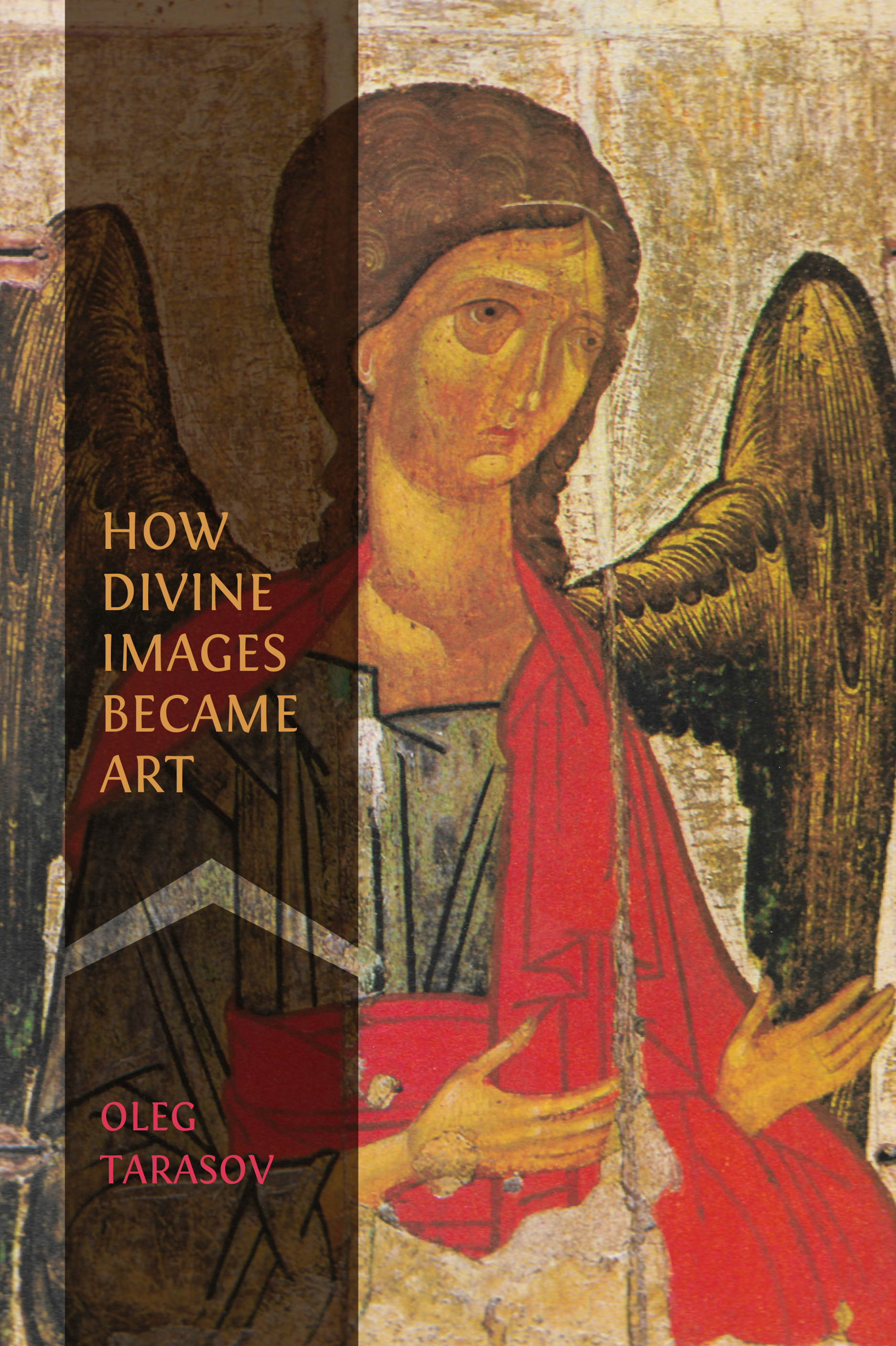
How Divine Images Became Art: Essays on the Rediscovery, Study and Collecting of Medieval Icons in the Belle Époque
- Oleg Tarasov (author)
- Stella Rock (translator)
| Title | How Divine Images Became Art |
|---|---|
| Subtitle | Essays on the Rediscovery, Study and Collecting of Medieval Icons in the Belle Époque |
| Contributor | Oleg Tarasov (author) |
| Stella Rock (translator) | |
| DOI | https://doi.org/10.11647/OBP.0378 |
| Landing page | https://www.openbookpublishers.com/books/10.11647/OBP.0378 |
| License | https://creativecommons.org/licenses/by-nc-nd/4.0/ |
| Copyright | Oleg Tarasov |
| Publisher | Open Book Publishers |
| Publication place | Cambridge, UK |
| Published on | 2024-02-09 |
| ISBN | 978-1-80511-158-0 (Paperback) |
| 978-1-80511-159-7 (Hardback) | |
| 978-1-80511-160-3 (PDF) | |
| 978-1-80511-163-4 (HTML) | |
| 978-1-80511-161-0 (EPUB) | |
| Short abstract | How Divine Images Became Art tells the story of the parallel ‘discovery’ of Russian medieval art and of the Italian ‘primitives’ at the beginning of the twentieth century. While these two developments are well-known, they are usually studied in isolation. Tarasov’s study has the great merit of showing the connection between the art world in Russia and the West, and its impact in the cultural history of the continent in the pre-war period. |
| Long abstract | How Divine Images Became Art tells the story of the parallel ‘discovery’ of Russian medieval art and of the Italian ‘primitives’ at the beginning of the twentieth century. While these two developments are well-known, they are usually studied in isolation. Tarasov’s study has the great merit of showing the connection between the art world in Russia and the West, and its impact in the cultural history of the continent in the pre-war period. Drawing on a profound familiarity with Russian sources, some of which are little known to Western scholars, and on equally expert knowledge of Western material and scholarship, Oleg Tarasov presents a fresh perspective on early twentieth-century Russian and Western art. The author demonstrates that during the Belle Époque, the interest in medieval Russian icons and Italian ‘primitives’ lead to the recognition of both as distinctive art forms conveying a powerful spiritual message. Formalist art theory and its influence on art collecting played a major role in this recognition of aesthetic and moral value of ‘primitive’ paintings, and was instrumental in reshaping the perception of divine images as artworks. Ultimately, this monograph represents a significant contribution to our understanding of early twentieth-century art; it will be of interest to art scholars, students and anyone interested in the spiritual and aesthetic revival of religious paintings in the Belle Époque. |
| Print length | 228 pages (viii+220) |
| Language | English (Original) |
| Dimensions | 156 x 16 x 234 mm | 6.14" x 0.63" x 9.21" (Paperback) |
| 156 x 20 x 234 mm | 6.14" x 0.79" x 9.21" (Hardback) | |
| Weight | 441g | 15.56oz (Paperback) |
| 625g | 22.05oz (Hardback) | |
| Media | 35 illustrations |
| OCLC Number | 1422039773 |
| LCCN | 2023446251 |
| THEMA |
|
| BIC |
|
| BISAC |
|
| LCC |
|
| Keywords |
|
Contents
Introduction
(pp. 1–10)- Oleg Tarasov
- Stella Rock
(pp. 11–44)- Fashion, Taste and Form
- Oleg Tarasov
- Stella Rock
(pp. 45–66)- From Images of Italy to Early Russian Art
- Oleg Tarasov
- Stella Rock
(pp. 67–116)- The New Museum of Medieval Icons
- Oleg Tarasov
- Stella Rock
(pp. 117–170)- Florenskii, Metaphysics and Reverse Perspective
- Oleg Tarasov
- Stella Rock
Conclusion
(pp. 171–176)- Oleg Tarasov
- Stella Rock
Contributors
Oleg Tarasov
(author)Oleg Tarasov is an independent scholar (Rome). The author of numerous publications on cultural history and art, his books include Icon and Devotion: Sacred Spaces in Imperial Russia, transl. and ed. by R.-M. Gulland (London: Reaktion Books, 2002), Framing Russian Art: From Early Icons to Malevich, transl. by R.-M. Gulland and A. Wood (London: Reaktion Books, 2011), and Russian Art Nouveau and Ancient Icons (Moscow: Indrik, 2016) (in Russian). Oleg obtained a Ph.D. in History at the Institute of Slavic Studies of the Russian Academy of Sciences and in Art History at Department of History and Theory of Arts of the State Moscow University. He held posts at the State Moscow University, Department of History, and at the Department of Cultural History of the Institute of Slavic Studies of the Russian Academy of Sciences. Oleg has been awarded fellowships at the Istituto Ellenico di Studi Bizantini e Postbizantini di Venezia, Italy, at the Getty Research Institute, USA and at Institute for Human Sciences, Vienna, Austria.
Stella Rock
(translator)Stella Rock is Honorary Associate at the Faculty of Arts and Social Sciences, School of Social Sciences and Global Studies, Religious Studies at the Open university (UK). Her publications include Popular Religion in Russia: ‘Double-belief’ and the making of an Academic Myth (Abington & New York: Routledge, 2007); “Russian Piety and Orthodox Culture 1380–1589”, in Angold, M. (ed.), The Cambridge History of Christianity, vol. 5: Eastern Christianity (Cambridge University Press, 2007), pp. 253–75; ‘The life of dry bones: Pilgrimage to relic shrines in Soviet Russia’, in Pazos, Antón M. (ed.), Relics, Shrines and Pilgrimages: Sanctity in Europe from Late Antiquity (London and New York: Routledge, 2020).
References
- Berenson Library Archive, Villa I Tatti, The Harvard University Center for Italian Renaissance Studies, Florence.
- Acheimastou-Potamianou, M., Icons of the Byzantine Museum of Athens (Athens: Ministry of Culture, Archaeological Receipts Fund, 1998).
- Biblioteka i archive doma-muzeia svaschennika Pavla Florenskogo v Moskve [Library and Archive of the House-museum of the Priest Pavel Florenskii, Moscow].
- Otdel rukopisei Gosudarstvennogo Russkogo Muzeia (OR GRM) [State Russian Museum, Manuscript Division, St Petersburg], fonds 137.
- Otdel rukopisei Gosudarstvennoi Tretiakovskoi Gellerei (OR GTG) [State Tretiakov Gallery, Manuscript Division, Moscow], fonds 10.
- Rossiiskii gosudarstvennyi arkhiv literatury i iskusstva (RGALI) [Russian State Archive of Literature and Art], fonds 822.
- Agosti, G., M. E. Manca and M. Panzeri, eds., Giovanni Morelli e la cultura dei conoscitori, Atti del convegno internazionale, Bergamo, 4–7 June 1987 (Bergamo: P. Lubrina, 1993).
- Ainalov, D. V., Ellinisticheskie osnovy vyzantiiskogo iskusstva (St Petersburg: n.p., 1900).
- Ainalov, D. V., The Hellenistic Origins of Byzantine Art, ed. C. Mango, trans. E. and S. Sobolevitch, (New Brunswick, NJ: Rutgers University Press, 1961).
- Alpatov, M., ‘K voprosu o zapadnom vliianii na drevnerusskoe iskusstvo’, Slavia, 3 (1924), 94–113.
- Anisimov, A. I., ‘Tserkovnaia starina na vystavke XV arkheologicheskogo s’ezda v Novgorode’, Starye gody (October 1911), 40–47.
- Anisimov, A. I., The Vladimir Icon of Mother of God (Prague: Seminarium Kondakovianum, 1928).
- Anisimov A. I., and P. P. Muratov, Novgorodskaia ikona Feodora Stratilata (Moscow: K. F. Nekrasov, 1916).
- Antonova, C., ‘On the Problem of “Reverse Perspective”: Definition East and West’, Leonardo, 43.5 (2010), 464–69.
- Antonova, C., Space, Time and Presence in the Icon: Seeing the World with the Eyes of God (Farnham: Ashgate, 2010).
- Antonova, C., Visual Thought in Russian Religious Philosophy: Pavel Florensky’s Theory of the Icon (New York: Routledge, 2020), https://doi.org/10.4324/9780429262890(opens in new tab)
- Art Institute of Chicago, Catalogue of Russian Icons (Chicago, IL: Metropolitan Museum of Art, 1931).
- Babelon, J.-P., M. Laclotte, N. S. F. Garnot and N. Volle, eds., Primitifs italiens du Musée Jacquemart-André (Paris: Editions Noesis, 2000).
- Bakhrakh, A., ‘“Evropeets” s Arbata’, in Vozvrashchenie Muratova. Ot ‘Obrazov Italii’ do ‘Istorii kavkazskikh voin’. Po materialam vystavki ‘Pavel Muratov – chelovek Serebrianogo veka’ v Gos. Muzee izovrazitel’nykh iskusstv imeni A. S. Pushkina 3 marta–20 aprelia 2008 goda, ed. G. I. Vzdornov and K. M. Muratova (Moscow: Indrik, 2008), pp. 158–59.
- Bakushinskii, A. V., ‘Linear perspektiva v isskustve i zritel’nom vospriiatii real’nogo prostranstva’, Iskusstvo, 1 (1923), 213–63.
- Baldassari, A., Icones de l’art moderne. La collection Chtchoukine (Livres d’art) (Paris: Fondation Louis Vuitton, 2016).
- Baldry, F., ‘Rooms of Taste. Houses and House Museums of Collectors and Antique Dealers in Florence between the 19th and 20th Centuries’, in Le stanze dei tesori. Collezionisti e antiquari a Firenze tra Ottocento e Novecento, ed. L. Mannini (Florence: Polistampa, 2011), pp. 44–64.
- Barchtchévski, I., and D. Laroche, Objets d’art Russes anciens faisant partie des collections de la Princesse Marie Tenichev, exposes au musée des arts décoratifs du 10 Mai au 10 Octobre, 1907 (Paris: Gauterin, 1907).
- Barolskii, P., ‘Walter Pater and Bernard Berenson’, New Criterion, 2 (1984), 47–57.
- Bazen, G., Istoriia istorii iskusstva. Ot Vazari do nashikh dnei, trans. K. A. Chekalov (Moscow: Progress, 1995).
- Bellini, L., Nel mondo degli antiquari (Florence: Edizioni del Turco, 1947).
- Belting, H., Obraz i kul’t. Istoriia obraza do epokhi iskusstva, trans. K. A. Piganovich (Moscow: Progress-Traditsiia, 2002).
- Bely, A., Simbolizm kak miroponimanie (Moscow: Respublika, 1994).
- Benois, A., ‘Ikony i novoe iskusstvo’, Rech’, 93 (1913), 2.
- Benois, A., Moi vospominaniia, 2 vols. (Moscow: Nauka, 1993).
- Benois, A., ‘Poslednaiai futuristicheskaia vystavka’, Rech’ (9 January 1916), n.p.
- Benois, A., ‘Russkie ikony i Zapad’, Rech’, 37 (1913), 2.
- Berdiaev, N., Filosofiia tvorchestva, kul’tury i iskusstva, 2 vols. (Moscow: Iskusstvo, 1994).
- Berdiaev, N., ‘Pikasso’, Sofiia, 3 (1914), 57–62.
- Berenson, B., The Central Italian Painters of the Renaissance (New York and London: Putnam, 1897).
- Berenson, B., Essays in the Study of Sienese Painting (New York: Frederic Fairchild Sherman, 1918).
- Berenson, B., Florentiiskie zhivopistsy Vozrozhdeniia, trans. with an introduction by P. P. Muratov (Moscow: S. I. Sakharov, 1923).
- Berenson, B., The Italian Painters in the Renaissance (Oxford: Oxford University Press, 1952).
- Berenson, B., The Italian Painters of the Renaissance (London: Phaidon, 1959).
- Berenson, B., Lorenzo Lotto (Milan: Electa, 1955).
- Berenson, B., ‘Osnovy khudozhestvennogo raspoznavaniia’, Sofiia, 1 (1914), 40–69.
- Berenson, B., Studies in Medieval Painting (New Haven, CT: Yale University Press, 1930).
- Berenson, B., The Study and Criticism of Italian Art (London: G. Bell and Sons, 1902).
- Berenson, B., Zhivopistsy ital’ianskogo Vozrozhdeniia (Moscow: Iskusstvo, 1965).
- Bernabó, M., ‘Pavel Muratov sull’arte bizantina e russa e sui primitivi italiani (1924–1928)’, in Letture Muratoviane III. Atti del Colloquio Internazionale (Napoli, 28–30 settembre 2017). Studi in memoria di Xenia Muratova, ed. R. Giuliani (Rome: Lithos, 2021), pp. 257–69.
- Bernardi, G., ed., Bernard Berenson and Byzantine Art. Correspondence, 1920–1957, with a contribution by S. Koulouris and preface by M. Bernabò (Turnhout: Brepols, 2023).
- Bode, W. von, Die Anfänge der Majolikakunst in Toskana (Berlin: Julius Bard, 1911).
- Bulgakov, S., Ikona i ikonopochitanie (Moscow: Russkii put’, 1996).
- Buslaev, F. I., ‘Moi vospominaniia’, Vestnik Evropy, 5 (1891), 171.
- Buslaev, F. I., Moi vospominaniia (Moscow: Tipografiia G. Lessnera i A. Geshel’ia, 1897).
- Buslaev, F. I., ‘Moskovskie molel’ni’, in F. I. Buslaev, Sochineniia F. I. Buslaeva, 3 vols. (St Petersburg: V Tipografii Tovarishchestva ‘Obschestvennaia pol’za’, 1908), I, 252–53.
- Bychkov, V., The Aesthetic Face of Being: Art in the Theology of Pavel Florensky (Crestwood, NY: St. Vladimir’s Seminary Press, 1993).
- Deonna, W., ‘Iskusstvo i deistvitel’nost’. Voprosy arkheologicheskogo metoda’, Sofiia, 5 (1914), 22–48.
- Du Prel, K., Filosofiia mistiki ili dvoistvennost’ chelovecheskogo sushchestva, trans. M. S. Aksenov (St Petersburg: n.p., 1895).
- Durand, J., ed., Byzance. L’art byzantine dans les collections publiques françaises (Paris: Éditions de la Réunion des musées nationaux, 1992).
- Calo, M. A., Bernard Berenson and the Twentieth Century (Philadelphia, PA: Temple University Press, 1994).
- Camporeale, E., ‘On the Early Collections of Italian Primitives’, in Le stanze dei tesori. Collezionisti e antiquari a Firenze tra Ottocento e Novecento, ed. L. Mannini (Florence: Polistampa, 2011), pp. 29–43.
- Carboni, C., L’ultima icona: arte, filosofia, teologia (Milan: Jaca Book, 2019).
- Carr, A. W., ed., Imprinting the Divine. Byzantine and Russian Icons from the Menil Collection (New Haven, CT: Yale University Press, 2011).
- Chalpachcjan, V., ‘Il destino della collezione romana del Conte Grigorij S. Stroganoff (1829–1910) dopo la scomparsa del collezionista’, Rivista d’arte, 5.2 (2012), 446–73.
- Chatzidakis, M., ‘Le peintures des madonneri ou Veneto cretoise et sa destination’, in Venezia centro di mediazione tra Oriente e Occidente, ed. H.-G. Beck, M. Manoussacs and A. Pertusi, 2 vols. (Florence: 1977), II, 675–90.
- Chatzidakis, N., Icons. The Velimezis Collection (Thessaloniki: The Benaki Museum, 1997).
- Cohen, R., Bernard Berenson: A Life in the Picture Trade (New Haven, CT: Yale University Press, 2013).
- Cohen, R., Bernard Berenson: da Boston a Firenze, trans. M. Gini (Milan: Adelphi, 2017).
- Cole, B., Sienese Painting from its Origins to the Fifteenth Century (New York: Harper and Row, 1980).
- Conti, A., A History of the Restoration and Conservation of Works of Art, trans. G. Glanville (Oxford: Oxford University Press, 2007).
- Conticelli, V., and D. Parenti, Icone russe in mostra alla Galleria degli Uffizi. Catalogo (Florence: Sillabe, 2014).
- Conway, M., ‘The History of Russian Icon Painting’, in Masterpieces of Russian Painting, ed. M. Farbman (London: Europa Publications, 1930), pp. 13–34.
- Cormack, R., Icons (London: The British Museum Press, 2007).
- Cormack, R., Painting the Soul: Icons, Death Masks, and Shrouds (London: Reaktion, 1997).
- Corrado, R., La mostra dell’antica arte senese. Aprile–Agosto 1904. Catalogo generale illustrato (Siena: L. Lazzeri, 1904).
- Craddock, P., Scientific Investigation of Copies, Fakes and Forgeries (Amsterdam: Elsevier, 2009).
- Dalton, O. M., Byzantine Art and Archaeology (Oxford: Clarendon Press, 1911).
- Danilova, I. E., ed., Gosudarstvennyi muzei izobrazitel’nykh iskusstv im. A.S. Pushkina. Katalog zhivopisi (Moscow: n.p., 1995).
- Deotto, P., ‘Pavel Muratov’, in Dictionary of Literary Biography: Russian Émigré Writers of the Twentieth Century, ed. M. Rubins (Washington, DC: Thomson Gale, 2005), pp. 237–47.
- Denkmäler altrussischer Malerei. Russische Ikonen vom 12.–18. Jahrhundert (n.a.) (Berlin: Ost-Europa-Verlag, 1929).
- Denkmäler altrussischer Malerei. Russische Ikonen vom 12.–18. Jahrhundert (n.a.) (Vienna: Hagenbund, 1929).
- Diaghilev, S., and A. Benois, Salon d’automne. Exposition de l’art Russe (Paris: Moreau frères, 1906).
- Diehl, C., Manuel d’art Byzantin (Paris: A. Picard, 1910).
- Douglas, R. L., ed., Exhibition of Pictures of the School of Siena, and Examples of the Minor Arts of that City (London: Burlington Fine Arts Club, 1904).
- Dzhotto I dzhotisty (n.a.) (Moscow: n.p., 1881).
- Efros, A. A., ‘Peterburgskoe i moskovskoe sobiratel’stvo (Paralleli)’, Sredi kollektsionerov, 4 (1921), 13–20.
- Evdokimov, P. N., Teologia della bellezza. L’arte dell’icona (Milan: Edizioni San Paolo, 2017).
- Ferrazza, R., Palazzo Davanzati e le collezioni di Elia Volpi (Florence: Centro Di, 1994).
- Ferretti, S., Cassirer, Panofsky and Warburg: Symbol, Art and History (New Haven, CT: Yale University Press, 1989).
- Fiorin, M. F., Catalogo della Pinacoteca Vaticana. Vol. 4: Icone della Pinacoteca Vaticana (Vatican City: Edizioni Musei Vaticani, 1995).
- Florenskii, P. A., ‘Analiz prostranstvennosti i vremeni v khudozhestvenno-izobrazitel’nykh proizvedeniiakh’, in P. A. Florenskii, Istoriia i filosofiia iskusstva. Sbornik tekstov (Moscow: Akademicheskij proekt, 2017), pp. 237–520.
- Florenskii, P. A., Bellezza e liturgia. Scritti su cristianesimo e cultura, trans. C. Zonghetti (Milan: Mondadori, 2010).
- Florenskii, P. A., Beyond Vision. Essays on the Perception of Art, ed. N. Misler, trans. W. Salmond (London: Reaktion, 2002).
- Florenskii, P. A., Detiam moim. Vospominaniia proshlykh let (Moscow: Moskovskii rabochii, 2000).
- Florenskii, P. A., Iconostasis, trans. D. Sheehan and O. Andrejev (Crestwood, NY: St. Vladimir’s Seminary Press, 1996).
- Florenskii, P. A., ‘Ikonostas’, in P. A. Florenskii, Istoriia i filosofiia iskusstva. Sbornik tekstov (Moscow: Akademicheskij proekt, 2017), pp. 9–118.
- Florenskii, P. A., Istoriia i filosofiia iskusstva. Sbornik tekstov, ed. Andronik Trubachev et al. (Moscow: Akademicheskij proekt, 2017).
- Florenskii, P. A., La colonna e il fondamento della verità, ed. N. Valentini and C. Balsamo (Milan: Edizioni San Paulo, 2010).
- Florenskii, P. A., La mistica e l’anima russa, ed. N. Valentini and L. Zak (Milan: Edizioni San Paolo, 2006).
- Florenskii, P. A., Le porte regali. Saggio sull’ icona, ed. E. Zolla (Milan: Adelphi, 1977).
- Florenskii, P. A., La prospettiva rovesciata e altri scritti, ed. N. Misler (Rome: Casa del libro, 1983).
- Florenskii, P. A., ‘Magichnost’ slova’, in P. A. Florenskii, Sochineniia v 2-x tomakh, 2 vols. (Moscow: Mysl’, 1990), II, 252–73.
- Florenskii, P. A., Mnimosti v geometrii (Moscow: Lazur’ Publ., 2004).
- Florenskii, P. A. ‘Molennye ikony prepodobnogo Sergiia’, in P. A. Florenskii, Istoriia i filosofiia iskusstva. Sbornik tekstov (Moscow: Akademicheskij proekt, 2017), pp. 145–63.
- Florenskii, P. A., ‘Obratnaia perspektiva’, in P. A. Florenskii, Istoriia i filosofiia iskusstva. Sbornik tekstov (Moscow: Akademicheskij proekt, 2017), pp. 181–236.
- Florenskii, P. A., ‘Obratnaia perspektiva’, Trudy po znakovym sistemam, 3 (1967), 381–416.
- Florenskii, P. A., ‘On the Icon’, Eastern Churches Review, 8.1 (1976), 11–37.
- Florenskii, P. A., ‘Predely gnoseologii’, Bogoslovskii vestnik, 1.1 (1913), 170–73.
- Florenskii, P. A., ‘Smysl idealizma (metafizika roda i lika)’, in P. A. Florenskii, Sochineniia v 4-x tomakh, 4 vols. (Moscow: Mysl’, 2000), III, 101–03.
- Florenskii, P. A., Stolp i utverzhdenie istiny. Opit pravoslavnoi teoditsei (Moscow: Izdavitel’stvo pravda, 1990).
- Florenskii, P. A., ‘Stroenie slova’, Kontekst (1972), 348–55.
- Florenskii, P. A., U vodorazdelov mysli. Т. 1. Stat’i po iskusstvu (Paris: YMCA Press, 1985).
- Florovskii, G., Puti russkogo bogosloviia (Moscow: Institut russkoi tsivilizatsii, 2009).
- Foletti, I., From Byzantium to Holy Russia. Nikodim Kondakov (1844–1925) and the Invention of the Icon, trans. S. Melker (Rome: Viella, 2011).
- Fondazione Giorgio Chini, L’immagine dello spirito. Icone dalle terre russe, collezione Ambroveneto (Milan: Electa, 1996).
- Freud, S., Tolkovanie snovidenii, trans. M. Kotik (Moscow: N. A. Stollyar, 1913).
- Friedländer, M., Der Kunstkenner (Berlin: Cassirer, 1919).
- Friedländer, M., Ob iskusstve i znatochestve, trans. M. I. Korenev, 2nd ed. (Moscow: Andrey Naslednikov, 2013).
- Frisby, J., and J. V. Stone, Seeing. The Computation Approach to Biological Vision (Cambridge, MA: The MIT Press, 2010).
- Fry, R. ‘Russian Icon Painting from the West European Point of View’, in Masterpieces of Russian Painting, ed. M. Farbman (London: Europa Publications, 1930), pp. 35–58.
- Gasbarri, G., Riscoprire Bisanzio. Lo studio dell’arte bizantina a Roma e in Italia tra Ottocento e Novecento (Rome: Viella, 2015).
- Georgievskii, V. T., ‘Kollektsiia drevnikh ikon N. P. Likhachev’, Novoe vremiia (29 July 1913), n.p.
- Georgievskii, V. T. ‘Obzor vystavki drevnerusskoi ikonopisi i khudozhestvennoi stariny’, Trudy Vserossiiskogo s”ezda khudozhnikov, 3 (1913), 163–74.
- Gevaert, F., ‘Vystavka “Zolotogo Runa” v Briugge’, Starye gody (December 1907), 616–17.
- Gombrich, E. H., The Preference for the Primitive. Episodes in the History of Western Taste and Art (London: Phaidon, 2002).
- Goncharova, N., Vystavka ikonopisnykh podlinnikov i lubkov, organizovannaia M. F. Larionovym (Moscow: Khudozhestvennyi salon, 1913).
- Grabar, I. E., ed., Istoriia Russkogo iskusstva, 6 vols. (Moscow: Knebel, 1910–14).
- Grabar, I. E., Moia zhizn’. Avtomonografiia. Etiudy o khudozhnikakh (Moscow: Respublika, 2001).
- Grabar, I. E., ‘Glaz’, Sredi kollektsionerov, 4 (1921), 3–5.
- Grabar, I. E., Pis’ma 1891–1917 (Moscow: Nauka, 1974).
- Graham, L., and J. M. Kantor, Naming Infinity. A True Story of Religious Mysticism and Mathematical Creativity (Cambridge, MA: Harvard University Press, 2009).
- Grekhem, L., Imena beskonechnosti: pravdivaia istoriia o religioznom mistitsizme i matematicheskom tvorchestve, trans. Kantor Zh. M. (St Petersburg: European University at St Petersburg, 2011).
- Grigorovich, D. V., ‘Dom P. S. Stroganov na Sergievskoi ulitse’, Pchela, 1 (1875), 9.
- Grishchenko, A., Russkaia ikona kak iskusstvo zhivopisi (Moscow: Izdanie Avtora, 1917).
- Grishchenko, A., O sviaziakh russkoi zhivopisi s Vizantiei i Zapadom. XIII–XX vv. (Moscow: A. A. Levenson, 1913).
- Grüneisen, W. de, ‘Illiuzionisticheskii portret’, Sofiia, 4 (1914), 5–59.
- Grüneisen, W. de., Sainte Marie Antique (Rome: Bretschneider, 1911).
- Hannay, H., Roger Fry and Other Essays (London: George Allen and Unwin, 1937).
- Haskell, F., ed., Anatole Demidoff. Prince of San Donato (1812–1870) (London: Trustees of the Wallace Collection, 1994).
- Haskell, F., History and Its Images. Art and Interpretation of the Past (New Haven, CT: Yale University Press, 1995).
- Haskell, F., ‘Les expositions des Maritres anciens et la seconde “redecouverte des primitifs”’, in Hommage à Michel Laclotte. Etudes sur la peinture du Moyen Age et de la Renaissance, ed. F. Bologna and M. Laclotte (Milan: Electa, 1994), pp. 552–64.
- Haskell, F., Rediscoveries in Art. Some Aspects of Taste, Fashion and Collecting in England and France (Ithaca, NY: Cornell University Press, 1976).
- Haustein-Bartsch, E., and I. Bentchev, Ikonen-Museum Recklinghausen (Moscow: Ikonen-Museum Recklinghausen, 2008).
- Hendy, P., European and American Paintings in the Isabella Stewart Gardner Museum (Boston, MA: Trustees of the Isabella Stewart Gardner Museum, 1974).
- Hildebrand, A., Problema formy v izobrazitel’nom iskusstve, trans. N. B. Rozenfel’d and V. A. Favorskii (Moscow: Musaget, 1914).
- Holly, M., Panofsky and the Foundation of Art History (Ithaca, NY: Cornell University Press, 1984).
- Horne, H., Alessandro Filipepi Commonly Called Sandro Botticelli, Painter of Florence (London: G. Bell and Sons, 1908).
- Hovey, W. R., The Nicholas Lochoff Cloister of the Henry Clay Frick Fine Arts Building (Pittsburgh, PA: University of Pittsburgh, 1967).
- ‘I falsi degli Uffizi’ (n.a.), L’Antiquario, 5 (1908), 38–39.
- Ivolgin, V., ‘Nravy ikonotorgovtsev’, Peterburgskii listok (30 July 1913), n.p.
- Iz kollektsii akademika N. P. Likhacheva. Katalog vystavki v Gosudarstvennom Russkom muzee (n.a.) (St Petersburg: Seda-S, 1993).
- Jandolo, A., Le memorie di un antiquario (Milan: Ceschina, 1935).
- Joni, I. F., Le memorie di un pittore di quadri antichi. A fronte la versione in inglese ‘Affairs of a Painter’, ed. G. Mazzoni (Siena: Protagon Editori, 2004).
- Kallab, W., Die toskanische Landschaftsmalerei in XIV und XV Jahrhundert (Vienna: Vienna Holzhausen, 1900).
- Kandinsky, W., Tochka i liniia na ploskosti, trans. E. Kozina (Moscow: Azbuka, 2003).
- Kandinsky, W., O dukhovnom v iskusstve (Moscow: Arkhimed, 1992).
- Kantor, S. G., Alfred H. Barr, Jr. and the Intellectual Origins of the Museum of Modern Art (Cambridge, MA: The MIT Press, 2002).
- Karakatsanis, A. A., ed., Treasures of Mount Athos (Thessaloniki: Museum of Byzantine Culture, 1999).
- Kauchtschischwili, N., and M. Hagemeister, eds., P. A. Florenskij e la cultura della sua epoca (Marburg: Blaue Hörner Verlag, 1995).
- Kazanaki-Lappa, M., ed., Nasledie Vizantii: Muzei ikon Grecheskogo instituta vizantiiskikh i postvizantiiskikh issledovanii v Venetsii (Moscow: Grand-Kholding, 2009).
- Kemp, M., The Science of Art: Optical Themes in Western Art from Brunelleschi to Seurat (New Haven, CT: Yale University Press, 1992).
- Khardzhiev, N., K istorii russkogo avangarda (Stockholm: Hylea Prints, 1976).
- Khvoshchinskii, V. T., Toskanskie khudozhniki. I. Primitivy (St Petersburg: n.p., 1912).
- Kieven, E., ed., 100 Jahre Bibliotheca Hertziana. Der Palazzo Zuccari und die Institutsgebäude 1590–2013 (Munich: Hirmer Verlag, 2013).
- Kondakov, N. P., Ikonografiia Bogomateri. Sviazi grecheskoi i russkoi ikonopisi s ital’ianskoi zhivopis’iu rannego Vozrozhdeniia (St Petersburg: Tipografiia imperatorskoi akademii nauk, 1911).
- Kondakov, N. P., The Russian Icon, trans. E. Minns (Oxford: Clarendon Press, 1927).
- Kondakov, N. P., Russkaia ikona, 4 vols. (Prague: Seminarium Kondakovianum, 1928–32).
- Kostenevich, A. G., and N. Y. Semenova, eds., Matiss v Rossii (Moscow: Avangard, 1993).
- Kustodieva, T. K., ed., Sobranie zapadnoevropeiskoi zhivopisi. Katalog. Ital’ianskaia zhivopis’ XIII–XVI vv (Moscow: Gosudarstvennyi Ermitazh, 1994).
- Kyzlasova, I. L., Aleksandr Ivanovich Anisimov (1877–1937) (Moscow: Izd. Moskovskogo Gosudarstvennogo Gornogo universiteta, 2000).
- Kyzlasova, I. L., ed., Mir Kondakova. Publikatsii. Stat’i. Katalog vystavki (Moscow: Russkii put’, 2004).
- Lantz, K. A., ed., The Sealed Angel and Other Stories by Nikolay Leskov (Knoxville, TN: University of Tennessee Press, 1984).
- Lazarev, V., L’arte russa delle icone dalle origini all’inizio del XVI secolo, ed. G. I. Vzdornov (Milan: Jaca Book, 1996).
- Lazarev, V., ‘Un nuovo capolavoro della pittura fiorentina duecentesca’, Rivista d’arte, 30 (1953), 3–63.
- Lenain, F., Art Forgery. A History of a Modern Obsession (London: Reaktion, 2012).
- Leroy, A., Histoire de la peinture religieuse des origines à nos jours (Paris: Amiot-Dumont, 1954).
- Likhachev, N. P., Istoricheskoe znachenie italo-grecheskoi ikonopisi. Izobrazhenie Bogomateri v proizvedeniiakh italo-grecheskikh ikonopistsev i ikh vliianie na kompozitsii nekotorykh proslavlennykh russkikh ikon (St Petersburg: Izdanie Russkago arkheologicheskogo obva, 1911).
- Likhachev, N. P., Materialy dlia istorii russkogo ikonopisaniia: Atlas (St Petersburg: Ekspeditsiia zagotovleniia gosudarstvennykh bumag, 1906).
- Lindsay, A. W. C., Sketches of the History of Christian Art, 3 vols. (London: John Murray, 1847).
- Lipgart, E., ‘Dar grafa P. S. Stroganova Imperatorskomu Ermitazhu’, Starye gody (April 1912), 33–45.
- Lipgart, E., ‘Imperatorskii Ermitazh. Priobreteniia i pereveski’, Starye gody (January 1910), 19.
- Lipgart, E., ‘Kak kollektsiionirovala Velikaia kniaginia Mariia Nikolaevna’, in Nasledie Velikoi Kniagini Marii Nikolaevny, ed. Baron N. N. Vrangel (St Petersburg: n.p., 1913), pp. 8–11.
- Lo Gatto, E., I miei incontri con la Russia (Milan: Mursia, 1976).
- Lock, C., ‘What is Reverse Perspective and Who was Oskar Wulff?’, Sobornost/Eastern Christian Review, 33.1 (2011), 60–89.
- Logan (Berenson), M., ‘A Reconstructor of Old Masterpieces’, The American Magazine of Art, 21 (1930), 628–38.
- Losev, A. F., Ocherki antichnogo simbolizma i mifologii (Moscow: Mysl’, 1930).
- Mach, E., Analiz oshchushchenii (Moscow: Skirmunta, 1908).
- Mach, E., Poznanie i zabluzhdenie. Ocherki po psikhologii issledovaniia (Moscow: Skirmunta, 1909).
- Makovskii, S., ed., Russkaia ikona, 3 vols. (St Petersburg: T. Golika and A. Vilborg, 1914).
- Mannini, L., ‘Antique Dealer Artists Between the 19th and 20th centuries (and Paintings like Antique Shops)’, in Le stanze dei tesori. Collezionisti e antiquari a Firenze tra Ottocento e Novecento, ed. L. Mannini (Florence: Polistampa, 2011), pp. 65–78.
- Markova, V. E., Italiia VIII–XVI vekov. Sobranie zhivopisi Gos. Muzeia izobrazitel’nykh iskusstv im. A. S. Pushkina. Katalog, 2 vols. (Moscow: Galart, 2002).
- Markova, V. E., ‘Ital’ianskie “primitivy” v traditsii russkogo sobiratel’stva’, in Chastnoe kollektsionirovanie v Rossii. Materialy nauchnoi konferentsii ’Vipperovaskie chteniia-1994’, ed. I. E. Danilova (Moscow: Gosudarstvennyĭ muzeĭ izobrazitel, nykh iskusstv im. A.S. Pushkina, 1995), pp. 186–99.
- ‘Matiss v Moskve: V Tret’iakovskoi galeree. V krugu estetov’ (n.a.), Utro Rossii, 248 (27 October 1911), 4.
- Mavarelli, C., ed., Museo Bandini di Fiesole. Guida (Florence: Polistampa, 2011).
- Mazzoni, G., ed., Falsi d’autore. Icilio Federico Joni e la cultura del falso tra otto e novecento (Siena: Protagon, 2004).
- Mazzoni, G., Quadri antichi del Novecento (Vicenza: Neri Pozza, 2001).
- Mikhailov, A. V., ‘Pavel Florenskii kak filosof granitsy. K vykhodu v svet kriticheskogo izdaniia “Ikonostasa”’, Voprosy iskussvoznaniia, 4 (1994), 33–71.
- Millet, G., Monuments byzantins de Mistra (Paris: E. Leroux, 1910), https://bibliotheque-numerique.inha.fr/collection/item/16247-monuments-byzantins-de-mistra
- Minns, E. H., ‘The Exhibition of Icons at the Victoria and Albert Museum’, Slavonic and East European Review, 8 (1930), 627–35.
- Moench, E., ed., Primitifs italiens, le vrai, le faux, la fortune critique (Milan: Silvana Editoriale, 2012).
- Moretti, S., Roma bizantina. Opere d’arte dall’ impero di Costantinopoli nelle collezioni romane (Rome: Campisano, 2014).
- Moscowitz, A. F., Stefano Bardini ‘Principe degli Antiquari’. Prolegomenon to a Biography (Florence: Centro Di, 2015).
- Muñoz, A., ‘La collezione Stroganoff’, Rassegna contemporanea, 3.10 (1910), 9.
- Muñoz, A., and L. Pollak, Pièces de choix de la collection du Comte Gregoire Stroganoff à Rome, 2 vols. (Rome: Impr. de l’Unione editrice, 1912).
- Muratov, P. P., ‘Drevniaia ikonopis’, Russkoe slovo, 36 (13 February 1913), 2.
- Muratov, P. P., Fra Angelico, trans. J. Chuzeville (Paris: Editions G. Crès, 1929).
- Muratov, P. P., Fra Angelico. His Life and Work, trans. E. Law-Gisiko (New York: F. Warne and Co., 1930).
- Muratov, P. P., Frate Angelico (Rome: Valori Plastici, 1929).
- Muratov, P. P., ‘Ikonopis’ pri pervom tsare iz Doma Romanovykh’, Starye gody (July–September 1913), 25–33.
- Muratov, P. P., Immagini dell’Italia, ed. R. Giuliani, trans. A. Romano, 2 vols. (Milan: Adelphi, 2019–21).
- Muratov, P. P., La peinture byzantine, trans. J. Chuzeville (Paris: Editions G. Crès, 1928).
- Muratov, P. P., La pittura bizantina (Rome: Valori Plastici, 1928).
- Muratov, P. P., La pittura russa antica, trans. E. Lo Gatto (Rome: A. Stock, 1925).
- Muratov, P. P., La sculpture gothique (Rome: Valori Plastici, 1931).
- Muratov, P. P., Les icones russes (Paris: Schiffrin 1927).
- Muratov, P. P., ed. and trans., Novelly ital’ianskogo Vozrozhdeniia, 2 vols. (Moscow: n.p., 1913).
- Muratov, P. P., ‘Novoe sobiratel’stvo’, Sredi kollektsionerov, 4 (1921), 1–3.
- Muratov, P. P., ‘Novoe tondo shkoly Bottichelli’, Starye gody (May 1911), 29–34.
- Muratov, P. P., Obrazy Italii, 2 vols. (Moscow: Izdanie Nauchnogo Slova, 1911–12).
- Muratov, P. P., ‘Ocherki ital’ianskoi zhivopisi v Moskovskom Rumiantsevskom muzee. I: Sienskaia Madonna’, Starye gody (November 1910), 605–11.
- Muratov, P. P., ‘Ocherki ital’ianskoi zhivopisi v Moskovskom Rumiantsevskom muzee. II: Kvatrochento’, Starye gody (October 1910), 3–11.
- Muratov, P. P., ‘Otkrytiia drevnego russkogo iskusstva’, Sovremennye zapiski, 14 (1923), 197–218.
- Muratov, P. P., ‘Otkrytiia drevnego russkogo iskusstva’, in P. P. Muratov, Russkaia zhivopis’ do serediny XVII veka. Istoriia otkrytiia i issledovaniia, ed. A. M. Khitrov (St Petersburg: Bibliopolis, 2008), pp. 323–24.
- Muratov, P. P., ‘Pereotsenki’, Sofiia, 2 (1914), 3–4.
- Muratov, P. P., ‘Pol’ Sezann’, Vesy, 12 (1906), 32–42.
- Muratov, P. P., ‘Puti russkoi ikony’, Perezvony, 43 (1928), 1360–67.
- Muratov, P. P., ‘Russkaia zhivopis’ do serediny XVII veka’, in Istoriia Russkogo iskusstva, ed. I. Grabar, 6 vols. (Moscow: Knebel, 1914–16), IV, 18–21.
- Muratov, P. P., Russkaia zhivopis’ do serediny XVII veka. Istoriia otkrytiia i issledovaniia, ed. A. M. Khitrov (St Petersburg: Bibliopolis, 2008).
- Muratov, P. P., ‘Shchukinskaia galereiia. Ocherki iz istorii noveishei zhivopisi’, Russkaia mysl’, 8 (1908), 116–38.
- Muratov, P. P., ‘Tvorchestvo M. V. Nesterova’, Russkaia mysl’, 4 (1907), 151–58.
- Muratov, P. P., ‘Vizantiiskoe mifotvorichesto’, Sofiia, 2 (1914), 3–4.
- Muratov, P. P., ‘Vokrug ikony’, Vozrozhdenie (January 1933), 2787, 2799, 2803, 2809.
- Muratov, P. P., ‘Vystavka drevnerusskogo iskusstva v Moskve. I: Epokhi drevnerusskoi ikonopisi’, Starye gody (April 1913), 31–38.
- Muratov, P. P., Drevnerusskaia zhivopis’ v sobranii I. S. Ostroukhova (Moscow: K. F. Nekrasov, 1914).
- Muratov, P. P., and A. I. Anisimov, Novgorodskaia ikona Sv. Feodora Stratilata (Moscow: K. F. Nekrasov, 1916).
- Muratova, K. M., ‘Ital’ianskoe iskusstvo XIII i XIV vekov v russkoi kritike: sviazi, vzaimovliianiia, sud”by’, in In Christo. Vo Khriste. Obmen khudozhestvennymi i dukhovnymi shedevrami mezhdu Rossiei i Italiei, ed. A. Melloni (Rome: Treccani, 2011), pp. 521–68.
- Muratova, K. M., ‘Pavel Muratov historien d’art en Occident’, in La Russie et l’Occident. Relations intellectuelles et artistiques au temps des révolutions russes, ed. I. Foletti (Rome: Viella, 2010), pp. 65–95.
- Museo dell’Opera del Duomo, Mostra di opere di Duccio di Buoninsegna e della sua scuola. Catalogo. Siena, Museo dell’Opera del Duomo, Settembre, 1912 (Siena: L. Lazzeri, 1912).
- Museum of Fine Arts, Russian Icons [Catalogue of Exhibition]. Museum of Fine Arts, Boston. October 14–December 14 (Boston, MA: Museum of Fine Arts, 1930).
- Nekrasov, E. A., ‘Neosushchestvlennyi zamysel 1920-x godov sozdaniia “Symbolarium’a” (Slovaria simbolov) i ego pervyi vypusk “Tochka”, Pamiatniki kul’tury. Novye otkrytiia. Ezhegodnik 1982 (1984), 99–115.
- Nelson, R. S., ‘A Painting Becomes Canonical: Bernard Berenson, Royall Tayler, and the Mellon Madonna’, in Renaissance Studies in Honor of Joseph Connors, ed. M. B. Israëls and L. A. Waldman, 2 vols., Villa I Tatti Series, 29 (Florence: Villa I Tatti, 2013), I, 696–701.
- Neradovskii, P., ‘Boris i Gleb iz sobraniia N. P. Likhacheva’, Russkaia ikona, 1 (1914), 63–77.
- Nersesjan, L., and D. Suchoverkov, Andrej Rublev. L’icona della Trinità. A lode di san Sergio (Rome: Orizzonti Edizioni, 2016).
- Niemeyer Chini, V., Stefano Bardini e Wilhelm Bode: mercanti e connaisseur fra Ottocento e Novecento (Florence: Polistampa, 2009).
- Nietzsche, F., The Birth of Tragedy or Hellenism and Pessimism, trans. W. A. Haussmann (London: George Allen and Unwin, 1910), https://www.gutenberg.org/files/51356/51356-h/51356-h.htm
- Nietzsche, F., ‘Rozhdenie tragedii iz dukkha muzyki. Predislovie k Richardu Vagneru’, in F. Nietzsche, Sobranie sochinenii v 2-x tomakh, 2 vols. (Moscow: Khudozhestvennaia literatura, 1990), I, 57–157.
- Nyberg, K. W., Omvänt perspektiv i bildkonst och kontrovers: En kritisk begreppshistoria från det gångna seklet (Uppsala: Uppsala Universitet, 2001).
- ‘O poddel’nikh kartinakh’ (n.a.), Starye gody (June 1909), 339–40.
- Olsuf’ev, Y. A., Opis’ ikon Troitse-Sergievoi lavry (Sergiev: Tipografia Ivanova Publ., 1920).
- Opie, J. L., Nel mondo delle icone. Dall’India a Bisanzio (Milan: Jaca Book, 2014).
- Ostroukhov, I. S., Alfavitnyi ukazatel’ biblioteki I. S. Ostroukhova (Moscow: n.p., 1914).
- ‘P. A. Florenskii po vospominaniiam A.F. Loseva’ (n.a.), Kontekst (1990), 6–24.
- Panofsky, E., Perspective as Symbolic Form, trans. C. S. Wood (New York: Zone Books, 1997).
- Parshin, A. N., and O. M. Sedykh, eds., Pavel Aleksandrovich Florenskii (Moscow: ROSSPEN, 2013).
- Pater, W., The Renaissance. Studies in Art and Poetry (New York: Macmillan, 1888), https://archive.org/details/renaissancestu00pate
- Pater, W., The Renaissance: Studies of Art and Poetry (n.p.: The Floating Press, 2010 [1873]).
- Pater, W., Renessans. Ocherki iskusstva i poezii, trans. S. G. Zaimovskii (Moscow: Problemy estetiki, 1912).
- Pater, W., Voobrazhaemye portrety. Rebenok v dome, trans. P. P. Muratov (Moscow: V. M. Sablin, 1908).
- Pavan G., ed., Icone dalle collezioni del Museo Nazionale di Ravenna (Ravenna: Il Museo, 1979).
- Pavlutskii, G. G., ‘K voprosu o vzaimnom vliianii vizantiiskogo i ital’ianskogo iskusstva’, Iskusstvo, 5–6 (1912), 208–20.
- Pegazzano, D., Scritti di museologia e di storia del collezionismo in onore di Cristina De Benedictis (Florence: Edifir, 2012).
- Perkins, M. F., ‘Appunti sulla mostra ducciana a Siena’, Rassegna d’Arte, 13 (1913), 5–9, 35–40.
- Perkins, M. F., ‘La pittura alla Mostra d’arte antica a Siena’, Rassegna d’Arte, 4.10 (1904), 145–53.
- ‘Peterburgskaia “Russkaia ikona”’ (n.a.), Sofiia, 96 (1914), n.p.
- Pirovano, C., ed., Arte e Sacro Mistero. Tesori dal Museo Russo di San Pietroburgo (Milan: Electa, 2000).
- Pirovano, C., ed., Icone russe. Collezione banca Intesa, catalogo ragionato in tre tomi (Milan: Electa, 2003).
- Pirovano, C., ed., Icone russe. Gallerie di Palazzo Leoni Montanari (Milan: Electa, 1999).
- Pisani, R. C., The Angeli Workshop: Federigo and the Angeli Workshop. Palazzo Davanzati. Dream and Reality (Florence: Sillabe, 2010).
- ‘Pis’ma P. P. Muratova (1923–1926). Publikatsiia P. Deotto i E. Garetto’ (n.a.), in Archivio russo-italiano 9: Olga Resnevic Signorelli e l’emigrazione russa: corripondenze, ed. E. Garetto, A. d’Amelia, K. Kumpan and D. Rizzi (Salerno: Europa Orientalis, 2012), pp. 81–108.
- Plato, Sobranie Sochinenii, trans. A. F. Losev, 3 vols. (Moscow: Mysl’, 1971).
- Podzemskaia, N. P., ‘Nauka ob iskusstve v GAKhN i teoreticheskii proekt V.V. Kandinskogo’, in Iskusstvo kak iazyk – iazyki iskusstva. Gosudarstvennaia Akademiia khudozhestvennykh nauk i esteticheskaia teoriia 1920-x godov, ed. N. S. Plotnikov and N. P. Podzemskaia, 2 vols. (Moscow: NLO, 2017), I, 203–05.
- Praz, M., Il patto col serpente (Milan: Adelphi, 2013).
- ‘Prazdnik drevnerusskogo iskusstva’ (n.a.), Tserkov’, 8 (1913), 180.
- Previtali, G., La fortuna dei primitivi: dal Vasari al Neoclassicismo (Turin: Einaudi, 1964).
- Punin, N., ‘Zametki ob ikonakh iz sobraniia N. P. Likhacheva’, Russkaia ikona 1 (1914), 21–45.
- Radnoti, S., The Fake: Forgery and Its Place in Art (Lanham: Rowman and Littlefield, 1999).
- Rauschenbach, B. V., Prostranstvennye postroeniia v drevnerusskoi zhivopisi (Moscow: Nauka, 1975).
- Rauschenbach, B. V., Prostranstvennye postroeniia v zhivopisi. Ocherk osnovnykh metodov (Moscow: Nauka, 1980).
- Riabushinskii, S., ‘O restavratsii i sokhranenii drevnikh sviatykh ikon’, Tserkov, 50 (1908), 1701–05.
- Richardson, J., Two Discourses. I. an Essay on the Whole Art of Criticism as it Relates to Painting… II. An Argument in Behalf of the Science of Connoisseur (London: W. Churchill, 1719), https://archive.org/details/twodiscoursesia00conggoog
- Rostovtsev, M., Ellinisticheski-rimskii arkhitekturnyi peizazh (St Petersburg: n.p., 1908).
- Rovinskii, D. A., Obozrenie ikonopisaniia v Rossii do kontsa XVII veka (St Petersburg: Izdatel’stvo A. S. Suvorina, 1856 [1903]).
- Rubin, W. S., Modern Sacred Art and the Church of Assy (New York: Columbia University Press, 1961).
- Russian Icon Exhibition, Ancient Russian Icons. From the XIIth to the XIXth Centuries, 2nd ed. (London: Russian Icon Exhibition Committee, 1929).
- Russoli, F., ed., The Berenson Collection (Milan: Arti Grafiche Ricordi, 1964).
- Salmond, W., ‘Ellis H. Minns and Nikodim Kondakov’s “The Russian Icon” (1927)’, in Modernism and the Spiritual in Russian Art. New Perspectives, ed. L. Hardiman and N. Kozicharow (Cambridge: Open Book Publishers, 2017), pp. 165–92, https://doi.org/10.11647/OBP.0115.08(opens in new tab)
- Salmond, W., Russian Icons at Hillwood (Washington, DC: Hillwood Museum and Gardens, 1998).
- Samuels, E., Bernard Berenson. The Making of a Connoisseur (Cambridge, MA: Harvard University Press, 1979).
- Samuels, E., Bernard Berenson. The Making of a Legend (Cambridge, MA: Harvard University Press, 1979).
- Schapiro, M., ‘Mr. Berenson’s Values’, Encounter, 16 (1961), 57–65.
- Semenova, N., Morozov: The Story of a Family and a Lost Collection, trans. A. Tait (New Haven, CT: Yale University Press, 2020), https://doi.org/10.2307/j.ctv17z848g (opens in new tab)
- Semenova, N., and A.-M. Delocque-Fourcaud, The Collector: The Story of Sergei Shchukin and His Lost Masterpieces (New Haven, CT: Yale University Press, 2018).
- Shchekotov, N. M., ‘Ikonopis’ kak iskusstvo. Po povodu sobraniia ikon I. S. Ostroukhov i S. P. Riabushinskogo’, Russkaia ikona, 2 (1914), 115–42.
- Shchekotov, N. M., ‘Nekotorye cherty stilia russkikh ikon XV veka’, Starye gody (April 1913), 38–42.
- Shcherbatov, S., Khudozhnik v ushedshei Rossii (New York: Izdatel’stvo imeni Chekhova, 1955).
- Shcherbatov, S., Khudozhnik v ushedshei Rossii (Moscow: Soglasie, 2000).
- Shmidt, D. A., ‘O primitivakh. Vozrozhdenie na Severe’, Starye gody (November–December 1908), 661–64.
- Shteler, T., ‘Obratnaia perspektiva: Pavel Florenskii i Moris Merlo-Ponti o prostranstve i lineinoi perspective v iskusstve Renessansa’, in Istoriko-filosofskii ezhegodnik, ed. N. V. Motroshilova and M. A. Solopova (Moscow: Nauka, 2006), pp. 320–29.
- Slesinski, R., Pavel Florensky: A Metaphysics of Love (Crestwood, NY: St. Vladimir’s Seminary Press, 1984).
- Smart, A., The Assisi Problem and the Art of Giotto: A Study of the ‘Legend of St. Francis’ in the Upper Church of San Francesco, Assisi (Oxford: Clarendon Press, 1971).
- Spira, A., Avant-Garde Icon: Russian Avant-Garde Art and the Icon Painting Tradition (Aldershot: Lund Humphries, 2008).
- Steegman, J., ‘Lord Lindsay’s “History of Christian Art”’, Journal of Warburg and Courtauld Institutes, 10 (1947), 123–31.
- Stoichita, V., A Short History of the Shadow (London: Reaktion, 2018).
- Strehlke, C. B., and M. B. Israels, eds., The Bernard and Mary Berenson Collection of European Paintings at I Tatti (Florence: Villa I Tatti, 2015).
- Strehlke, C. B., Rediscovering Fra Angelico, a Fragmentary History (New Haven, CT: Yale Universit Press, 2001).
- Strugova, O. B., ‘M. K. Tenisheva – neokonchennyi portret’, in Kniaginia M. K. Tenisheva v zerkale Serebrianogo veka. Katalog vystavki v Gos. Istoricheskom muzee, ed. Gosudarstvennyi istoricheskii muzei (Moscow: GIM, 2008), p. 169.
- Strzygowski, J., Orient oder Rom: Beitrag zur Geschichte der spätantiken und früchristlichen Kunst (Leipzig: Hinrichs, 1901).
- Stuart, J., Ikons (London: Faber and Faber, 1975).
- Sychev, N., ‘Ikona sv. Troitsy v Troitse-Sergievoi lavre’, Zapiski otdeleniia russkoi i slavianskoi arkhitektury Russkogo arkheologicheskogo obshchestva, 10 (1913), 1.
- Symonds, J. A., Sketches and Studies in Italy and Greece, 3 vols. (London: J. Murray, 1907–14).
- Tarabukin, N. M., Smysl ikony (Moscow: Pravoslavnogo bratstva Sviatitelia Filareta, 1999).
- Tarasov, O., ‘Florensky and “Reverse Perspective”: Investigating the History of a Term’, Sobornost/Eastern Churches Review, 43.1 (2021), 7–37.
- Tarasov, O., ‘Florensky, Malevich e la semiotica dell’icona’, Nuova Europa, 1 (2002), 34–47.
- Tarasov, O., Framing Russian Art: From Early Icons to Malevich, trans. R. Milner-Gulland and A. Wood (London: Reaktion, 2011).
- Tarasov, O., Icon and Devotion. Sacred Spaces in Imperial Russia, trans. R. Milner-Gulland (London: Reaktion, 2002).
- Tarasov, O., Ikona i blagochestie: Ocherki ikonnogo dela v imperatorskoi Rossii (Moscow: Progress-Kul’tura, 1995).
- Tarasov, O., ‘Pavel Muratov, i “primitivi” italiani e le icone russe antiche’, in Letture Muratoviane III. Atti del Colloquio Internazionale (Napoli, 28–30 settembre 2017). Studi in memoria di Xenia Muratova, ed. R. Giuliani (Rome: Lithos, 2021), pp. 247–55.
- Tarasov, O., ‘Retsenziia na knigu: Uspenskii B. A. Gentskii altar’ Iana van Eika. Bozhestvennaia i chelovecheskaia perspektiva. Moscow 2013’, Toronto Slavic Quarterly, 50 (2014), 280–91.
- Tarasov, O., ‘Russian Icons and the Avant-Garde: Tradition and Change’, in The Art of Holy Russia. Icons from Moscow, 1400–1600, ed. R. Cormack and D. Gaze (London: Royal Academy of Arts, 1998), pp. 93–9.
- Tarasov, O., ‘Spirituality and the Semiotics of Russian Culture: From the Icon to Avant-Garde Art’, in Modernism and the Spiritual in Russian Art: New Perspectives, ed. L. Hardiman and N. Kozicharow (Cambridge: Open Book Publishers, 2017), 115–28, https://doi.org/10.11647/OBP.0115.05 (opens in new tab)
- Tarasov, O., Ten Icons of the 15th–16th Centuries from a Private Collection: From the History of Collecting and Studying Medieval Russian Painting in Soviet Russia (Rome: Editoriali e Poligrafici, 2023).
- Tartuferi, A., La pittura a Firenze nel Duecento (Florence: Alberto Bruschi, 1990).
- Tartuferi, A., and G. Tormen, La fortuna dei primitivi. Tesori d’arte dalle collezioni italiane fra Sette e Ottocento. Firenze, Galleria dell’Academia, 24 giugno–8 dicembre 2014 (Florence: Giunti, 2014).
- Tonini, L., I Demidoff a Firenze e in Toscana, Atti del convegno (Florence: Olschki, 1996).
- Tonini, L., ‘Nicola Demidoff collezionista russo a Firenze all’inizio del XIX secolo’, in Il collezionismo in Russia da Pietro I all’Unione Sovietica, ed. L. Tonini (Napoli: Artistic and Publishing Company, 2009), pp. 67–88.
- Toporov, V. N., ‘Ob odnom arkhaichnom indoevropeiskom elemente v drevnerusskoi dukhovnoi kul’ture - *svet-’, in Iazyki kul’tury i problemy perevodimosti, ed. B. A. Uspenskii (Moscow: Nauka, 1987), pp. 184–252.
- Tormen, G., Dipinti ‘sull’asse d’oro’: I primitivi nelle collezioni italiane tra Sette e Ottocento. Un itinerario, in Tesori d’arte dalle collezioni italiane fra Sette e Ottocento, Firenze, Galleria dell’Academia, 24 giugno–8 dicembre 2014 (Florence: Giunti, 2014).
- Trubetskoi, E. N., Umozrenie v kraskakh (Paris: YMCA Press, 1965).
- Uspenskii, B. A., Gentskii altar’ Iana van Eika. Bozhestvennaia i chelovecheskaia perspektiva (Moscow: zdatel’skii dom ‘Rip-Kholding’, 2013).
- Uspenskii, B. A., ‘O semiotike ikony’, Trudy po znakovym sistemam, 5 (1971), 178–222.
- Uspenskii, B. A., ‘“Pravoe” i “levoe” v ikonopisnom izobrazhenii’, in Sbornik statei po vtorichnym modeliryiushchim sistemam, ed. J. Lotman (Tartu: Tart. Un-t, 1973), pp. 137–45.
- Uspenskii, B. A., Prospetiva divina e prospetiva umana: La pala di van Eyk a Grand (Milan: Mondadori Università, 2010).
- Uspenskii, B. A., The Semiotics of the Russian Icon (Lisse: Peter de Ridder Press, 1976), https://archive.org/details/semioticsofrussi0000uspe
- Uspenskii, L., Bogoslovie ikony pravoslavnoi tserkvi (Paris: Izd-vo Zapadno-evropeĭskogo Ekzarkhata, Moskovskiĭ patriarkhat, 1989).
- Uspenskii, L., La teologia dell’icona. Storia e iconografia (Milan: La Casa di Matriona, 1995).
- Uspenskii, L., and V. Losskii, The Meaning of Icons (Boston, MA: Boston Book and Art Shop, 1952).
- Uspenskii, P. D., Chetvertoe izmerenie. Obzor glavneishikh teorii i popytok issledovaniia oblasti neizmerimogo (Petrograd: Iz. M. V. Pirozhkova, 1918).
- Vaganova, I. V., ‘Iz istorii sotrudnichestva P. P. Muratova s izdatel’stvom K. F. Nekrasova’, Litsa: Biograficheskii al’manakh, 3 (1993), 155–265.
- Vagner, R., ‘Proizvedenie iskusstva budushchego’, in R. Vagner, Izbrannye raboty (Moscow: Arts, 1978), pp. 164–95.
- van Hadley, R., ed., The Letters of Bernard Berenson and Isabella Stewart Gardner, 1887–1924 (Boston, MA: Northeastern University Press, 1987), https://archive.org/details/lettersofbernard0000bere/mode/2up
- Varalis, Y. D., ‘The Painter Angelos in Constantinople? Answers from the Pantokrator Icon at the State Pushkin Museum, Moscow’, The Annual Journal of the Benaki Museum, 13–14 (2013–14), 79–88.
- Velmans, T., ed., Icone. Il grande viaggio (Milan: Jaca Book, 2015).
- Velmans, T., ed., L’arte dell’icona (Milan: Jaca Book, 2013).
- Venturi, A., La Galleria Sterbini a Roma. Saggio illustrativo (Rome: Casa editrice de l’Arte, 1906), https://archive.org/details/lagalleriasterbi00vent
- Venturi, L., Il gusto dei primitivi (Bologna: Zanichelli, 1926).
- Veresova, T. V., and M. G. Talalai, Chelovek Renessansa. Khudozhnik Nikolai Lokhov i ego okruzhenie (Moscow: Staraya Basmannaya, 2017).
- Lee, V., Italiia. Volume 1: Genius loci. Vol. 2: Teatr i muzyka, ed. P. P. Muratov, trans. E. S. Urenius (Moscow: n.p., 1914–15).
- Vrangel, N. N., ‘Sobranie I. S. Ostroukhov v Moskve’, Apollon, 10 (1911), 5–14.
- Vrangel, N. N., and A. Trubnikov, ‘Kartiny sobraniia grafa G.S. Stroganova v Rime’, Starye gody (March 1909), 115–36.
- ‘Vystavka drevnerusskogo iskusstva’ (n.a.), Svetil’nik, 3 (1913), 33–35.
- Vystavka drevnerusskogo iskusstva, ustroennaia v 1913 godu v oznamenovanie 300-letiia Doma Romanovykh (n.a.) (Moscow: Imperatorskii Moskovskii Arkheologicheskii Institut Imeni Imperatora Nikolaia II, 1913).
- Vzdornov, G. I., The History of the Discovery and Study of Russian Medieval Painting, ed. M. Sollins, trans. V. G. Dereviagin (Leiden: Brill, 2017).
- Vzdornov, G. I., ‘Nikodim Kondakov v zerkale sovremennoi vizantinistiki’, in Nauka i restavratsiia. Ocherki po istorii i izucheniia drevnerusskoi zhivopisi (Moscow: Indrik, 2006).
- Vzdornov, G. I., and K. M. Muratova, eds., Vozvrashchenie Muratova. Ot ‘Obrazov Italii’ do ‘Istorii kavkazskikh voin’. Po materialam vystavki ‘Pavel Muratov – chelovek Serebrianogo veka’ v Gos. Muzee izovrazitel’nykh iskusstv imeni A. S. Pushkina 3 marta–20 aprelia 2008 goda (Moscow: Indrik, 2008).
- White, J., The Birth and Rebirth of Pictorial Space (London: Faber and Faber, 1957).
- Weaver, W. A., Legacy of Excellence: The Story of Villa I Tatti (New York: Harry N. Abrams, 1997).
- Wölfflin, H., Principles of Art History: The Problem of the Development of Style in Early Modern Art, trans. E. A. Levy and T. Weddigen (Los Angeles, CA: Getty Research Institute, 2015).
- Wulff, O., ‘Die umgekehrte Perspektive und die Niedersicht. Eine raumanschauungsform der altbyzantinischen Kunst und ihre Fortbildung in der Renaissance’, in Kunstwissenschaftliche Beiträge, August Schmarsow gewidmet zum fünfzigsten Semester seiner akademischen Lehrtätigkeit, ed. H. Weizsäcker (Leipzig: K. Hiersemann, 1907), pp. 3–42, https://archive.org/details/bub_gb_oJjpAAAAMAAJ
- Wulff, O., and M. Alpatov, Denkmaler der Ikonenmalerei (Dresden: Avalun-Verlag, 1925).
- Zabelin, I., Domashnii byt russkikh tsarei v XVI i XVII stoletiiakh, 2 vols. (Moscow: V. Grachev and Komp., 1862).
- Zachauk, P., ed., Icons. Icon Museum Frankfurt am Main (Frankfurt: Ikonenmuseum der Stadt Frankfurt am Main, 2005).
- Zeri, F., Abecedario pittorico (Milan: Longanesi, 2008).
- Zeri, F., Cos’e un falso e altri conversazioni sul’arte, ed. M. Castellotti (Milan: Longanesi, 2011).
- Zeri, F., La collezione Federico Mason Perkins (Turin: Allemandi, 1988).
- Zeri, F., ‘Qualche appunto sul Daddi’, in F. Zeri, Giorno per giorno nella pittura. Scritti sull arte Toscana dal Trecento al primo Cinquecento (Turin: Allemandi, 1991), pp. 19–23.
- Zhegin, L. F., ‘Vospominaniia o. P. Florenskom’, Vestnik russkogo khristianskogo dvizheniia, 135 (1982), 60–71.
- Zhegin, L. F., Iazykh zhivopisnogo proizvedeniia (Uslovnost’ drevnego iskusstva). Predislovie i kommentarii B. A. Uspenskogo (Moscow: Iskusstvo, 1970).