
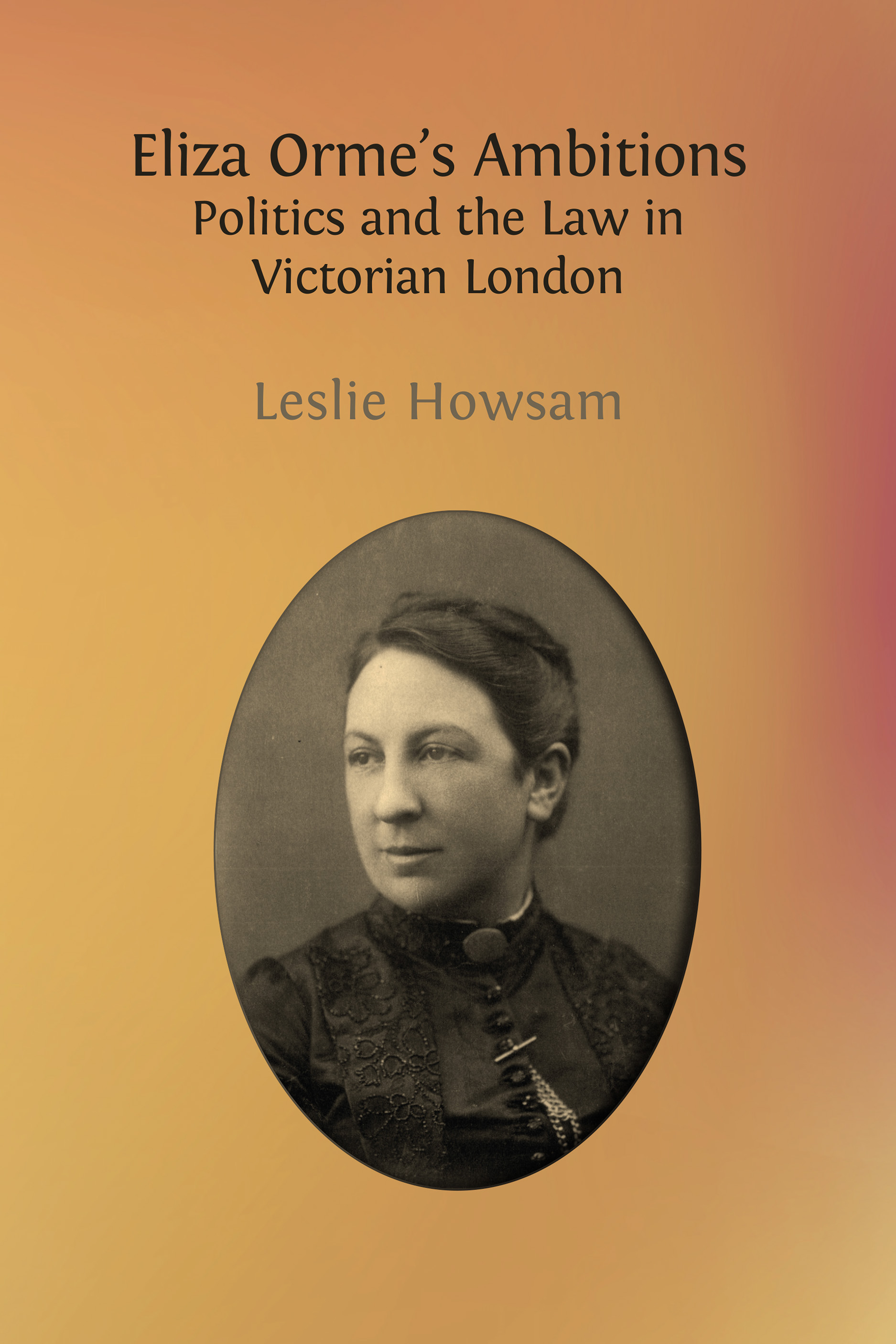
Eliza Orme’s Ambitions: Politics and the Law in Victorian London
- Leslie Howsam(author)
| Title | Eliza Orme’s Ambitions |
|---|---|
| Subtitle | Politics and the Law in Victorian London |
| Contributor | Leslie Howsam(author) |
| DOI | https://doi.org/10.11647/OBP.0392 |
| Landing page | https://www.openbookpublishers.com/books/10.11647/OBP.0392 |
| License | https://creativecommons.org/licenses/by-nc/4.0/ |
| Copyright | Leslie Howsam |
| Publisher | Open Book Publishers |
| Publication place | Cambridge, UK |
| Published on | 2024-03-08 |
| ISBN | 978-1-80511-233-4 (Paperback) |
| 978-1-80511-234-1 (Hardback) | |
| 978-1-80511-235-8 (PDF) | |
| 978-1-80511-238-9 (HTML) | |
| 978-1-80511-236-5 (EPUB) | |
| Short abstract | Why are some figures hidden from history? Eliza Orme, despite becoming the first woman in Britain to earn a university degree in Law in 1888, leading both a political organization and a labour investigation in 1892, and participating actively in the women’s suffrage movement into the early twentieth century, is one such figure. |
| Long abstract | Why are some figures hidden from history? Eliza Orme, despite becoming the first woman in Britain to earn a university degree in Law in 1888, leading both a political organization and a labour investigation in 1892, and participating actively in the women’s suffrage movement into the early twentieth century, is one such figure. Framed as a ‘research memoir’, Eliza Orme’s Ambitions fills out earlier scant accounts of this intriguing life, while speculating about why it has been overlooked. Established historian Leslie Howsam shapes the story around her own persistent curiosity in the context of a transformed research landscape, where important letters and explosive newspaper accounts have only recently come to light. These materials show how Orme’s career ambitions brought her into conflict with the male-dominated legal community of her time, while her political ambitions were cut short by disputes with other women activists whose notions of political strategy she repudiated. In public, Orme was a formidable debater for the causes she supported and against opponents whose strategies—even for women’s suffrage—she repudiated. In private, she was generous, warm, and witty, close to friends, family, and her female partner. Howsam’s account of uncovering Orme’s professional and personal trajectory will appeal to academic and non-academic readers interested in the progress and setbacks women experienced in the late-Victorian and Edwardian decades. |
| Print length | 176 pages (x+166) |
| Language | English (Original) |
| Dimensions | 156 x 13 x 234 mm | 6.14" x 0.51" x 9.21" (Paperback) |
| 156 x 16 x 234 mm | 6.14" x 0.63" x 9.21" (Hardback) | |
| Weight | 346g | 12.20oz (Paperback) |
| 518g | 18.27oz (Hardback) | |
| Media | 9 illustrations |
| OCLC Number | 1426006311 |
| LCCN | 2023446246 |
| THEMA |
|
| BIC |
|
| BISAC |
|
| LCC |
|
| Keywords |
|
Contents
Prologue
(pp. 1–8)- Leslie Howsam
(pp. 9–20)- An Unthinkable Job for a Woman
- Leslie Howsam
(pp. 21–36)- Before Law: 1848 to 1871
- Leslie Howsam
(pp. 37–54)- The Commitment to Law: 1872 to 1888
- Leslie Howsam
(pp. 55–80)- Private Life
- Leslie Howsam
(pp. 81–104)- Public Figure: 1888 to about 1903
- Leslie Howsam
(pp. 105–118)- Journalism and Authorship
- Leslie Howsam
(pp. 119–128)- Last years
- Leslie Howsam
(pp. 129–146)- Who was Eliza Orme?
- Leslie Howsam
Contributors
Leslie Howsam
(author)Leslie Howsam is a Fellow of the Royal Society of Canada and Emerita Distinguished University Professor at the University of Windsor (as well as Senior Research Fellow in the Centre for Digital Humanities at Toronto Metropolitan University). Her most recent book is the Cambridge Companion to the History of the Book (2015); her best-known book is Old Books & New Histories: An Orientation to Studies in Book and Print Culture (2006). For further information please see https://lesliehowsam.ca(opens in new tab)
References
- Letters to Samuel Alexander. Alexander Papers, John Rylands Library, University of Manchester. Eighteen letters dated 1886 to 1916, some undated. GB133 ALEX/A/1/216.
- ‘University Degrees for Women’, The Examiner (16 May 1874), p. 508. Signed Eliza Orme.
- ‘A Group of Liberal Dames’, British Weekly, 3 March 1892. Reprinted in Women’s Gazette and Weekly News, 12 April 1892. Anonymous, but possibly attributable to William Robertson Nicoll.
- Letter to Susan B. Anthony, 26 February 1884. Published in National Woman Suffrage Association. Report of the Sixteenth Annual Washington Convention, March 1884. Library of Congress. https://tile.loc.gov/storage-services/service/rbc/rbnawsa/n8341/n8341.pdf
- Letter to Clara Collet about Edith Gissing. 29 December 1897. Reproduced in Pierre Coustillas, The Heroic Life of George Gissing. Vol. 3, 2014: p. 48.
- Letters to Talfourd Ely responding to Pascoe Daphne’s protest, 9 and 11 January 1877. University College London Library Special Collections. File includes also letters from Pascoe Daphne to Sheldon Amos and others, dated November-December 1876.
- Letter to Richard Garnett, 19 May 1873. Harry Ransom Center, University of Texas at Austin.
- Letter to William Stanley Jevons, 14 March 1881, informing him of an error in his Elementary Lessons in Logic. Jevons Family Papers, John Rylands Library, University of Manchester. GB133 JA/6/1.
- Letter to Miss Ridley, 18 September 1874. London School of Economics. Women’s Library Archive. Autograph Letter Collection: Female Education. Seeking recommendation of a school with instruction of an advanced kind. This is presumably Annie E. Ridley (1839–1923, novelist and school administrator). GB 106 9/04/18.
- Letters to Harriet Taylor, and drafts of Taylor’s replies. Mill-Taylor collection. London School of Economics Library, British Library of Political and Economic Science. Nineteen letters dated 1872–1875.
- Letter to the Editor, Women’s Gazette & Weekly News, headed ‘The Ethics of Public Life’, signed EO (30 November 1889; continued the following week).
- Letter to the Editor, Pall Mall Gazette, signed as Editor of WGWN, concerning Dilke (24 November 1891).
- Letter from the Editor, WGWN (i.e. E. Orme), 7 December 1891, referring to WGWN policy with respect to publishing comment from the ‘progressive’ faction.
- Letter to the Editor, WGWN, 12 April 1892, satirizing Nora Philipps’s article in the Welsh Review and recommending Jevons’s Elements of Logic to recognize a fallacy.
- Letter to the Editor, WGWN, 30 August, 1892, concerning the dispute within the Women’s Liberal Federation.
- ‘University Degrees for Women’, The Examiner (4 July 1874), pp. 707–08. Signed E.O.
- ‘Sound Minded Women’, The Examiner (1 August 1874), pp. 820–21. Signed E.O.
- ‘Song’, The Examiner (31 July 1875), p.13. Signed E.O. Poem.
- ‘Women in College’, One and All: A Journal for Everybody (September 1880). I have not seen this item, which has apparently not been digitized. Advertised in the Weekly Dispatch on 19 September. This may be the ‘obnoxious article’ referred to by Eliza Savage in her 21 September letter to Samuel Butler (although that may also refer to ‘A New Club for Women’ published anonymously in the same newspaper in August 1880, except that it contains nothing particularly obnoxious).
- ‘Matilda Chaplin Ayrton, MD’, Englishwoman’s Review (15 August 1883), p. 343.
- ‘Jeanette Wilkinson’, Englishwoman’s Review (15 September 1886), p. 385.
- ‘Women’s Work in Creation. A Reply’, Longman’s Magazine (December 1886), pp. 149–158.
- Index to Savill Vaizey, A Treatise on the Law of Settlements of Property, Made Upon Marriage and Other Occasions. 2 volumes. (London: H. Sweet and Co., et al, 1887).
- Various leading articles, Weekly Dispatch. Possibly 1887–1892, the period coinciding with W. A. Hunter’s editorship of that newspaper.
- Various editorials, Women’s Gazette and Weekly News. From 7 September 1889 to 7 March 1892, Orme served as Editor of the weekly newspaper (which later appeared monthly). Regular editorials/leaders were published anonymously and cannot be identified with precision. Identifiable articles and letters are cited below.
- ‘Parted’, Women’s Gazette and Weekly News (26 July 1890). Unsigned poem; text almost identical to ‘Song’ in 1875 Examiner.
- ‘A Clear Issue’, Women’s Gazette and Weekly News (15 June 1891). Supplement to WGWN, signed essay on Women’s Liberal Federation politics.
- ‘Women as Politicians’, East Anglian Daily Times (12 February 1892). Part of a series by several ‘Representative Women on Questions Social and Political’.
- ‘A Commonplace Correction’, Welsh Review (March 1892). Reply to Nora Philipps’s article with respect to Women’s Liberal Federation’s suffrage policy (‘The Problem of the Nineteenth Century’).
- ‘On the Condition of Women in the Nail, Chain and Bolt Making Industries in the Black Country’. Parliamentary Paper 36 (1892), Vol. II., Minutes of Evidence, Group A, pp. 569–75. See also 1895 report listed below.
- The Employment of Women. Reports by Miss Eliza Orme, Miss Clara E. Collet, Miss May E. Abraham, and Miss Margaret H. Irwin (Lady Assistant Commissioners) on the Conditions of Work in Various Industries in England, Wales, Scotland, and Ireland. (London: Eyre and Spottiswoode, 1893).
- ‘The Legal Status of Women in England’, The Albany Law Journal (19 August 1893), p. 8.
- ‘The Employment of Women. Report by Eliza Orme (Senior Assistant Commissioner) on the Condition of Women in the Nail, Chain, and Bolt Making Industries in the “Black Country”.’ Minutes of Evidence, with Appendices, Taken before Group ‘A’ of the Royal Commission on Labour (Volume II) Mining. Presented to both houses of Parliament, June 1892, pp. 569–75. Published 1895.
- The Trial of Shama Charan Pal: An Illustration of Village Life in Bengal (London: Lawrence & Bullen, 1897). https://archive.org/details/in.ernet.dli.2015.283821/page/n5/mode/2up
- ‘How Poor Ladies Live: A Reply’. Nineteenth Century (April 1897, vol. 41, no. 242).
- ‘Sketch of Lady Fry’. British Weekly (May 1897); reprinted in other papers.
- Lady Fry of Darlington (London: Hodder & Stoughton, 1898). https://archive.org/details/ladyfrydarlingt00ormegoog/mode/2up
- ‘ Our Female Criminals’. Fortnightly Review (May, 1898), pp. 790–96.
- ‘William Alexander Hunter’, Dictionary of National Biography. Supplement. Ed. Sidney Lee (London: Macmillan, 1901). https://doi.org/10.1093/ref:odnb/14236 (opens in new tab)
- ‘Samuel Plimsoll’, Dictionary of National Biography. Supplement. Ed. Sidney Lee (London: Macmillan, 1901). https://doi.org/10.1093/ref:odnb/22384. (opens in new tab)
- ‘Thomas Bayley Potter’, Dictionary of National Biography. Supplement. Ed. Sidney Lee (London: Macmillan, 1901). https://doi.org/10.1093/ref:odnb/22621 (opens in new tab)
- Howsam, Leslie, ‘Eliza Orme and the Women’s Gazette and Weekly News: Editing the Organ of a Fractious Federation, 1888–92’, Victorian Periodicals Review 55, 1 (Spring 2022), 100–124. https://doi.org/10.1353/vpr.2022.0004 (opens in new tab)
- ―, ‘Legal Paperwork & Public Policy in Late-Victorian Britain: Eliza Orme’s Professional Expertise’, in Precarious Professionals: Gender, Identities and Social Change in Modern Britain, ed. Heidi Egginton and Zoë Thomas (London: University of London Press, 2021), 107–24. This Open Access volume also contains an essay by Ren Pepitone about the masculine culture of the Inns of Court. https://www.sas.ac.uk/publications/precarious-professionals https://doi.org/10.14296/202110.9781912702633 (opens in new tab)
- ―, ‘Eliza Orme, 1848–1937’, The Dictionary of National Biography Missing Persons, ed. C. S. Nicholls (Oxford: Oxford University Press, 1993), 505–06. Updated and expanded in subsequent online editions of the Oxford Dictionary of National Biography. https://doi.org/10.1093/ref:odnb/37825 (opens in new tab)
- ―, ‘“Sound-Minded Women:” Eliza Orme and the Study and Practice of Law in Late-Victorian England’, Atlantis: A Women’s Studies Journal 15, 1 (1989), 44–55. https://journals.msvu.ca/index.php/atlantis/article/view/5125/4323
- Mossman, Mary Jane, The First Women Lawyers: A Comparative Study of Gender, Law and the Legal Professions (Oxford: Hart Publishing, 2006). Chapter 3: ‘“Sound Women” and Legal Work: the First Women in Law in Britain’.
- ―, ‘Precedents, Patterns and Puzzles: Feminist Reflections on the First Women Lawyers’, Laws 5, 4 (2016), 1–17. https://doi.org/10.3390/laws5040039 (opens in new tab)
- Robson, Ann. ‘Legal Proof of [John Stuart Mill’s] Dissertations and Discussions’, Mill News Letter (Summer 1976), pp. 22–25. https://www.ucl.ac.uk/bentham-project/sites/bentham_project/files/Mill011-2.pdf.