
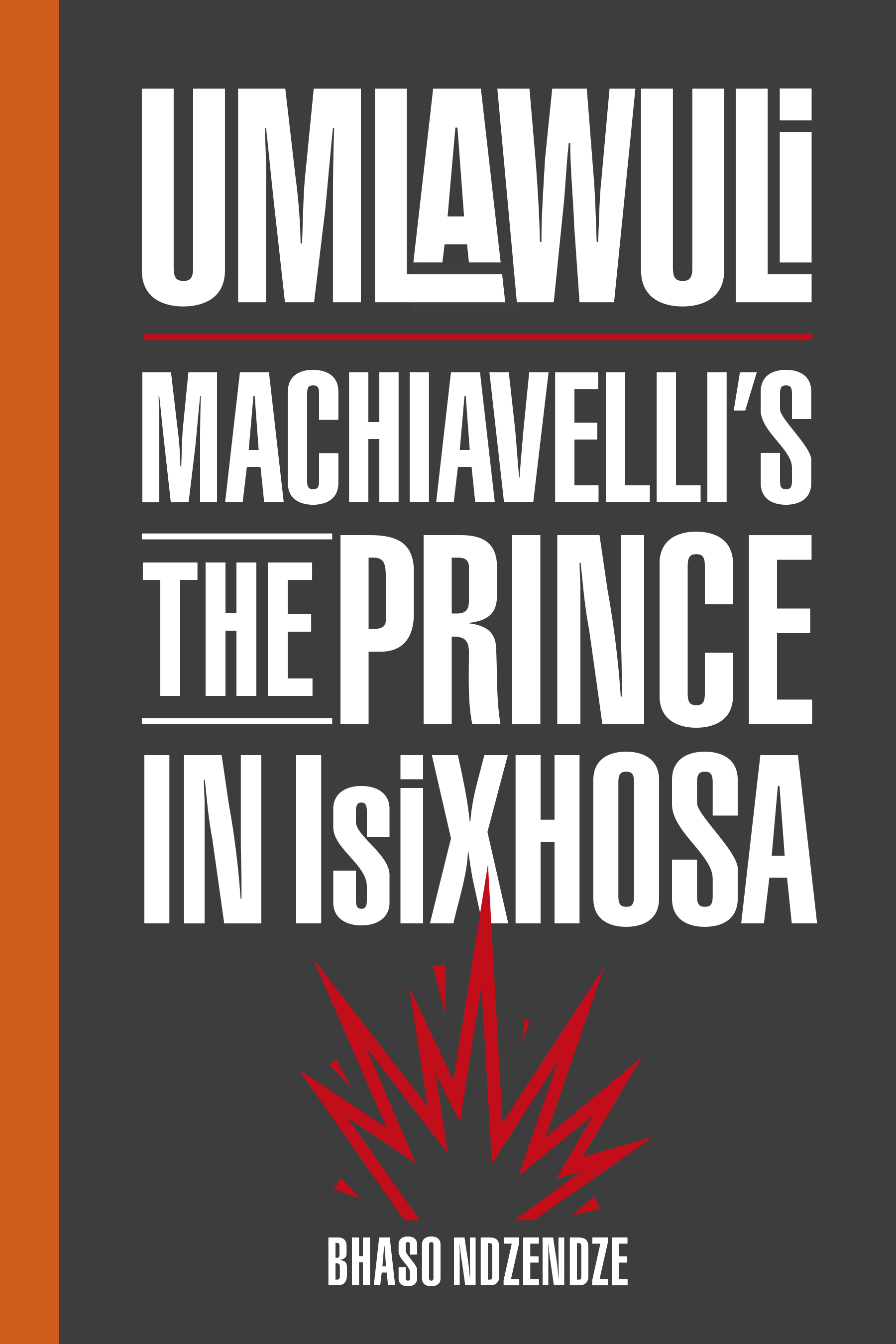
| Title | Umlawuli: Niccolò Machiavelli’s The Prince in IsiXhosa |
|---|---|
| Contributor | Bhaso Ndzendze(author) |
| DOI | https://doi.org/10.64449/9781991539397 |
| Landing page | https://ujonlinepress.uj.ac.za/index.php/ujp/catalog/book/177 |
| License | https://creativecommons.org/licenses/by/4.0/ |
| Copyright | Bhaso Ndzendze |
| Publisher | UJ Press |
| Published on | 2026-09-15 |
| ISBN | 978-1-991539-38-0 (Paperback) |
| 978-1-991539-39-7 (PDF) | |
| 978-1-991539-41-0 (XML) | |
| 978-1-991539-34-2 (EPUB) | |
| Long abstract | Ingaba kokuphi okungcono: ukuba umlawuli athandwe okanye oyikwe ngabo abaphetheyo?Zeziphi iindlela zokuphatha ezibangela ukuba abalawulayo bachithe okanye bongeze emandleni wabo?Niccolò Machiavelli’s The Prince is a classic text of political thought. First published in 1532, it has shaped the theory and practice of political behavior for nearly fi ve centuries. It has served as a guidebook for statesmen, tyrants, and revolutionaries alike. Machiavelli asks fundamental questions of rulership and off ers empirical, amoral answers based on his sweeping historical studies, fi rsthand experience, and observations of his contemporaries. He draws from military conquerors, politicians, diplomats, popes and others to determine, among others, whether it is better for a leader to be loved or feared, and what actions leaders take that retain, increase or diminish their power.Now published in IsiXhosa, for the fi rst time in an African language, under the title UMlawuli (‘The Ruler’), translator Bhaso Ndzendze unravels its lessons and continued relevance to a post-colonial and post-apartheid society ruled by elected politicians who must grapple with a changing geopolitical landscape in which adherence to international law and treaties is increasingly not guaranteed. |
| Print length | 254 pages (nulla+254+nulla) |
| Language | Xhosa (Original) |
| THEMA |
|
| BIC |
|
| BISAC |
|