
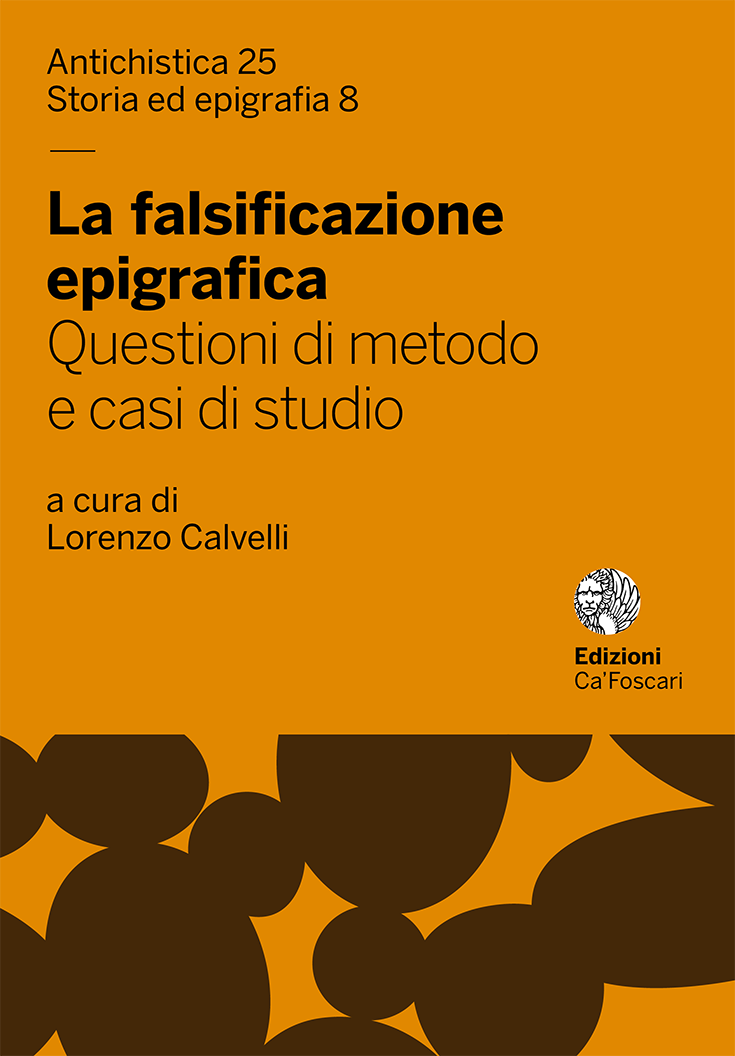
Epigraphic Falsification: Methods and Case Studies
- Lorenzo Calvelli(editor)
| Title | Epigraphic Falsification |
|---|---|
| Subtitle | Methods and Case Studies |
| Contributor | Lorenzo Calvelli(editor) |
| DOI | https://doi.org/10.30687/978-88-6969-386-1 |
| Landing page | https://edizionicafoscari.it/en/edizioni4/libri/978-88-6969-387-8/ |
| License | https://creativecommons.org/licenses/by/4.0/ |
| Copyright | Lorenzo Calvelli |
| Publisher | Edizioni Ca’ Foscari – Venice University Press |
| Publication place | Venice, Italy |
| Published on | 2019-12-16 |
| Series |
|
| ISBN | 978-88-6969-386-1 (Paperback) |
| 978-88-6969-386-1 (PDF) | |
| Short abstract | The book investigates the complex articulations of epigraphic forgery, a phenomenon widely attested in Italy between the late Middle Ages and the 18th century. Non-genuine inscriptions or falsae, as Theodor Mommsen called them, are those that present themselves as ancient, but in reality are not. They can be produced either on material support or simply on paper. Within them, different types of documents can be distinguished: forgeries made for malicious purposes, replicas of ancient inscriptions, and texts or monuments inspired by classical epigraphic models. The book brings together fifteen scholarly essays, which examine individual cases of forgery, reconstruct the epistemology of forgery criticism and rehabilitate numerous epigraphs mistakenly believed to be forgeries, while confirming their actual antiquity. |
| Long abstract | The book investigates the complex articulations of epigraphic forgery, a phenomenon widely attested in Italy between the late Middle Ages and the 18th century. Non-genuine inscriptions or falsae, as Theodor Mommsen called them, are those that present themselves as ancient, but in reality are not. They can be produced either on material support or simply on paper. Within them, different types of documents can be distinguished: forgeries made for malicious purposes, replicas of ancient inscriptions, and texts or monuments inspired by classical epigraphic models. The book brings together fifteen scholarly essays, which examine individual cases of forgery, reconstruct the epistemology of forgery criticism and rehabilitate numerous epigraphs mistakenly believed to be forgeries, while confirming their actual antiquity. |
| Print length | 312 pages |
| Language | Italian (Original) |
| THEMA |
|
| BISAC |
|
| Keywords |
|