
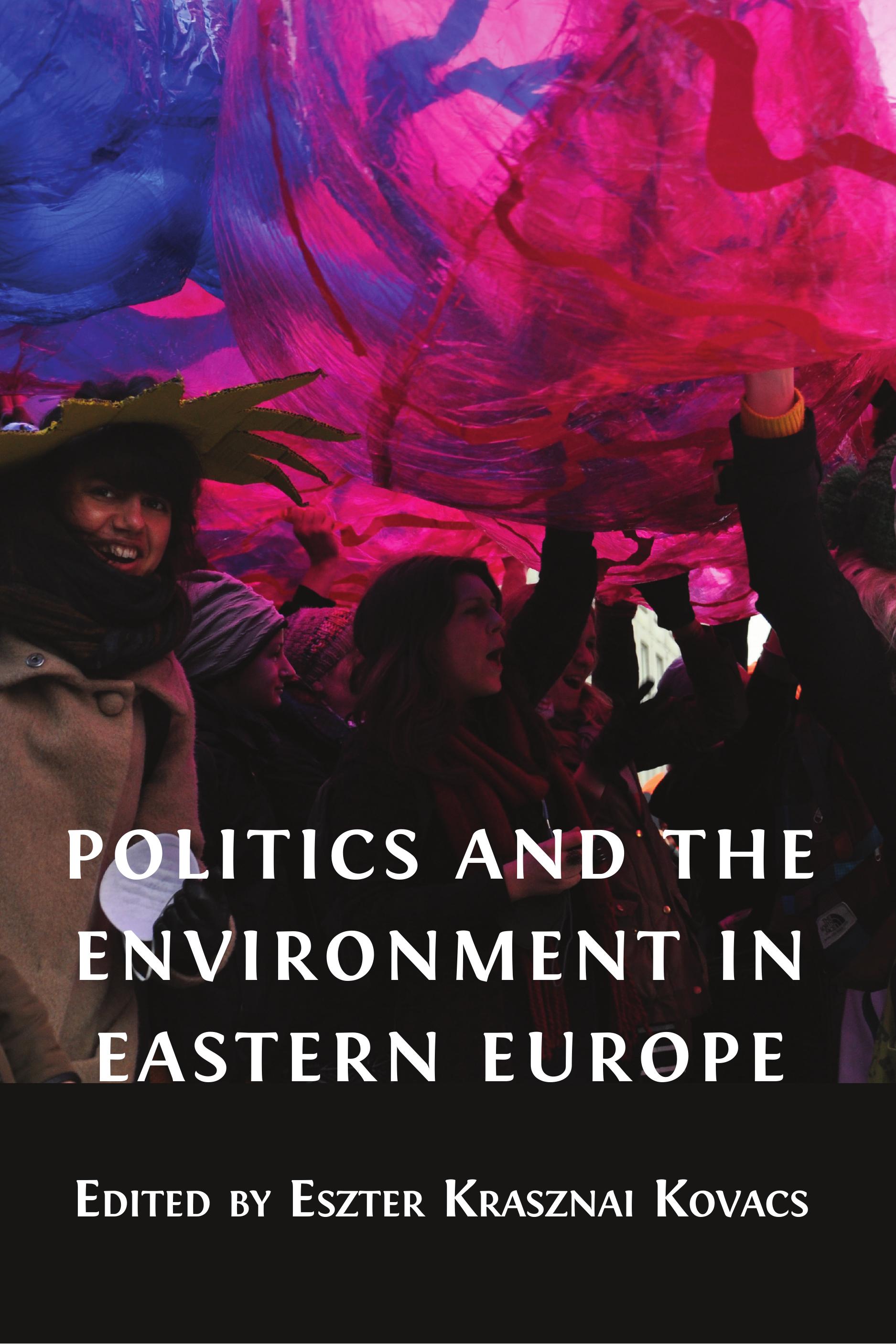
| Title | Politics and the Environment in Eastern Europe |
|---|---|
| Contributor | Eszter Krasznai Kovacs(editor) |
| DOI | https://doi.org/10.11647/OBP.0244 |
| Landing page | https://www.openbookpublishers.com/books/10.11647/obp.0244 |
| License | https://creativecommons.org/licenses/by/4.0/ |
| Copyright | Eszter Krasznai Kovacs |
| Publisher | Open Book Publishers |
| Publication place | Cambridge, UK |
| Published on | 2021-07-28 |
| ISBN | 978-1-80064-132-7 (Paperback) |
| 978-1-80064-133-4 (Hardback) | |
| 978-1-80064-134-1 (PDF) | |
| 978-1-80064-644-5 (HTML) | |
| 978-1-80064-137-2 (XML) | |
| 978-1-80064-135-8 (EPUB) | |
| 978-1-80064-136-5 (MOBI) | |
| Short abstract | This volume draws together essays by early-career academic researchers from across eastern Europe. |
| Long abstract | Europe remains divided between east and west, with differences caused and worsened by uneven economic and political development. Amid these divisions, the environment has become a key battleground. The condition and sustainability of environmental resources are interlinked with systems of governance and power, from local to EU levels. Key challenges in the eastern European region today include increasingly authoritarian forms of government that threaten the operations and very existence of civil society groups; the importation of locally-contested conservation and environmental programmes that were designed elsewhere; and a resurgence in cultural nationalism that prescribes and normalises exclusionary nation-building myths. This volume draws together essays by early-career academic researchers from across eastern Europe. Engaging with the critical tools of political ecology, its contributors provide a hitherto overlooked perspective on the current fate and reception of ‘environmentalism’ in the region. It asks how emergent forms of environmentalism have been received, how these movements and perspectives have redefined landscapes, and what the subtler effects of new regulatory regimes on communities and environment-dependent livelihoods have been. Arranged in three sections, with case studies from Czechia, Hungary, Lithuania, Poland, Romania and Serbia, this collection develops anthropological views on the processes and consequences of the politicisation of the environment. It is valuable reading for human geographers, social and cultural historians, political ecologists, social movement and government scholars, political scientists, and specialists on Europe and European Union politics. |
| Print length | 342 pages (xii+330) |
| Language | English (Original) |
| Dimensions | 156 x 24 x 234 mm | 6.14" x 0.93" x 9.21" (Paperback) |
| 156 x 27 x 234 mm | 6.14" x 1.06" x 9.21" (Hardback) | |
| Weight | 1433g | 50.55oz (Paperback) |
| 1827g | 64.45oz (Hardback) | |
| Media | 27 illustrations |
| OCLC Number | 1262131675 |
| LCCN | 2020447490 |
| BIC |
|
| BISAC |
|
| LCC |
|
| Keywords |
|
Contents
- Eszter Krasznai Kovacs
(pp. 25–52)- The Dismantling of Environmentalism in Hungary
- Eszter Krasznai Kovacs
- György Pataki
- Arnošt Novák
(pp. 73–96)- The Construction of Climate Justice Imaginaries through Resistance in the Czech Republic and Poland
- Mikulás Černìk
- Jana Hrckova
(pp. 121–140)- Far-right Grassroots Environmental Activism in Poland and the Blurry Lines of ‘Acceptable’ Environmentalisms
- Balsa Lubarda
- Alexandra Coțofană
- Imola Püsök
- George Iordăchescu
(pp. 211–234)- Domesticating the Taste of Place: Post-Socialist Terroir and Policy Landscapes in Tokaj, Hungary
- June Brawner
- Renata Blumberg
- Jovana Dikovic
(pp. 283–306)- Failure to Hive. A Co-narrated Story of a Failed Social Co-operative from the Hungarian Countryside
- Éva Mihalovics
- Zsüli Fehér
Concluding Thoughts
(pp. 307–314)- Eszter Krasznai Kovacs
- György Pataki
- Arnošt Novák
- Mikulás Černìk
- Jana Hrckova
- Balsa Lubarda
- Alexandra Coțofană
- Imola Püsök
- George Iordăchescu
- June Brawner
- Renata Blumberg
- Jovana Dikovic
- Éva Mihalovics
- Zsüli Fehér
Contributors
Eszter Krasznai Kovacs
(editor)Eszter Krasznai Kovács is a Lecturer in Environment, Society and Politics at University College London. Her research looks at how conservation and environmental management are thought about and realised between 'centres' and 'peripheries', such as between the urban and rural, the European west and east, the Global North and South. She has a particular interest in farming and food systems and agricultural policy's effects on biodiversity, water and farmers' livelihoods.