
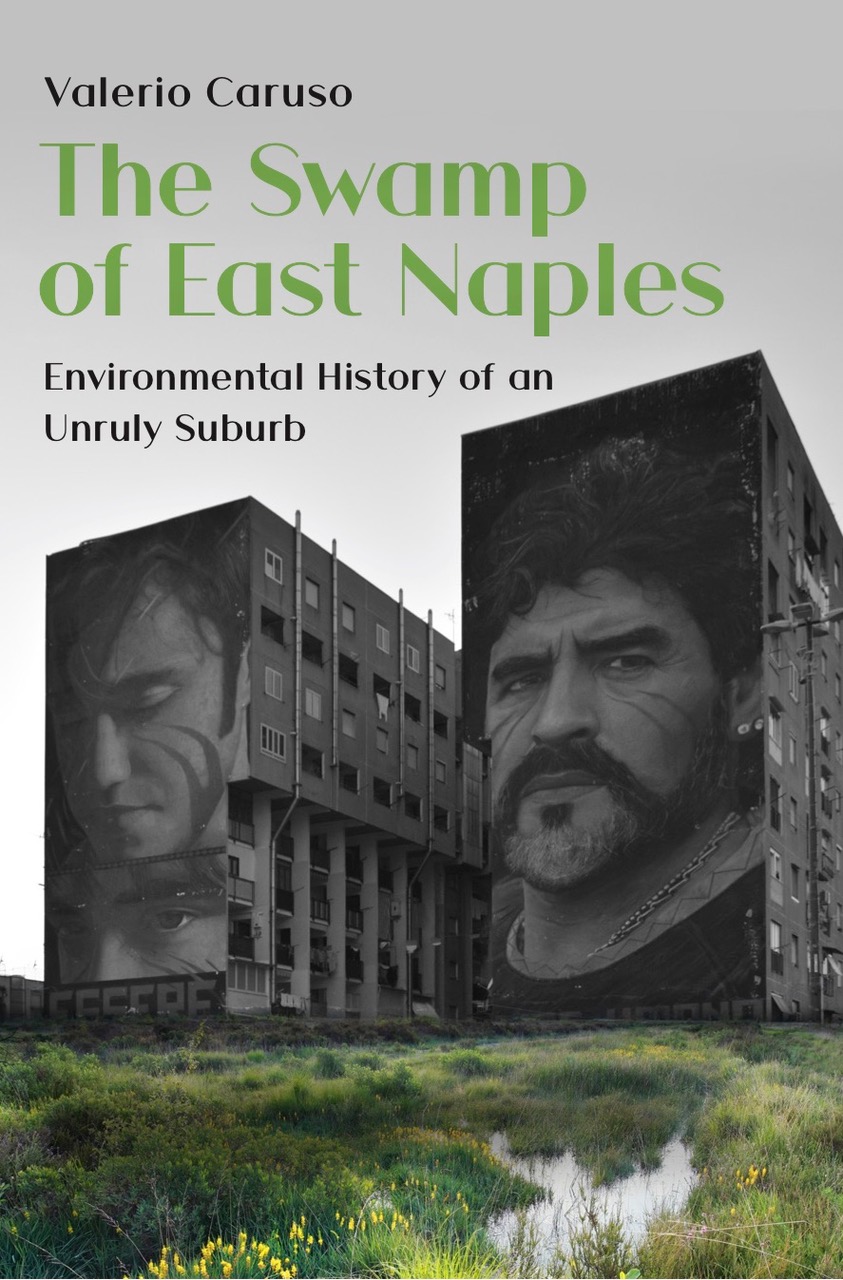
The Swamp of East Naples: Environmental History of an Unruly Suburb
- Valerio Caruso (author)
- Sara Ferraioli (translator)
| Title | The Swamp of East Naples |
|---|---|
| Subtitle | Environmental History of an Unruly Suburb |
| Contributor | Valerio Caruso (author) |
| Sara Ferraioli (translator) | |
| Landing page | https://www.whpress.co.uk/publications/2021/09/16/swamp/ |
| Copyright | The White Horse Press |
| Publisher | The White Horse Press |
| Publication place | Winwick, UK |
| Published on | 2021-09-15 |
| ISBN | 978-1-912186-21-1 (Hardback) |
| 978-1-912186-28-0 (PDF) | |
| Short abstract | A case study with worldwide resonance, the book offers East Naples as emblematic of the deep environmental changes wrought on peripheral areas by processes of energy transitions, economic development and urbanisation. It interrogates modernity’s distinctive global processes of industrialisation and deindustrialisation as enacted on an ancient natural landscape – Naples’ former threshold of coastal and marshy ecosystems, now buried in the sedimentary accumulation of concrete, fumes and toxic chemicals unleashed by industrial and urban development. |
| Long abstract | East Naples’ contemporary history is not special, or unique: its processes shaped a mostly grey suburb nestled in the immediate vicinity of the great southern city, sharing its limits and feeding its needs. A case study with worldwide resonance, the book offers East Naples as emblematic of the deep environmental changes wrought on peripheral areas by processes of energy transitions, economic development and urbanisation. It interrogates modernity’s distinctive global processes of industrialisation and deindustrialisation as enacted on an ancient natural landscape – Naples’ former threshold of coastal and marshy ecosystems, now buried in the sedimentary accumulation of concrete, fumes and toxic chemicals unleashed by industrial and urban development. Caruso interrogates the human choices, the material context and the different perceptions of nature, health or production that led to these changes; and his book turns an environmentally-focused perspective on two of modernity’s distinctive global processes: industrialisation and deindustrialisation. The volume reconstructs the discursive and physical factors that created the East Naples ‘swamp’, from the late eighteenth century to the present, through its transition from actual swamp to metaphorical, an ambiguous space characterised by chaos and disorder, hostility and risks, but also resistance, dignity and hope. It is a story both local and global, of ‘hygienist’ thought, urbanisation, industrialisation and deindustrialisation, ecological risk and attempted regeneration. |
| Print length | 215 pages |
| Language | English (Translated into) |
| Dimensions | 152 x 229 mm | 5.98" x 9.02" (Hardback) |
| Media | 22 illustrations |
| BIC |
|
| BISAC |
|
| Keywords |
|
Contributors
Valerio Caruso
(author)Valerio Caruso studied late modern history and graduated in Historical Sciences at the University of Naples ‘Federico II’ in 2019. He studied contemporary environmental change and economic transformations as part of the deindustrialisation process in the eastern suburbs of Naples, through the lenses of urban planning, economic analysis and oral history. He has published essays on the subject of deindustrialisation in East Naples in Italian academic journals such as Meridiana. Rivista di Storia e Scienze Sociali and Italia Contemporanea; in the international journal Global Environment. A Journal of Transdisciplinary History; and in local newspapers. He is currently a Ph.D. student in Social and Political Change, enrolled in a partnership between the University of Turin and the University of Florence. His research interests comprise the analysis of urban environmental issues in the Mediterranean area, Middle East studies, oral history, industrial history and deindustrialisation studies.
Sara Ferraioli
(translator)Sara Ferraioli studied literature and foreign languages and graduated in art and urban studies at the University ‘L’Orientale’ of Naples. She works as an art educator in the eastern suburbs of Naples and as a teacher in a primary school. She’s also a freelance translator, specialising in architecture, art and urban planning.