
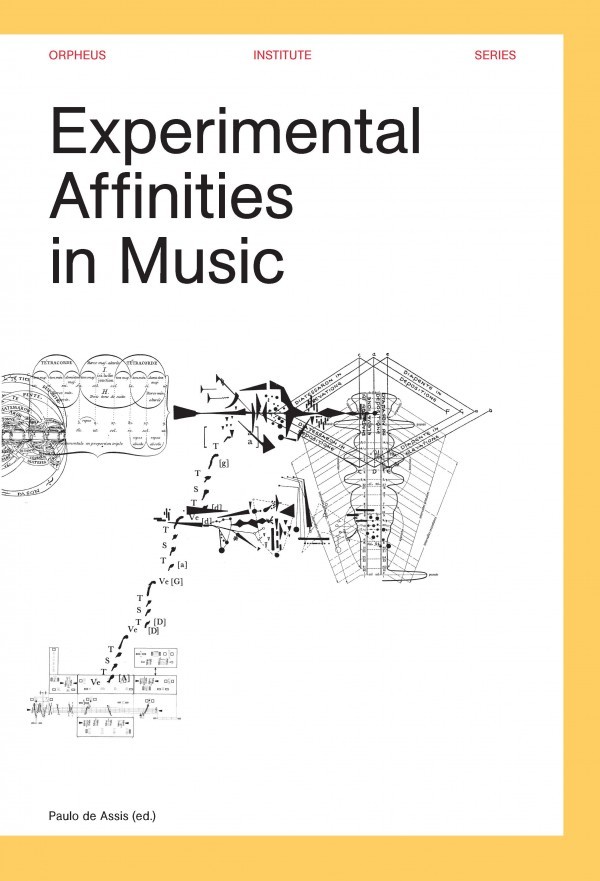
Experimental Affinities in Music
- Paulo de Assis (editor)
- Lydia Goehr (contributions by)
- Felix Diergarten (contributions by)
- Martin Kirnbauer (contributions by)
- Helmut Lachenmann (contributions by)
- Mark Lindley (contributions by)
- Edward Wickham (contributions by)
- Lawrence Kramer (contributions by)
- Leon Fleisher (contributions by)
- Hermann Danuser (contributions by)
- Thomas Christensen (contributions by)
- Luk Vaes (contributions by)
- Frederic Rzewski (contributions by)
| Title | Experimental Affinities in Music |
|---|---|
| Contributor | Paulo de Assis (editor) |
| Lydia Goehr (contributions by) | |
| Felix Diergarten (contributions by) | |
| Martin Kirnbauer (contributions by) | |
| Helmut Lachenmann (contributions by) | |
| Mark Lindley (contributions by) | |
| Edward Wickham (contributions by) | |
| Lawrence Kramer (contributions by) | |
| Leon Fleisher (contributions by) | |
| Hermann Danuser (contributions by) | |
| Thomas Christensen (contributions by) | |
| Luk Vaes (contributions by) | |
| Frederic Rzewski (contributions by) | |
| DOI | https://doi.org/10.11116/9789461661883 |
| Landing page | https://lup.be/book/experimental-affinities-in-music/ |
| License | https://creativecommons.org/licenses/by-nc-nd/4.0/ |
| Publisher | Leuven University Press |
| Publication place | Leuven, BE |
| Published on | 2015-12-17 |
| Series |
|
| ISBN | 978-94-6270-061-1 (Paperback) |
| 978-94-6166-188-3 (PDF) | |
| Long abstract | Exploring experimental attitudes in music Experimental Affinities in Music brings together diverse artistic, musicological, historical, and philosophical essays, enhancing a broad discourse on artistic experimentation, and exploring various experimental attitudes in music composed between the thirteenth and twentieth centuries. The golden thread running through the different chapters is the quest for inherently experimental musical practices, a quest pursued from interrogating, descriptive, or challenging perspectives, and always in relation to concrete music examples. Experimental is taken as an adventurous compositional, interpretive, or performative attitude that can cut across different ages and styles. Affinitiessuggest connectors and connections, convergences, contiguities, and adjacencies that are found in and through a diversity of approaches and topics. The texts share a common genesis: the lectures of the International Orpheus Academies for Music and Theory convened by Luk Vaes (2011) and Paulo de Assis (2012, 2013). The affinities found in this volume include essays by Lydia Goehr, Felix Diergarten, Mark Lindley, Martin Kirnbauer, Edward Wickham, Lawrence Kramer, Hermann Danuser, and Thomas Christensen, as well as interviews with pianist Leon Fleisher, with pianist-composer Frederic Rzewski, and with composer Helmut Lachenmann. Ebook available in Open Access. This publication is GPRC-labeled (Guaranteed Peer-Reviewed Content). Contributors Paulo de Assis (Orpheus Institute, Ghent), Thomas Christensen (University of Chicago), Hermann Danuser (Humboldt University), Felix Diergarten (Schola Cantorum Basiliensis), Leon Fleisher (pianist), Lydia Goehr (Columbia University), Martin Kirnbauer (University of Basel), Lawrence Kramer (Fordham University), Helmut Lachenmann (composer), Mark Lindley (University of Hyderabad), Frederic Rzewski (pianist-composer), Luk Vaes (Orpheus Institute, Ghent), Edward Wickham (St Catharine’s College, Cambridge) |
| Print length | 252 pages |
| Language | English (Original) |
| THEMA |
|
| BIC |
|
| BISAC |
|
| Funding |
Contributors
Paulo de Assis
(editor)Paulo de Assis is artist researcher (pianist, composer, music philosopher) and research fellow at the Orpheus Institute.
Lydia Goehr
(contributions by)Felix Diergarten
(contributions by)Martin Kirnbauer
(contributions by)Helmut Lachenmann
(contributions by)Mark Lindley
(contributions by)Edward Wickham
(contributions by)Lawrence Kramer
(contributions by)Leon Fleisher
(contributions by)Hermann Danuser
(contributions by)Thomas Christensen
(contributions by)Thomas Christensen** **is Professor of Music and the Humanities at the University of Chicago.