
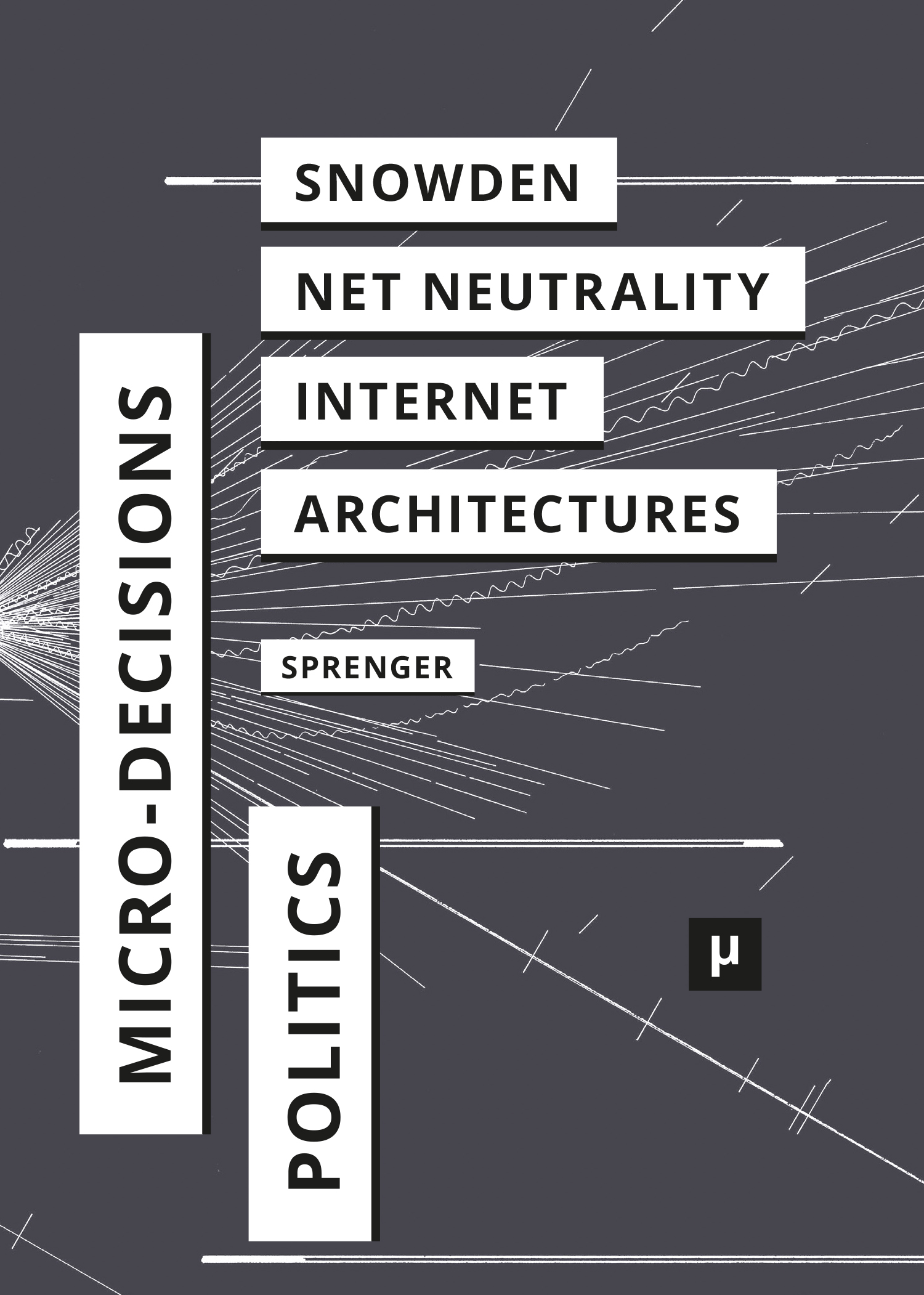
The Politics of Micro-Decisions: Edward Snowden, Net Neutrality, and the Architectures of the Internet
- Florian Sprenger(author)
- Christopher Kelty(foreword by)
- Valentine A. Pakis (translator)
| Title | The Politics of Micro-Decisions |
|---|---|
| Subtitle | Edward Snowden, Net Neutrality, and the Architectures of the Internet |
| Contributor | Florian Sprenger(author) |
| DOI | https://doi.org/10.14619/005 |
| Landing page | https://meson.press/books/the-politics-of-micro-decisions/ |
| License | https://creativecommons.org/licenses/by-sa/4.0/ |
| Copyright | Florian Sprenger |
| Publisher | meson press |
| Publication place | Lüneburg |
| Published on | 2015-06-18 |
| Series |
|
| ISBN | 978-3-95796-040-5 (Paperback) |
| 978-3-95796-041-2 (PDF) | |
| 978-3-95796-042-9 (EPUB) | |
| Short abstract | Be it in the case of opening a website, sending an email, or high-frequency trading, bits and bytes of information have to cross numerous nodes at which micro-decisions are made. These decisions concern the most efficient path through the network, the processing speed, or the priority of incoming data packets. Despite their multifaceted nature, micro-decisions are a dimension of control and surveillance in the twenty-first century that has received little critical attention. They represent the smallest unit and the technical precondition of a contemporary network politics – and of our potential opposition to it. The current debates regarding net neutrality and Edward Snowden’s revelation of NSA surveillance are only the tip of the iceberg. What is at stake is nothing less than the future of the Internet as we know it. |
| Long abstract | Be it in the case of opening a website, sending an email, or high-frequency trading, bits and bytes of information have to cross numerous nodes at which micro-decisions are made. These decisions concern the most efficient path through the network, the processing speed, or the priority of incoming data packets. Despite their multifaceted nature, micro-decisions are a dimension of control and surveillance in the twenty-first century that has received little critical attention. They represent the smallest unit and the technical precondition of a contemporary network politics – and of our potential opposition to it. The current debates regarding net neutrality and Edward Snowden’s revelation of NSA surveillance are only the tip of the iceberg. What is at stake is nothing less than the future of the Internet as we know it. |
| Print length | 128 pages |
| Language | English (Translated into) |
| Dimensions | 127 x 178 mm | 5" x 7.01" (Paperback) |
| THEMA |
|
| BIC |
|
| BISAC |
|
| LCC |
|
| Keywords |
|
| Funding |
|
| |
|
Contributors
Florian Sprenger
(author)Florian Sprenger is professor of virtual humanities at Ruhr-Universität Bochum. He is author of Politics of Micro-Decisions: Edward Snowden, Net Neutrality and the Architecture of the Internet (Meson Press, 2015). His research covers topics such as the history of artificial environments, media of immediacy, and the internet of things.
Christopher Kelty
(foreword by)Florian Sprenger is professor of virtual humanities at Ruhr-Universität Bochum. He is author of Politics of Micro-Decisions: Edward Snowden, Net Neutrality and the Architecture of the Internet (Meson Press, 2015). His research covers topics such as the history of artificial environments, media of immediacy, and the internet of things.