
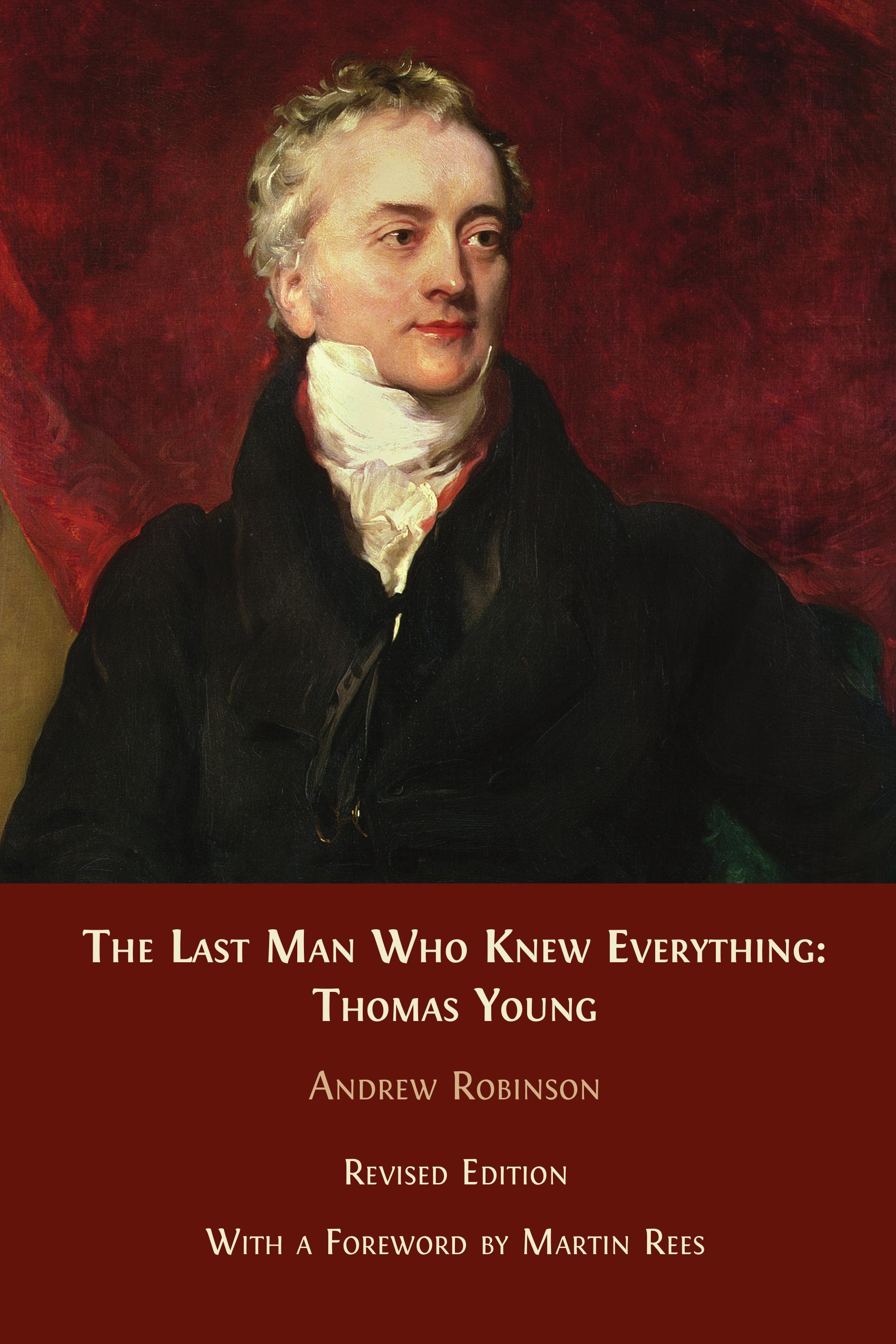
The Last Man Who Knew Everything: Thomas Young
- Andrew Robinson (author)
- Martin Rees (foreword by)
| Title | The Last Man Who Knew Everything |
|---|---|
| Subtitle | Thomas Young |
| Contributor | Andrew Robinson (author) |
| Martin Rees (foreword by) | |
| DOI | https://doi.org/10.11647/OBP.0344 |
| Landing page | https://www.openbookpublishers.com/books/10.11647/OBP.0344 |
| License | https://creativecommons.org/licenses/by-nc/4.0/ |
| Copyright | Andrew Robinson |
| Publisher | Open Book Publishers |
| Publication place | Cambridge, UK |
| Published on | 2023-05-09 |
| ISBN | 978-1-80511-018-7 (Paperback) |
| 978-1-80511-019-4 (Hardback) | |
| 978-1-80511-020-0 (PDF) | |
| 978-1-80511-024-8 (HTML) | |
| 978-1-80511-023-1 (XML) | |
| 978-1-80511-021-7 (EPUB) | |
| 978-1-80511-022-4 (AZW3) | |
| Short abstract | No one has given the polymath Thomas Young (1773-1829) the all-round examination he so richly deserves—until now. Celebrated biographer Andrew Robinson portrays a man who solved mystery after mystery in the face of ridicule and rejection, and never sought fame. |
| Long abstract | No one has given the polymath Thomas Young (1773–1829) the all-round examination he so richly deserves—until now. Celebrated biographer Andrew Robinson portrays a man who solved mystery after mystery in the face of ridicule and rejection, and never sought fame. As a physicist, Young challenged the theories of Isaac Newton and proved that light is a wave. As a physician, he showed how the eye focuses and proposed the three-colour theory of vision, only confirmed a century and a half later. As an Egyptologist, he made crucial contributions to deciphering the Rosetta Stone. It is hard to grasp how much Young knew. This biography is the fascinating story of a driven yet modest hero who cared less about what others thought of him than for the joys of an unbridled pursuit of knowledge—with a new foreword by Martin Rees and a new postscript discussing polymathy in the two centuries since the time of Young. It returns this neglected genius to his proper position in the pantheon of great scientific thinkers. |
| Print length | 296 pages (xxx+266) |
| Language | English (Original) |
| Dimensions | 156 x 20 x 234 mm | 6.14" x 0.79" x 9.21" (Paperback) |
| 156 x 24 x 234 mm | 6.14" x 0.94" x 9.21" (Hardback) | |
| Weight | 565g | 19.93oz (Paperback) |
| 742g | 26.17oz (Hardback) | |
| Media | 17 illustrations |
| OCLC Number | 1389616925 |
| LCCN | 2022361858 |
| BIC |
|
| BISAC |
|
| LCC |
|
| Keywords |
|
Contents
Foreword
(pp. ix–xiii)- Martin Rees
Preface
(pp. xv–xvi)- Andrew Robinson
Introduction
(pp. xvii–xxx)- Andrew Robinson
(pp. 1–18)- Child Prodigy
- Andrew Robinson
(pp. 19–27)- Fellow of the Royal Society
- Andrew Robinson
(pp. 29–43)- Itinerant Medical Student
- Andrew Robinson
(pp. 45–55)- ‘Phenomenon’ Young
- Andrew Robinson
(pp. 57–73)- Physician of Vision
- Andrew Robinson
(pp. 75–84)- Royal Institution Lecturer
- Andrew Robinson
(pp. 85–103)- Let There Be Light Waves
- Andrew Robinson
(pp. 105–122)- ‘Natural Philosophy and the Mechanical Arts’
- Andrew Robinson
(pp. 123–134)- Dr Thomas Young, M.D., F.R.C.P.
- Andrew Robinson
(pp. 135–156)- Reading the Rosetta Stone
- Andrew Robinson
(pp. 157–170)- Waves of Enlightenment
- Andrew Robinson
(pp. 171–180)- Walking Encyclopaedia
- Andrew Robinson
(pp. 181–192)- In the Public Interest
- Andrew Robinson
(pp. 193–199)- Grand Tour
- Andrew Robinson
(pp. 201–214)- Duelling with Champollion
- Andrew Robinson
(pp. 215–231)- A Universal Man
- Andrew Robinson
Postscript: Polymathy Then—and Now?
(pp. 233–241)- Andrew Robinson
Contributors
Andrew Robinson
(author)References
- Adkins, Lesley and Roy, The Keys of Egypt: The Race to Read the Hieroglyphs, London: HarperCollins, 2000
- Arago, Dominique-François, ‘Biographical memoir of Dr Thomas Young’, Edinburgh New Philosophical Journal, vol. 20 (Apr. 1836): 213–40
- Ahmed, Waqas, The Polymath: Unlocking the Power of Human Versatility, Hoboken: John Wiley, 2019
- Anderson, Verily, Friends and Relations: Three Centuries of Quaker Families, London: Hodder and Stoughton, 1980
- Andrews, Carol, The Rosetta Stone, London: British Museum Publications, 1981
- Andriesse, C. D., Huygens: The Man Behind the Principle, Cambridge, UK: Cambridge University Press, 2005
- Belzoni, Giovanni, Belzoni’s Travels: A Narrative of the Operations and Recent Discoveries in Egypt and Nubia, Alberto Siliotti ed., London: British Museum Press, 2001
- Bence Jones, Henry, The Royal Institution: Its Founders, and Its First Professors, London: Longmans, Green, 1871
- Boas, George, trans., The Hieroglyphics of Horapollo, Princeton: Princeton University Press, 1993
- Brodie, Benjamin, The Works of Sir Benjamin Collins Brodie, collected and arranged by Charles Hawkins, 3 vols, London: Longmans, 1865
- Buchwald, Jed Z., The Rise of the Wave Theory of Light: Optical Theory and Experiment in the Early Nineteenth Century, Chicago: University of Chicago Press, 1989
- Burke, Peter, The Polymath: A Cultural History from Leonardo da Vinci to Susan Sontag, New Haven and London: Yale University Press, 2020
- Chadwick, John, The Decipherment of Linear B, Cambridge, UK: Cambridge University Press, 1958
- Champollion, Jean-François, Egyptian Diaries: How One Man Solved the Mysteries of the Nile, London: Gibson Square Books, 2001
- Chapman, Allan, Mary Somerville and the World of Science, Bristol: Canopus, 2004
- Claiborne, Robert, The Birth of Writing, New York: Time-Life Books, 1974
- Dalzel, Andrew, History of the University of Edinburgh, from its Foundation: with a Memoir of the Author, Edinburgh: Edmonston and Douglas, 1862 (memoir of Dalzel by C. Innes)
- Duleep Singh, Frederick, Portraits in Norfolk Houses, Edmund Farrer ed., vol. 1, Norwich: Jarrold and Sons, 1928—gives details of the portrait of Thomas Young by Lawrence
- Einstein, Albert, Ideas and Opinions, Carl Seelig ed., New York: Three Rivers Press, 1982
- ― The New Quotable Einstein, Alice Calaprice ed., Princeton: Princeton University Press, 2005
- El-Daly, Okasha, Egyptology: The Missing Millennium: Ancient Egypt in Medieval Arabic Writings, London: UCL Press, 2005
- Feynman, Richard, Robert Leighton and Matthew Sands, The Feynman Lectures on Physics, vol. 1, Reading, US: Addison-Wesley, 1965
- Findlen, Paula, ed., Athanasius Kircher: The Last Man Who Knew Everything, London: Routledge, 2004
- Gardiner, Alan, The Egyptians: An Introduction, London: Folio Society, 1999 (originally published in 1961)
- Geikie, Archibald, Annals of the Royal Society Club; the record of a London dining-club in the eighteenth & nineteenth centuries, London: Macmillan, 1917
- Gillispie, Charles Coulston, Science and Polity in France: The Revolutionary and Napoleonic Years, Princeton: Princeton University Press, 2004
- Godfrey, Richard, James Gillray: The Art of Caricature, London: Tate Publishing, 2001
- Hahn, Roger, Pierre-Simon Laplace 1749–1827: A Determined Scientist, Cambridge, US: Harvard University Press, 2005
- Helmholtz, Hermann, Popular Lectures on Scientific Subjects, London: Longmans, Green, 1873
- Hetnarski, Richard B. and Józef Ignaczak, Mathematical Theory of Elasticity, London: Taylor and Francis, 2004
- Holmes, Richard, The Age of Wonder: How the Romantic Generation Discovered the Beauty and Terror of Science, London: HarperPress, 2008
- Hubel, David, Eye, Brain, and Vision, New York: Freeman (Scientific American Library), 1995
- James, Frank A. J. L., ed., ‘The Common Purposes of Life’: Science and Society at the Royal Institution of Great Britain, Aldershot: Ashgate, 2002
- Kaku, Michio, Einstein’s Cosmos: How Albert Einstein’s Vision Transformed Our Understanding of Space and Time, London: Weidenfeld and Nicolson, 2004
- Kipnis, Nahum, History of the Principle of Interference of Light, Basel: Birkhäuser, 1991
- Kline, Daniel Louis, Thomas Young, Forgotten Genius: An Annotated Narrative Biography, Cincinnati: Vidan Press, c. 1993
- Moore, Walter, Schrödinger: Life and Thought, Cambridge, UK: Cambridge University Press, 1989
- Moore, Wendy, The Knife Man: The Extraordinary Life and Times of John Hunter, Father of Modern Surgery, London: Bantam, 2005
- Murray, Alexander, ed., Sir William Jones 1746–94: A Commemoration, Oxford: Oxford University Press, 1998
- Newton, Isaac, Opticks, London: G. Bell and Sons, 4th edn, 1931 (with a foreword by Albert Einstein)
- Oldham, Frank, Thomas Young, F.R.S.: Philosopher and Physician, London: Edward Arnold, 1933
- Park, David, The Fire in the Eye: A Historical Essay on the Nature and Meaning of Light, Princeton: Princeton University Press, 1997
- Parkinson, Richard, Cracking Codes: The Rosetta Stone and Decipherment, London: British Museum Press, 1999
- ― The Rosetta Stone, London: British Museum Press, 2005
- Peacock, George, Life of Thomas Young, M.D., F.R.S., London: John Murray, 1855
- Pope, Maurice, The Story of Decipherment: From Egyptian Hieroglyphs to Maya Script, rev. edn, London: Thames and Hudson, 1999
- Porter, Roy, London: A Social History, London: Penguin, 1996
- ― The Greatest Benefit to Mankind: A Medical History of Humanity from Antiquity to the Present, London: HarperCollins, 1997
- ― Quacks: Fakers and Charlatans in Medicine, Stroud: Tempus, 2001
- Rayleigh, Lord (John William Strutt), Scientific Papers, 6 vols, Cambridge, UK: Cambridge University Press, 1899–1920
- Renfrew, Colin, Archaeology and Language: The Puzzle of Indo-European Origins, London: Cape, 1987
- Robinson, Andrew, The Story of Writing: Alphabets, Hieroglyphs and Pictograms, London: Thames & Hudson, 1995
- ― Lost Languages: The Enigma of the World’s Undeciphered Scripts, New York: McGraw-Hill, 2002
- ― The Man Who Deciphered Linear B: The Story of Michael Ventris, London: Thames & Hudson, 2002
- ― Writing and Script: A Very Short Introduction, Oxford: Oxford University Press, 2009
- ― Cracking the Egyptian Code: The Revolutionary Life of Jean-François Champollion, London: Thames & Hudson, 2012
- ― Einstein on the Run: How Britain Saved the World’s Greatest Scientist, New Haven and London: Yale University Press, 2019
- Sobel, Dava, Longitude: The True Story of a Lone Genius Who Solved the Greatest Scientific Problem of His Time, London: Fourth Estate, 1996
- Solé, Robert and Dominique Valbelle, The Rosetta Stone: The Story of the Decoding of Hieroglyphics, London: Profile, 2001
- Somerville, Martha, Personal Recollections from Early Life to Old Age of Mary Somerville, London: John Murray, 1873
- Strutt, Robert John, Life of John William Strutt, Third Baron Rayleigh, O.M., F.R.S., Madison: University of Wisconsin Press, 1968
- Wade, Nicholas J., A Natural History of Vision, Cambridge, US: MIT Press, 1998
- ― Perception and Illusion: Historical Perspectives, New York: Springer, 2005
- Westfall, Richard S., The Life of Isaac Newton, Cambridge, UK: Cambridge University Press, 1993
- Whewell, William, History of the Inductive Sciences, From the Earliest to the Present Time, vol. 2, 3rd edn, London: Frank Cass, 1967 (new impression, with index, of the 1857 edn)
- Wood, Alex, Thomas Young: Natural Philosopher 1773–1829, Cambridge, UK: Cambridge University Press, 1954 (completed by Frank Oldham)
- Young, Thomas, An Introduction to Medical Literature, Including a System of Practical Nosology, London: W. Phillips, 1813
- ― A Practical and Historical Treatise on Consumptive Diseases, London: Thomas Underwood and John Callow, 1815
- ― An Account of Some Recent Discoveries in Hieroglyphical Literature, and Egyptian Antiquities, London: John Murray, 1823
- ― Rudiments of an Egyptian Dictionary in the Ancient Enchorial Character, London: J. and A. Arch, 1831
- ― A Course of Lectures on Natural Philosophy and the Mechanical Arts, 4 vols, Bristol: Thoemmes, 2002 (with an introduction by Nicholas J. Wade)—facsimile reprint of the original two-volume edition published in London in 1807 by Joseph Johnson
- ― Miscellaneous Works of the Late Thomas Young, M.D., F.R.S., George Peacock ed. (vols 1 and 2) and John Leitch ed. (vol. 3), Bristol: Thoemmes, 2003—facsimile reprint of the original edition published in London in 1855 by John Murray
- Zajonc, Arthur, Catching the Light: The Entwined History of Light and Mind, London: Bantam, 1993
- NB: Some of the above works by Young are freely available at: https://archive.org
- Asimov, Isaac, ‘Thomas Young’, in Asimov’s Biographical Encyclopedia of Science and Technology, rev. edn, Garden City: Doubleday, 1972: 241–42
- Boycott, Brian B., ‘John Zachary Young’, Biographical Memoirs of Royal Society Fellows, London: Royal Society, 1998: 487–509
- Brooke, John and Geoffrey Cantor, ‘”A taste for philosophical pursuits”—Quakers in the Royal Society of London’, in Brooke and Cantor, Reconstructing Nature: The Engagement of Science and Religion, New York: Oxford University Press, 2000: 282–313
- [Brougham, Henry], review of three lectures by Thomas Young, Edinburgh Review, vol. 1 (Jan. 1803): 450–60, and vol. 5 (Oct. 1804): 97–103
- Cantor, Geoffrey, ‘The changing role of Young’s ether’, British Journal for the History of Science, vol. 5 (1970): 44–62
- ― ‘Thomas Young’s lectures at the Royal Institution’, Notes and Records of the Royal Society of London, vol. 25 (1970): 87–112
- ― ‘Henry Brougham and the Scottish methodological tradition’, Studies in the History and Philosophy of Science, vol. 2 (1971): 69–89
- ― ‘The reception of the wave theory of light in Britain: a case study illustrating the role of methodology in scientific debate’, Historical Studies in the Physical Sciences, vol. 6 (1975): 109–32
- ― ‘Thomas Young’, in Oxford Dictionary of National Biography, 60, Oxford: Oxford University Press, 2004–2005: 945–49
- Craik, Alex D. D., ‘James Ivory, F.R.S., mathematician: ‘the most unlucky person that ever existed’’, Notes and Records of the Royal Society of London, vol. 54 (2000): 223–47
- Fonda, Gerald, ‘Bicentenary of the birth of Thomas Young, M.D., F.R.S.’, British Journal of Ophthalmology, vol. 57 (1973): 803–08
- [Gurney, Hudson], ‘Memoir [of Young]’, in Thomas Young, Rudiments of an Egyptian Dictionary: 5–47
- Hilts, Victor L., ‘Thomas Young’s “Autobiographical sketch”’, Proceedings of the American Philosophical Society, vol. 122 (Aug. 1978): 248–60
- Kelland, Philip, ‘Preface by the editor’, in Thomas Young, A Course of Lectures on Natural Philosophy and the Mechanical Arts, 2nd edn, London: Taylor and Walton, 1845: iii–v
- Lancet, The, ‘Dr Young’, vol. 2 (23 May 1829): 255
- Larmor, Joseph, ‘Thomas Young’, Nature, vol. 133 (24 Feb. 1934): 276–79
- Lees, Charles Herbert, ‘Thomas Young’, in Dictionary of National Biography, Oxford: Oxford University Press, 1997: 1308–14 (entry originally published in 1900)
- Levene, John, ‘Sir George Biddell Airy, F.R.S. (1801–1892) and the discovery and correction of astigmatism’, Notes and Records of the Royal Society of London, vol. 21 (1966): 180–99
- Morse, Edgar W., ‘Thomas Young’, in Charles Coulston Gillispie ed., Dictionary of Scientific Biography, vol. 14, New York: Scribner, 1976: 562–72
- Oldham, Frank, ‘Thomas Young’, British Medical Journal, 19 Oct. 1974: 150–52
- Oyen, Michelle, ‘Thomas Young: polymath, bioengineer and interdisciplinary pioneer’, Emmanuel College Magazine, 2016–2017: 100–05
- Pettigrew, Thomas Joseph, ‘Thomas Young, M.D., F.R.S.’, in Pettigrew, Biographical Memoirs of the Most Celebrated Physicians, Surgeons, London: Whittaker, 1839: 1–24
- Rayleigh, Lord, ‘Commemoration lecture’, Journal of the Royal Institution, 1899–1902: 204–06
- Robinson, Andrew, ‘A polymath’s dilemma’, Nature, vol. 438 (17 Nov. 2005): 291
- ― ‘Thomas Young: physicist, physician and polymath’, Physics World, Mar. 2006: 30–33
- ― ‘Thomas Young: the man who knew everything’, History Today, Apr. 2006: 53–57
- ― ‘A clash of symbols’, Nature, vol. 483 (1 Mar. 2012): 27–28 [on Champollion and Young]
- ― ‘Polymathic pursuits’, The Author, Winter 2016: 133–35
- ― ‘A history of insatiable intellectuals’, Science, vol. 369 (28 Aug. 2020): 1064
- ― ‘Indian polymath’, British Museum Magazine, Winter 2021: 56 [on Satyajit Ray]
- Robinson, Herbert Spencer, ‘Thomas Young: a chronology and a bibliography with estimates of his work and character’, Medical Life, vol. 36 (1929): 527–40
- Rowell, H. S., ‘Thomas Young and Göttingen’, Nature, vol. 88 (15 Feb. 1912): 516
- Rubinowicz, A., ‘Thomas Young and the theory of diffraction’, Nature, vol. 180 (27 July 1957): 160–62
- Schaffer, Simon, ‘Paper and brass: the Lucasian professorship 1820–39’, in From Newton to Hawking: A History of Cambridge University’s Lucasian Professors of Mathematics, Kevin C. Knox and Richard Noakes eds, Cambridge UK: Cambridge University Press, 2003: 241–93
- Thomas, John Meurig, ‘Sir Benjamin Thompson, Count Rumford and the Royal Institution’, Notes and Records of the Royal Society of London, vol. 53 (1999): 11–25
- See also the website of the Thomas Young Centre, based in London: https://thomasyoungcentre.org