
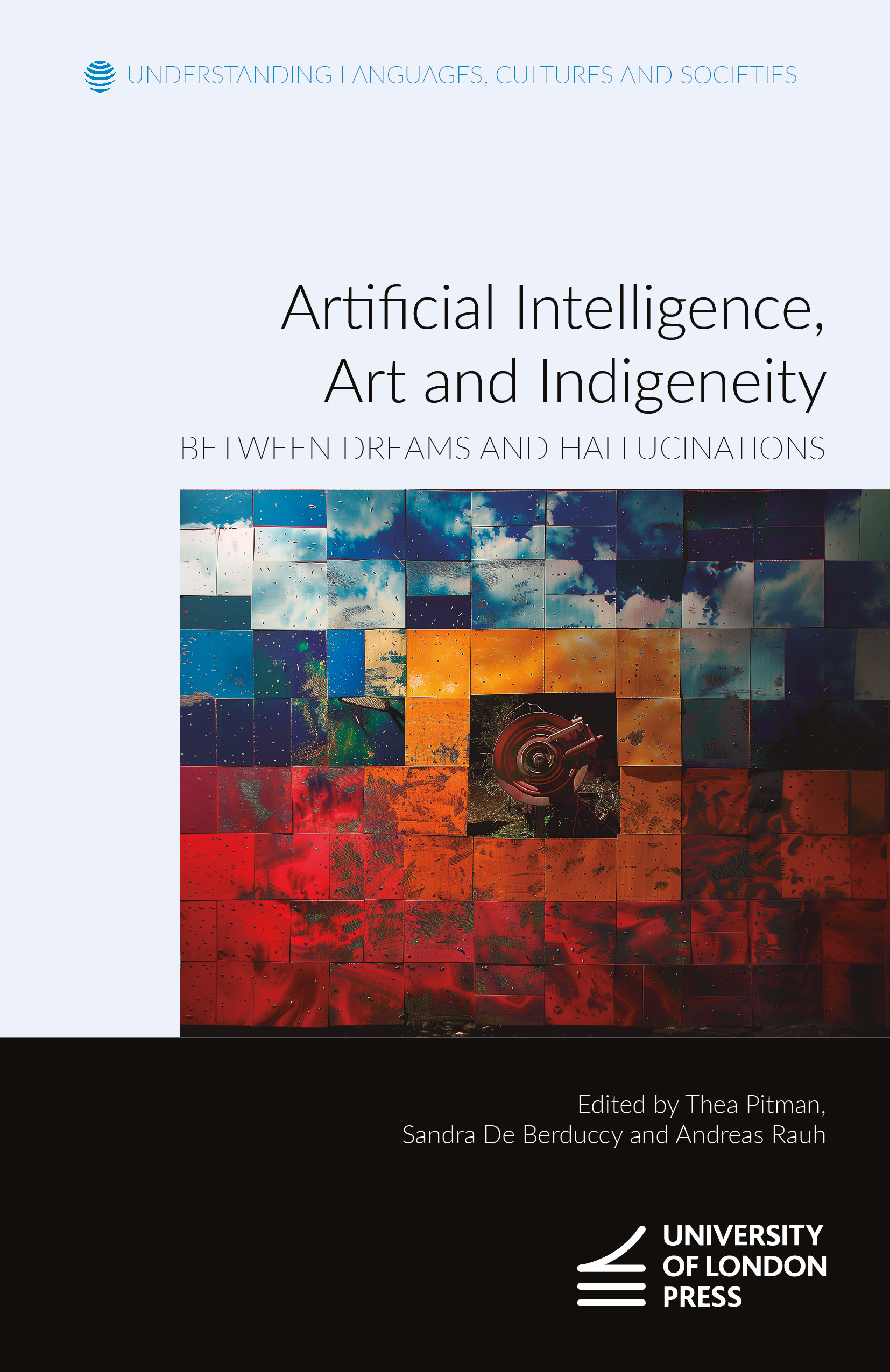
Artificial Intelligence, Art and Indigeneity: Between Dreams and Hallucinations
- Thea Pitman(editor)
- Sandra De Berduccy (editor)
- Andreas Rauh(editor)
| Title | Artificial Intelligence, Art and Indigeneity |
|---|---|
| Subtitle | Between Dreams and Hallucinations |
| Contributor | Thea Pitman(editor) |
| Sandra De Berduccy (editor) | |
| Andreas Rauh(editor) | |
| DOI | https://doi.org/10.63674/cjav6755 |
| Landing page | https://uolpress.co.uk/book/artificial-intelligence-art-and-indigeneity/ |
| License | https://creativecommons.org/licenses/by-nc-nd/4.0/ |
| Copyright | Authors |
| Publisher | University of London Press |
| Publication place | London |
| Published on | 2026-09-17 |
| Series |
|
| ISBN | 978-1-80716-001-2 (Paperback) |
| 978-1-80716-000-5 (Hardback) | |
| 978-1-80716-003-6 (PDF) | |
| Short abstract | This book explores the cultural and ethical implications of generative AI through the lens of Indigenous visual culture in Latin America. Responding to the rise of tools like DALL·E and Midjourney, it documents the AIAI project, which invited Indigenous artists and writers to critically engage with text-to-image technologies. |
| Long abstract | Artificial Intelligence, Art and Indigeneity explores the cultural and ethical implications of generative AI through the lens of Indigenous visual culture in Latin America. Responding to the rise of tools like DALL·E and Midjourney, this groundbreaking volume documents the AIAI project (2023–), which invited a group of Indigenous artists and writers from Argentina, Bolivia, Brazil, Chile and Peru to critically engage with image generation technologies. Through collaborative experimentation with a range of both commercial and bespoke tools, contributors reflect on the promises and pitfalls of AI—from its potential for ‘dreaming’, for imagining Indigenous futures, to the frustration of its ability to ‘hallucinate’, to distort and misrepresent Indigenous cultures. Bringing together artists, writers, and scholars, the book challenges dominant narratives around AI and representation, using a decolonial framework rooted in Indigenous epistemologies. Structured in three parts – context and theory, creative reflections, and generative critique – it foregrounds multivocal and multilingual perspectives, resisting homogenisation and reframing participatory research. This is the first book-length study of generative AI’s impact on Indigenous visual culture in Latin America, making a timely and vital contribution to global debates on AI, art, and cultural sovereignty. |
| Print length | 392 pages (nulla+392+nulla) |
| Language | English (Translated into) |
| Portuguese (Original) | |
| Spanish (Original) | |
| Dimensions | 140 x 216 mm | 5.5" x 8.5" (Paperback) |
| 144 x 220 mm | 5.6875" x 8.6875" (Hardback) | |
| Media | 49 illustrations |
| THEMA |
|
| BISAC |
|
| Keywords |
|
Contributors
Thea Pitman
(editor)Thea Pitman is Professor of Latin American Studies in the School of Languages, Cultures and Societies, University of Leeds. Her research focuses on Latin/x American digital cultural production, in particular Indigenous appropriations of digital technologies. Her publications include the co-edited anthology Latin American Cyberculture and Cyberliterature (LUP, 2007), and the monographs Latin American Identity in Online Cultural Production (Routledge, 2013) and Decolonising the Museum: The Curation of Indigenous Contemporary Art in Brazil (Tamesis, 2021).
Sandra De Berduccy
(editor)Sandra De Berduccy, also known as aruma, is an artist, researcher, and specialist in Andean textile weaving. She is currently studying for a PhD in the Interdisciplinary Humanities Doctoral Programme at the Universidad Finis Terrae, Chile, and is a lecturer in the master’s program in Art and Technology at the Escuela Politécnica del Litoral, Ecuador. Her artistic research explores Andean textile practices and their relationship with new media art.
Andreas Rauh
(editor)Andreas Rauh is Assistant Professor of Audio and Cultural Production in the School of Communications at Dublin City University. His research focuses on grassroots cultural production and digital technologies, particularly sonic design, music and the cultural industries, and generative AI, and has been published in a range of academic journals. He is also active as a musician and sound designer: projects include Sincronia Sonora (2019), with the Ymboré Indigenous community in Bahia, Brazil.