
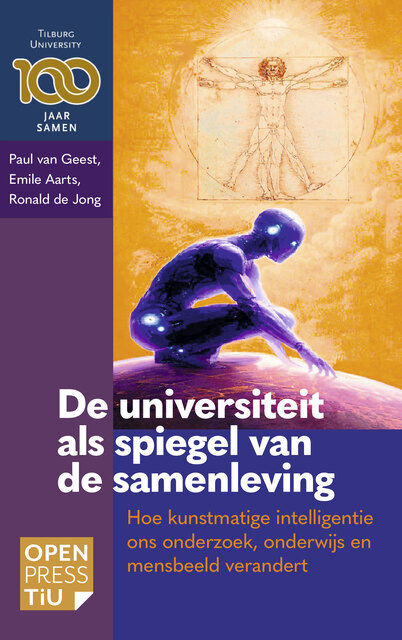
De universiteit als spiegel van de samenleving: Hoe kunstmatige intelligentie ons onderzoek, onderwijs en mensbeeld verandert
- Paul van Geest(author)
- Emile Aarts (author)
- Ronald de Jong (author)
| Title | De universiteit als spiegel van de samenleving |
|---|---|
| Subtitle | Hoe kunstmatige intelligentie ons onderzoek, onderwijs en mensbeeld verandert |
| Contributor | Paul van Geest(author) |
| Emile Aarts (author) | |
| Ronald de Jong (author) | |
| DOI | https://doi.org/10.56675/9789403874104 |
| Landing page | https://openpress.tilburguniversity.edu/projects/de-universiteit-als-spiegel-van-de-samenleving |
| License | https://creativecommons.org/licenses/by/4.0/ |
| Copyright | Paul van Geest, Emile Aarts, Ronald de Jong |
| Publisher | Open Press Tilburg University |
| Publication place | Tilburg, The Netherlands |
| Published on | 2026-06-01 |
| ISBN | 978-94-038-7410-4 (Paperback) |
| 978-94-038-7410-4 (PDF) | |
| 978-94-038-7410-4 (HTML) | |
| 978-94-038-7410-4 (EPUB) | |
| Short abstract | Paul van Geest, Emile Aarts, and Ronald de Jong examine how artificial intelligence affects education, research, governance, scientific integrity, and the university’s conception of the human being. |
| Long abstract | What will happen to the university when knowledge is no longer scarce, but ubiquitously available and even produced by machines? In The University as a Mirror of Society, Paul van Geest, Emile Aarts, and Ronald de Jong show how artificial intelligence reaches into the very heart of academia, thus impacting education, research, governance, and our understanding of what it means to be human. This book is a journey taking the reader from the medieval university to the contemporary campus, demonstrating how universities have continuously been challenged to respond to major societal shifts. However, the current AI revolution is different. AI is not merely a tool; it is transforming the very conditions under which knowledge is created, evaluated, and trusted. In doing so, it places the university’s traditional role as gatekeeper under increasing existential pressure.The authors provide a clear analysis of AI as a system technology and discuss its implications for scientific integrity, the transformation of academia, and the future of work at large. At the same time, they pose a fundamental question: how will AI-technologies shape our conception of humankind and how does this inflict the university as a space for reflection and critical inquiry? This book is a powerful plea for a university that strives not only to be faster and more efficient, but above all wiser, more careful, and more humane. |
| Print length | 238 pages (VIII+238+nulla) |
| Language | Dutch; Flemish (Original) |
| Dimensions | 135 x 215 mm | 5.31496062992126" x 8.46456692913386" (Paperback) |
| OCLC Number | 1592237953 |
| THEMA |
|
| Funding |
|