
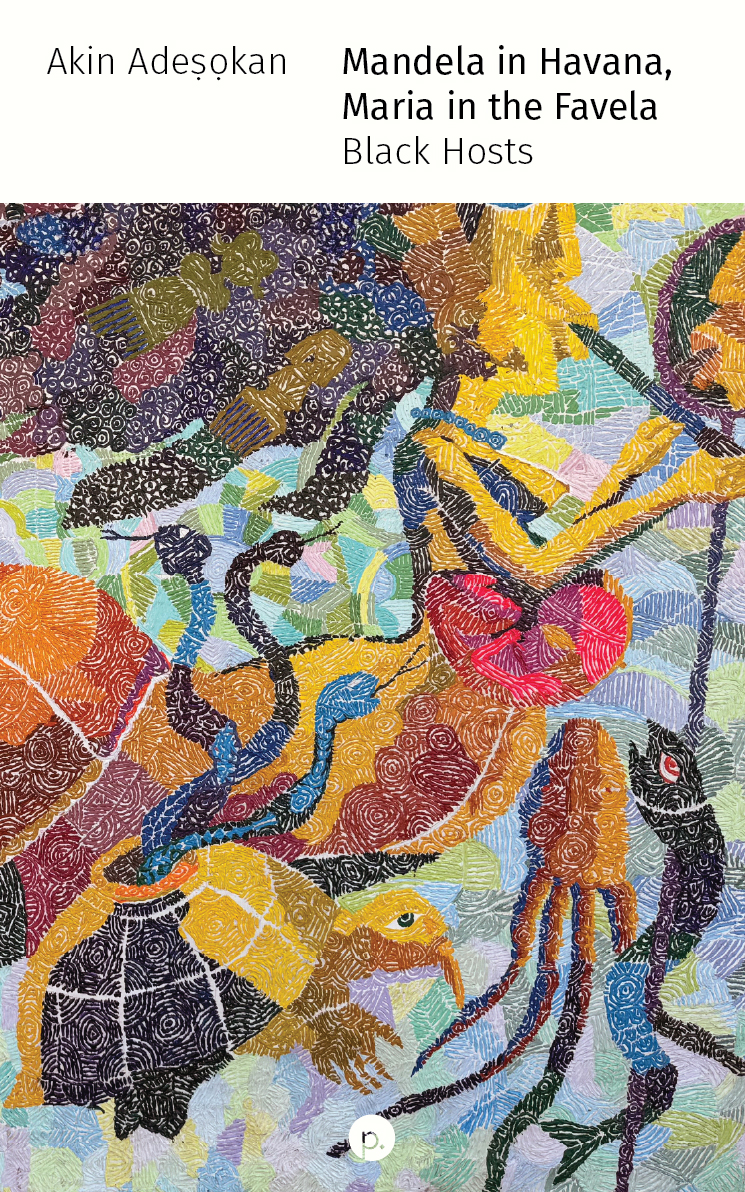
Mandela in Havana, Maria in the Favela: Black Hosts
- Akin Adeṣọkan (author)
| Title | Mandela in Havana, Maria in the Favela |
|---|---|
| Subtitle | Black Hosts |
| Contributor | Akin Adeṣọkan (author) |
| DOI | https://doi.org/10.53288/0568.1.00 |
| Landing page | https://punctumbooks.com/catalog/10.53288/0568.1.00 |
| License | https://creativecommons.org/licenses/by-nc-sa/4.0/ |
| Copyright | Akinwumi Adeṣọkan |
| Publisher | punctum books |
| Publication place | Earth, Milky Way |
| Published on | 2028-12-31 |
| ISBN | 978-1-68571-359-1 (Paperback) |
| 978-1-68571-360-7 (PDF) | |
| 978-1-68571-361-4 (EPUB) | |
| Long abstract | Why is Pan-Africanism, an intellectual idea which carried much political weight in the twentieth century, no longer of consequential interest to most Africans and Blacks in the world? Why is it that the ideas and individuals that tend to be popular about the African world do not often grapple with the complexity of said world? Even with the brilliance of Bessie Head’s revelations in Lesotho in the shadow of apartheid, the willfully imaginative poetic acts of Martinican Aimé Césaire, the astonishing military genius of revolutionary leader Amilcar Cabral of Guinea Bissau, and the self-flagellating howling sounds of Fẹla Anikulapo-Kuti’s music on the streets of Nigeria and beyond, why do rich experiences of global Blackness still struggle for active engagement in the plain light of routine reckoning? The essays in Mandela in Havana, Maria in the Favela: Black Hosts are an attempt to reflect on these questions, and many others like them. Anchored in two catalytic moments in the period following the Second World War—the Pan-African Congress in Manchester in 1945 and the founding in 1947 of the journal Présence Africaine—as well as the impact on contemporary Black selfhoods of the events they set in motion, the essays frame the subsequent events as opportunities for Black people, intellectuals especially, to become hosts to the world, in a manner that was impossible for them to do in the previous decades. The chapters look closely at trends that animated that history and, through selected profiles, offer exemplary analyses of the attendant changes. |
| Language | English (Original) |
| Dimensions | 127 x 203.2 mm | 5" x 8" (Paperback) |
| THEMA |
|
| BISAC |
|
| Keywords |
|
Contributors
Akin Adeṣọkan
(author)Akin Adeṣọkan is a novelist, scholar, professor of Comparative Literature and Cinema and Media Studies at Indiana University, Bloomington and the editor-in-chief of Black Camera. His books include Everything Is Sampled: Print and Digital Mediations in African Arts and Letters (Indiana University Press, 2023), Postcolonial Artists and Global Aesthetics (Indiana University Press, 2011), and the novels South Side and Roots in the Sky. He translated Ayé D’Ayé Òyìnbó, a classic Yoruba-language novel of colonialism, into English as The Age of White Rulers, and has also published on a range of topics and genres in journals as well as in numerous edited volumes.