
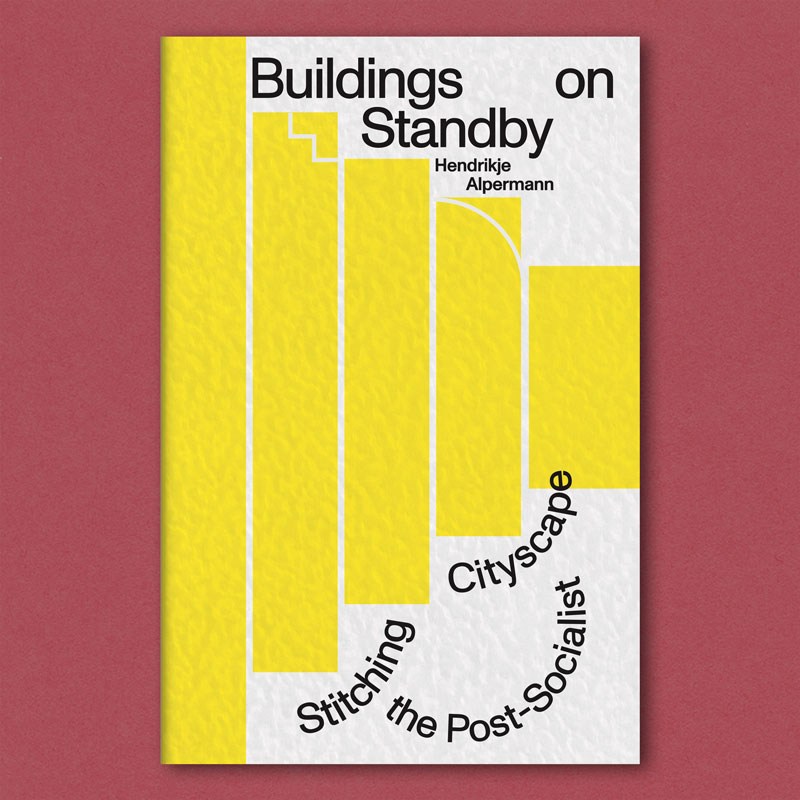
| Title | Buildings on Standby |
|---|---|
| Subtitle | Stitching the Post-Socialist Cityscape |
| Contributor | Hendrikje Alpermann(author) |
| DOI | https://doi.org/10.53198/9783691130003 |
| Landing page | https://adocs.de/de/buecher/raum/buildings-standby |
| License | https://creativecommons.org/licenses/by/4.0/ |
| Publisher | adocs |
| Publication place | Hamburg |
| Published on | 2026-03-18 |
| ISBN | 978-3-943253-96-2 (Paperback) |
| 978-3-69113-000-3 (PDF) | |
| Short abstract | Buildings on Standby describes the vacant high-rise buildings A–E in Halle-Neustadt as places of uncertain future, where the possibilities/impossibilities of urban planning after socialism are being negotiated. |
| Long abstract | Buildings on Standby describes the vacant high-rise buildings A–E in Halle-Neustadt as places of uncertain future, where the possibilities/impossibilities of urban planning after socialism are being negotiated. For more than 20 years, four of the five tower blocks have been vacant and remain on standby – in a state of future-oriented availability and a contested space between shutdown and reactivation. At the interface of actor-network theory and ethnographic urban research, the study examines this state in its temporal, material and political dimensions. It shows that buildings on standby cost a lot of energy, harbour risks and become a bargaining chip for trust and responsibility. The book opens up new perspectives on shrinking cities, interstitial spaces and urban transformation – in and beyond the post-socialist space. The text is accompanied by numerous architectural illustrations and a photo essay by Eiko Grimberg. |
| Print length | 272 pages (nulla+272+nulla) |
| Language | English (Original) |
| THEMA |
|
| BISAC |
|
| Funding |
Contributors
Hendrikje Alpermann
(author)Hendrikje Alpermann is an interdisciplinary urban researcher, curator and project coordinator. She studied ethnology in Leipzig, Halle (Saale) and Tbilisi, sociocultural studies with a focus on urban studies in Frankfurt (Oder) and Paris and completed her PhD at the University of Lausanne’s Institute of Geography and Sustainability. Her work explores architecture, everyday urban life and the temporalities and entanglements of the built environment, planning and society. Her research into demolition, regeneration and urban futures developed through her master’s thesis on demolition and new construction policies in Lyon and continued in eastern Germany, shaped by her work at the Leibniz Institute for Research on Society and Space in Erkner and her biographical background. Alongside her academic work, she has held coordinating and administrative positions, was a fellow of the Schader Foundation in Darmstadt and co-curated the transdisciplinary festival wohn_komplex to celebrate the 60th anniversary of Halle-Neustadt.