
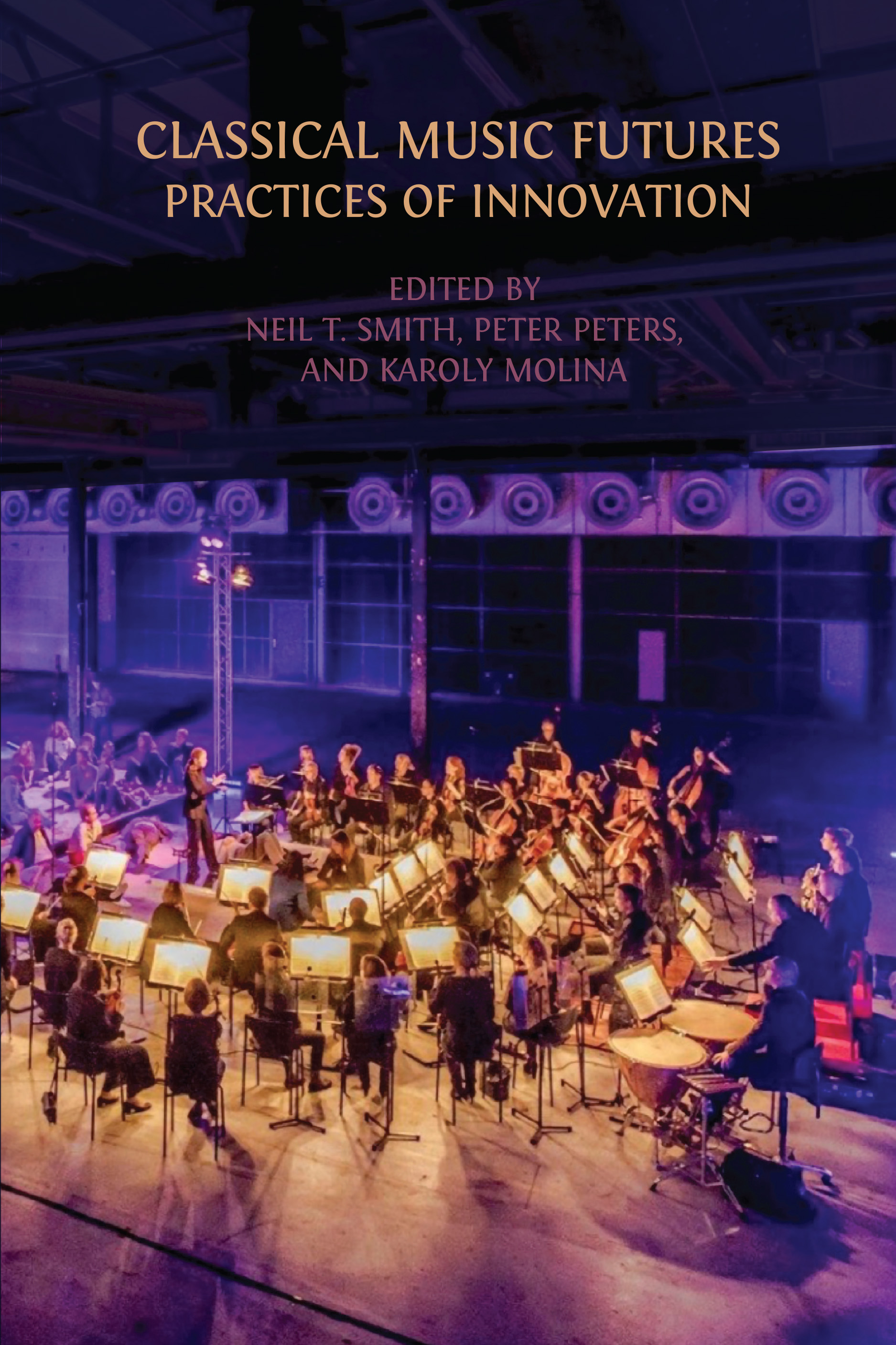
Classical Music Futures: Practices of Innovation
- Neil Thomas Smith (editor)
- Peter Peters(editor)
- Karoly Molina (editor)
| Title | Classical Music Futures |
|---|---|
| Subtitle | Practices of Innovation |
| Contributor | Neil Thomas Smith (editor) |
| Peter Peters(editor) | |
| Karoly Molina (editor) | |
| DOI | https://doi.org/10.11647/OBP.0353 |
| Landing page | https://www.openbookpublishers.com/books/10.11647/OBP.0353 |
| License | https://creativecommons.org/licenses/by-nc/4.0/ |
| Copyright | Peter Peters; Neil T. Smith; Karoly Molina. Copyright of individual chapters are maintained by the chapter author(s). |
| Publisher | Open Book Publishers |
| Publication place | Cambridge, UK |
| Published on | 2024-01-30 |
| ISBN | 978-1-80511-073-6 (Paperback) |
| 978-1-80511-074-3 (Hardback) | |
| 978-1-80511-075-0 (PDF) | |
| 978-1-80511-079-8 (HTML) | |
| 978-1-80511-076-7 (EPUB) | |
| Short abstract | This edited volume brings together contributions from a wide range of international academics and practitioners. It traces innovations within classical music practice, showing how these offer divergent visions for its future. The interdisciplinary contributions to the volume highlight the way contrasting ideas of the future can effect change in the present. |
| Long abstract | This volume brings together contributions from a wide range of international academics and practitioners. It traces innovations within classical music practice, showing how these offer divergent visions for its future. The interdisciplinary contributions to the volume highlight the way contrasting ideas of the future can effect change in the present. A rich balance of theoretical and practical discussion brings authority to this collection, which lays the foundations for timely responses to challenges ranging from the concept of the musical work, and the colonial values within Western musical culture, to unsustainable models of orchestral touring. The authors highlight how labour to meet the demands of particular futures for classical music might impact its creation and consumption, presenting case studies to capture the mediating roles of technology and community engagement. This book will be of interest to scholars and students in the fields of musicology and the sociology of music, as well as a general audience of practitioners, freelance musicians, music administrators and educators. |
| Print length | 430 pages (xviii+412) |
| Language | English (Original) |
| Dimensions | 156 x 30 x 234 mm | 6.14" x 1.18" x 9.21" (Paperback) |
| 156 x 34 x 234 mm | 6.14" x 1.34" x 9.21" (Hardback) | |
| Weight | 812g | 28.64oz (Paperback) |
| 991g | 34.96oz (Hardback) | |
| Media | 32 illustrations |
| 4 tables | |
| 9 audio | |
| OCLC Number | 1419383163 |
| THEMA |
|
| BIC |
|
| BISAC |
|
| Keywords |
|
| Funding |
Contents
Classical Music Futures: An Introduction
(pp. 1–28)- Neil Thomas Smith
- Peter Peters
(pp. 29–40)- Roundtable 1: Whose Future?
- Neil Thomas Smith
- Maria Hansen
- Kirsteen Davidson Kelly
- George E. Lewis
(pp. 41–58)- Classical Music has a Diversity Problem
- Brandon Farnsworth
- Neil Thomas Smith
- Hannah Bujic
- Francine Gorman
- Fiona Robertson
(pp. 81–90)- Until George Floyd: An Afrofuturist Perspective on the Future of Classical Music and Opera
- Antonio C. Cuyler
(pp. 91–102)- The Voice Party: A New Opera for a New Political Era
- Lore Lixenberg
(pp. 103–126)- Becoming a Classical Musician of the Future: The Effects of Training and Experience on Performer Attitudes to Innovation
- Stephanie Pitts
- Karen Burland
- Tom Spurgin
(pp. 127–152)- The Global Conservatoire: Towards an Integrated Approach to Developing Twenty-First-Century Artists
- Diana Salazar
- Christina Guillaumier
- Krista de Wit
- Beste Sevindik
(pp. 177–190)- Roundtable 3: Orchestras in a Changing Climate
- Neil Thomas Smith
- Peter Peters
- Teemu Kirjonen
- Detlef Grooß
- Jan Jaap Knoll
- Georgina MacDonell Finlayson
(pp. 191–204)- Is It Time for Brahms, Again? The Many Roles of Classical Music in the German-Speaking Lands in 2023
- Jutta Toelle
(pp. 205–228)- The Environmental Sustainability of Symphony Orchestras: Challenges and Potential Solutions
- Stine Skovbon
- Denise Petzold
- Noga Rachel Chelouche
(pp. 277–298)- Changing Rooms: A Diary of Spatial Innovation
- Neil Thomas Smith
(pp. 299–314)- Monsieur Croche: Concerts at Eye Level
- Tal Walker
- Folkert Uhde
- Hans-Joachim Gögl
(pp. 333–354)- Audiences of the Future: How Can Streamed Music Performance Replicate the Live Music Experience?
- Michelle Phillips
- Amanda E. Krause
(pp. 355–378)- Artificial Intelligence and the Symphony Orchestra
- Robert Laidlow
(pp. 379–400)- Ghosts of the Hidden Layer
- Jennifer Walshe
Contributors
Neil Thomas Smith
(editor)Neil Thomas Smith is a researcher and composer, teaching at the University of Edinburgh and the Open College of the Arts. Between 2018 and 2022 he was a postdoctoral researcher at the Maastricht Centre for the Innovation of Classical Music, where his research focussed on orchestras’ attempts at spatial innovation, both inside the concert hall and beyond. Neil has also worked on German contemporary music and sociological examinations of ‘emerging’ composers, with articles appearing in journals including Music & Letters, Cultural Sociology, Contemporary Music Review, the Journal of the Royal Musical Association, Tempo, and the British Journal of Sociology. His first monograph, a critical companion to the composer Mathias Spahlinger, was published in 2021; while a debut disc of chamber music, Stop Motion Music, was released in 2023.
Peter Peters
(editor)Peter Peters is endowed professor in the innovation of classical music and associate professor at the Faculty of Arts and Social Sciences, Maastricht University. His current research combines a life-long passion for music with an interest in how artistic practices can be a context for doing academic and practice-oriented research. In previous years, he worked on an ethnography of a project at the Orgelpark in Amsterdam aimed at building a baroque organ for the twenty-first century. More recently, his research focuses on innovating classical music practices, especially symphonic music. Together with Stefan Rosu, director of Philzuid (South Netherlands Philharmonic), he developed the research lines in the Maastricht Centre for the Innovation of Classical Music: the role of classical music and its value for society; the ways in which the relationship between performers of classical music, such as symphony orchestras and their audience is mediated; and the ways in which classical music practices contribute to the preservation of our cultural and social sounding heritage.
Karoly Molina
(editor)Karoly Molina is currently a researcher and support staff for the Maastricht Centre for the Innovation of Classical Music, a collaboration between Maastricht University, Zuyd University of Applied Sciences and the South Netherlands Philharmonic (philzuid). Karoly completed her BA in English literature at Texas A&M University and her MA at Maastricht University. Before her work at MCICM, Karoly taught English language and literature and worked as a translator.