
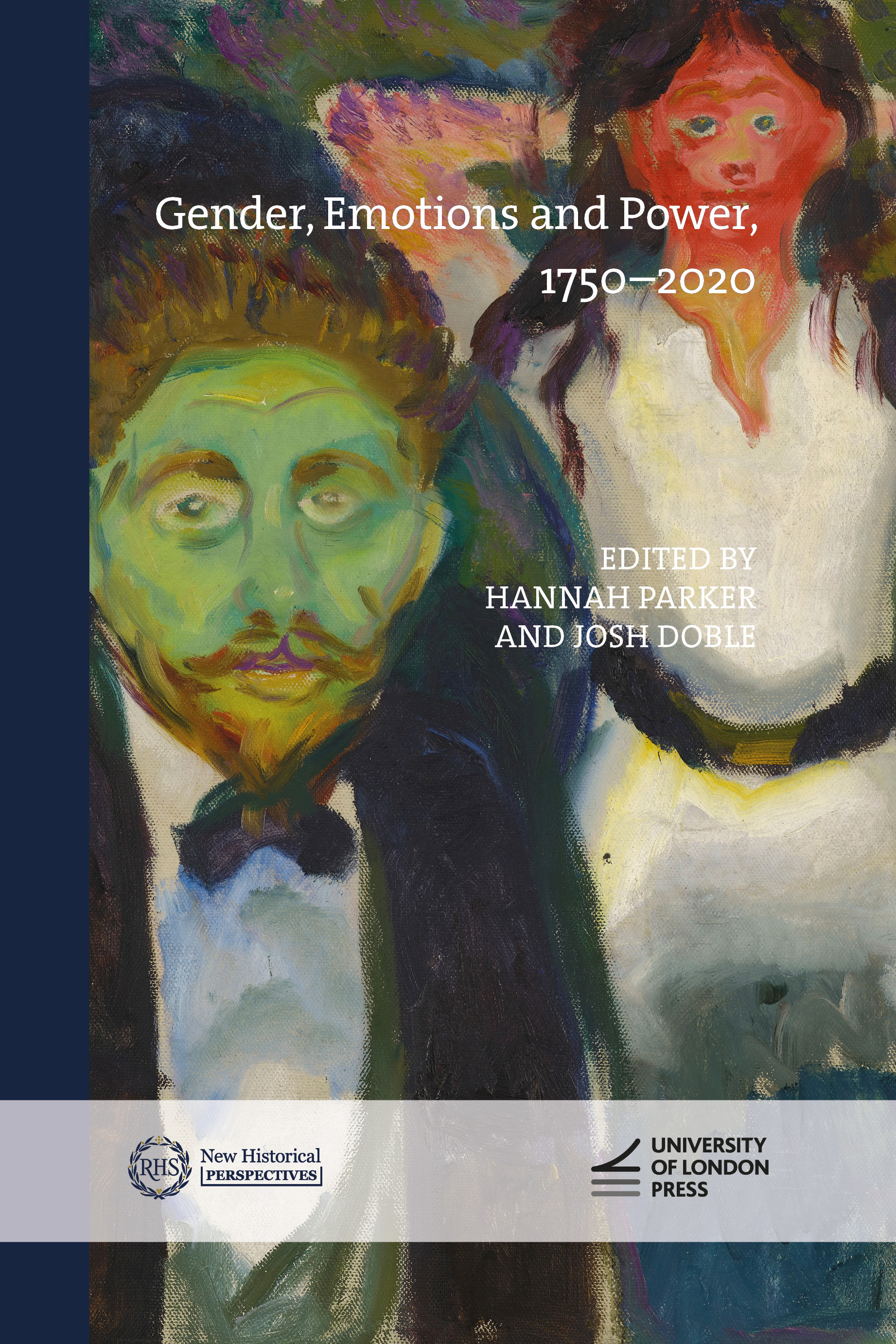
Gender, Emotions and Power, 1750–2020
- Hannah Parker(editor)
- Josh Doble(editor)
| Title | Gender, Emotions and Power, 1750–2020 |
|---|---|
| Contributor | Hannah Parker(editor) |
| Josh Doble(editor) | |
| DOI | https://doi.org/10.14296/cwfb4352 |
| Landing page | https://uolpress.co.uk/book/gender-emotions-and-power-1750-2020/ |
| License | https://creativecommons.org/licenses/by-nc-nd/4.0/ |
| Copyright | Authors |
| Publisher | University of London Press |
| Publication place | London, GB |
| Published on | 2023-11-30 |
| ISBN | 978-1-915249-16-6 (Paperback) |
| 978-1-915249-15-9 (Hardback) | |
| 978-1-915249-19-7 (PDF) | |
| 978-1-915249-66-1 (HTML) | |
| 978-1-915249-17-3 (EPUB) | |
| Short abstract | A timely intervention into contemporary debates on emotions, gender, race and power, this collection of essays interrogates how emotional expectations are established as gendered, racialised and class-based notions. It then explores the ways these expectations have historically been generated, stratified and maintained by institutions, societies, media and those with access to power. Global in outlook, it examines twentieth-century transnational feminists, settler colonies in southern Africa and post-unification Italy, Maoist China, the Soviet Union and the medicalised spaces of the British Raj. |
| Long abstract | This collection of essays constitutes a timely intervention into contemporary debates on emotions, gender, race and power. Interrogating how emotional expectations are established as gendered, racialised and class-based notions, the volume explores the ways these expectations have been generated, stratified and maintained by institutions, societies, media and those with access to power. The collection draws upon a diverse set of case studies to present a chronologically and geographically broad intervention. The authors identify and explore connections between the depiction of twentieth-century transnational feminists, settler colonies in southern Africa, post-unification Italy, Maoist China, the twentieth-century Soviet Union and the medicalized spaces of the British Raj. Contributions also move across time from notions of eighteenth-century British masculinity, through Victorian Britain and whiteness in settler colonialism, to the Liverpool docks of the 1990s and contemporary Russia. Collectively, the volume’s authors seek to understand how the normalisation of emotions as a range of gendered qualities forms the basis upon which notions of self, and connectedly, social identities are performed. As such, this is an important contribution to the history of emotions that addresses how gender and emotions are formed as co-constituents within dominant power structures, in different geographic and temporal spaces. |
| Print length | 304 pages |
| Language | English (Original) |
| Dimensions | 156 x 21 x 234 mm | 6.125" x 0.8125" x 9.1875" (Paperback) |
| 163 x 24 x 245 mm | 6.4375" x 0.9375" x 9.625" (Hardback) | |
| Weight | 430g | 15.25oz (Paperback) |
| 600g | 21.25oz (Hardback) | |
| Media | 1 illustration |
| THEMA |
|
| BIC |
|
| BISAC |
|
| Keywords |
|
Contributors
Hannah Parker
(editor)Hannah Parker (she/her) is a historian of the Soviet Union. She holds a PhD from the University of Sheffield, and works at the Open University. Her recent publications have pursued interests in the emotions of female librarians in the Soviet 1920s, gender, loyalty and gratitude in letters to Soviet authorities during Stalin's Terror, and new scholarship in public history. She is an organizer with the intersectional feminist collective Sheffield Feminist Archive.
Josh Doble
(editor)Josh Doble is an honorary fellow at the University of Edinburgh and the policy manager for Community Land Scotland. His research focuses on histories of land, emotions, settler colonialism and race within the decolonizing territories of East and Central Africa.