
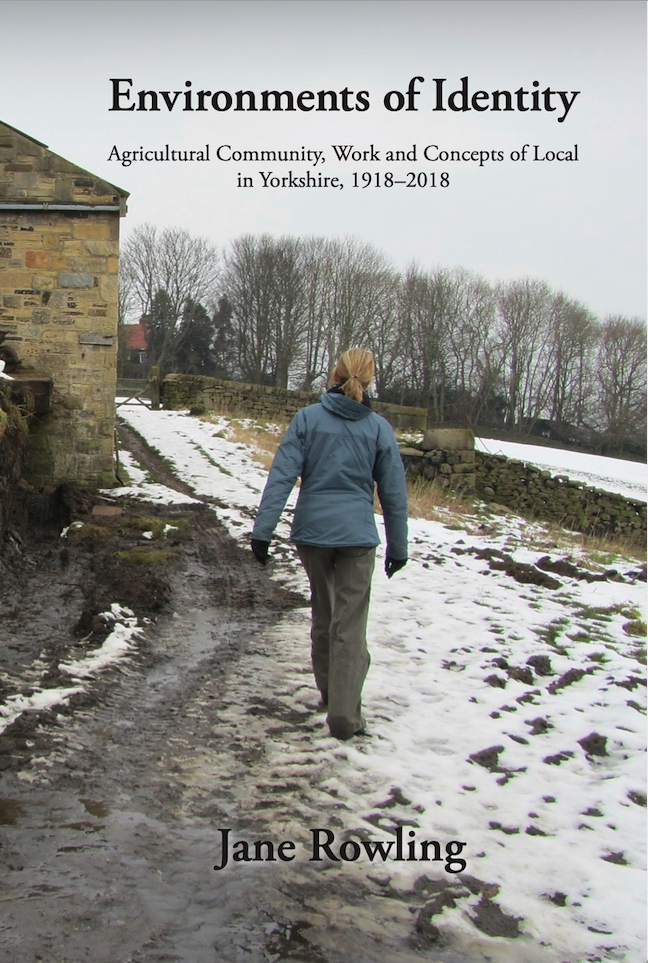
Environments of Identity: Agricultural Community, Work and Concepts of Local in Yorkshire, 1918–2018
- Jane Rowling (author)
| Title | Environments of Identity |
|---|---|
| Subtitle | Agricultural Community, Work and Concepts of Local in Yorkshire, 1918–2018 |
| Contributor | Jane Rowling (author) |
| Landing page | https://www.whpress.co.uk/publications/2022/01/21/environments-of-identity/ |
| Copyright | The White Horse Press |
| Publisher | The White Horse Press |
| Publication place | Winwick, UK |
| Published on | 2022-07-01 |
| ISBN | 978-1-912186-52-5 (Hardback) |
| 978-1-912186-61-7 (PDF) | |
| Short abstract | The UK countryside is under pressure. The needs of food production compete with those of the environment, heritage and leisure, and this pressure is increasing as ever more space is allocated to development and for carbon capture and conservation projects. The history of how rural space has been managed has been tackled by both environmental and agricultural historians. For the first time, this book brings together these two subdisciplines to build a detailed portrait of the symbiotic relationship between land managers and the British farmed landscape from the end of the First World War to the twenty-first century. |
| Long abstract | The UK countryside is under pressure. The needs of food production compete with those of the environment, heritage and leisure, and this pressure is increasing as ever more space is allocated to development and for carbon capture and conservation projects. The history of how rural space has been managed has been tackled by both environmental and agricultural historians. For the first time, this book brings together these two subdisciplines to build a detailed portrait of the symbiotic relationship between land managers and the British farmed landscape from the end of the First World War to the twenty-first century. Taking the idyllic Yorkshire landscape of Lower Wharfedale as the main character, this is a story of farming through a century of change. Based on detailed oral history interviews with local farmers who began their careers in the early part of study period, and their grandchildren and counterparts who are linked to the same farms in the twenty-first century, this book explores the impact of the farming community on the farmed environment while also highlighting the agency of the environment in forming farming identities. This study not only illuminates the way in which the land has been managed in the past, but also draws out the stories of farmers’ relationships with their land over generations. Understanding how these relationships function, in the context of their agricultural and environmental histories, will be crucial for the successful implementation of the landscape level change in practices and approaches that will be essential to mitigate climate change. |
| Print length | 297 pages |
| Language | English (Original) |
| Dimensions | 152 x 229 mm | 5.98" x 9.02" (Hardback) |
| Media | 19 illustrations |
| 2 tables | |
| BIC |
|
| BISAC |
|
| Keywords |
|
Contributors
Jane Rowling
(author)Jane Rowling completed her Ph.D. in 2017 and has since worked at the University of Leeds and the University of Hull. Her publications have explored the themes of trust, community, land management, women’s work on the farm, and the relationships between farmers, farmworkers, and other bodies which have interests in managing the countryside. Jane is now managing the development of the Farm and Rural Liaison project with Calder and Colne Rivers Trust, and is a BASIS qualified soil and water management advisor.