
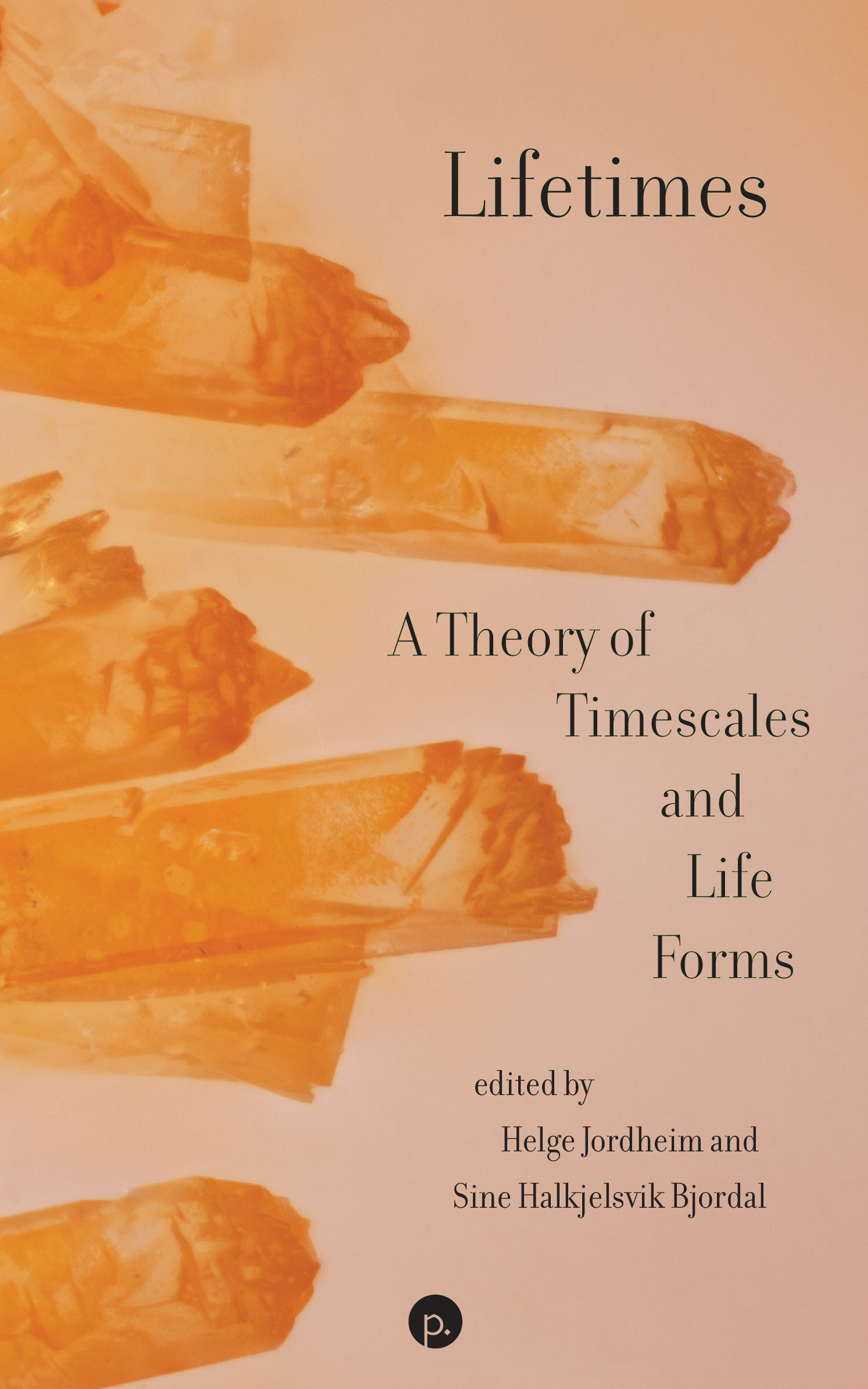
Lifetimes: A Theory of Timescales and Life Forms
- Helge Jordheim(editor)
- Sine Halkjelsvik Bjordal(editor)
| Title | Lifetimes |
|---|---|
| Subtitle | A Theory of Timescales and Life Forms |
| Contributor | Helge Jordheim(editor) |
| Sine Halkjelsvik Bjordal(editor) | |
| DOI | https://doi.org/10.53288/0484.1.00 |
| Landing page | https://punctumbooks.com/titles/lifetimes-a-theory-of-timescales-and-life-forms/ |
| License | https://creativecommons.org/licenses/by-nc-sa/4.0/ |
| Copyright | Sine Halkjelsvik Bjordal and Helge Jordheim |
| Publisher | punctum books |
| Publication place | Earth, Milky Way |
| Published on | 2026-05-21 |
| ISBN | 978-1-68571-242-6 (Paperback) |
| 978-1-68571-243-3 (PDF) | |
| 978-1-68571-307-2 (EPUB) | |
| Long abstract | At the beginning of the twenty-first century, many of our most well-known and dependable forms of keeping, managing, and representing time are losing their grasp on the real. Clocks cannot measure how societies speed up, or come to a standstill during crisis, modern historiography is unable to come up with meaningful narratives about mankind as the sixth extinction event, and calendars are insufficient as tools for societal and political change. Lifetimes: A Theory of Timescales and Life Forms presents an alternative framework for studying lives and times, and the relationships between them. Building on post-war theories of history, as well as several historical sub-disciplines, such as cultural history, history of science, and medical history, Lifetimes integrates approaches from anthropology, game studies, cultural studies, literary studies, critical heritage studies, science & technology studies, and critical time studies. Times are understood as always existing in plural, as embodied and emergent—in things, in assemblages of things, and in the relations between things. Among them are the lives of humans, but also the lives of viruses, plants, animals, rocks, computers, nations, concepts, policies, technologies, infrastructures, etc. Lifetimes explores theoretical foundations while at the same time developing them through case studies in individual chapters. The result is a bottom-up theory of temporal multiplicity, conceptually and theoretically open enough to be productive across various academic disciplines. Rather than discussing how different disciplines relate to time, the authors in this edited collection present a theoretically sustained, empirically diverse range of cases, in which times in plural become politically and historically salient. Out of these case studies a new theory emerges: a theory of lifetimes. |
| Print length | 496 pages (nulla+496+nulla) |
| Language | English (Original) |
| Dimensions | 127 x 28.448 x 203.2 mm | 5" x 1.12" x 8" (Paperback) |
| Weight | 626g | 22.08oz (Paperback) |
| LCCN | 2026936832 |
| THEMA |
|
| BISAC |
|
| Keywords |
|
Contents
- Helge Jordheim
- Sine Halkjelsvik Bjordal
- Stine Alling Jacobsen
- Espen Ytreberg
- Laura op de Beke
- Helge Jordheim
- Einar Wigen
- Anne Kveim
- Ingrid Eskild
- Leonoor Zuiderveen Borgesius
- Emil Flatø
- Erik Ljungberg
- Sine Halkjelsvik Bjordal
- Brita Brenna
- Rana Issa
- Hugo Reinert
- Geoffrey C. Bowker
Contributors
Helge Jordheim
(editor)Helge Jordheim is Professor of Cultural History of Nature at the University of Oslo, where for the last decade or so he has directed research on the cultural history of time, chronopolitics, synchronization, theories of history, and historiography. His main areas are German and European cultural and intellectual history since the 17th century as well as theories and key concepts of the human sciences.
Sine Halkjelsvik Bjordal
(editor)Sine Halkjelsvik Bjordal is a postdoctoral researcher specializing in the history and practices of natural history. She is currently affiliated with the project “The Afterlives of Natural History” at the University of Oslo, where she focuses on the practices of natural history writing, as well as on how the field of natural history developed after the 18th century. Her research interests include 18th- and 19th-century history of knowledge, heritage studies, literary theory, and rhetoric.
References
- (opens in new tab)
- (opens in new tab)
- (opens in new tab)
- (opens in new tab)
- (opens in new tab)
- (opens in new tab)
- (opens in new tab)
- (opens in new tab)
- (opens in new tab)
- (opens in new tab)
- (opens in new tab)
- (opens in new tab)
- (opens in new tab)
- (opens in new tab)
- (opens in new tab)
- (opens in new tab)
- (opens in new tab)
- (opens in new tab)
- (opens in new tab)
- (opens in new tab)
- (opens in new tab)
- (opens in new tab)
- (opens in new tab)
- (opens in new tab)
- (opens in new tab)
- (opens in new tab)
- (opens in new tab)
- (opens in new tab)
- (opens in new tab)
- (opens in new tab)
- (opens in new tab)
- (opens in new tab)
- (opens in new tab)
- (opens in new tab)
- (opens in new tab)
- (opens in new tab)
- (opens in new tab)
- (opens in new tab)
- (opens in new tab)
- (opens in new tab)
- (opens in new tab)
- (opens in new tab)
- (opens in new tab)
- (opens in new tab)
- (opens in new tab)
- (opens in new tab)
- (opens in new tab)
- (opens in new tab)
- (opens in new tab)
- (opens in new tab)
- (opens in new tab)
- (opens in new tab)
- (opens in new tab)
- (opens in new tab)
- (opens in new tab)
- (opens in new tab)
- (opens in new tab)
- (opens in new tab)
- (opens in new tab)
- (opens in new tab)
- (opens in new tab)
- (opens in new tab)
- (opens in new tab)
- (opens in new tab)
- (opens in new tab)
- (opens in new tab)
- (opens in new tab)
- (opens in new tab)
- (opens in new tab)
- (opens in new tab)
- (opens in new tab)
- (opens in new tab)
- (opens in new tab)
- (opens in new tab)
- (opens in new tab)
- (opens in new tab)
- (opens in new tab)
- (opens in new tab)
- (opens in new tab)
- (opens in new tab)
- (opens in new tab)
- (opens in new tab)
- (opens in new tab)
- (opens in new tab)
- (opens in new tab)
- (opens in new tab)
- (opens in new tab)
- (opens in new tab)
- (opens in new tab)
- (opens in new tab)
- (opens in new tab)
- (opens in new tab)
- (opens in new tab)
- (opens in new tab)
- (opens in new tab)
- (opens in new tab)
- (opens in new tab)
- (opens in new tab)
- (opens in new tab)
- (opens in new tab)
- (opens in new tab)
- (opens in new tab)
- (opens in new tab)
- (opens in new tab)
- (opens in new tab)
- (opens in new tab)
- (opens in new tab)
- (opens in new tab)
- (opens in new tab)
- (opens in new tab)
- (opens in new tab)
- (opens in new tab)
- (opens in new tab)
- (opens in new tab)
- (opens in new tab)
- (opens in new tab)
- (opens in new tab)
- (opens in new tab)
- (opens in new tab)
- (opens in new tab)
- (opens in new tab)
- (opens in new tab)
- (opens in new tab)
- (opens in new tab)
- (opens in new tab)
- (opens in new tab)
- (opens in new tab)
- (opens in new tab)