
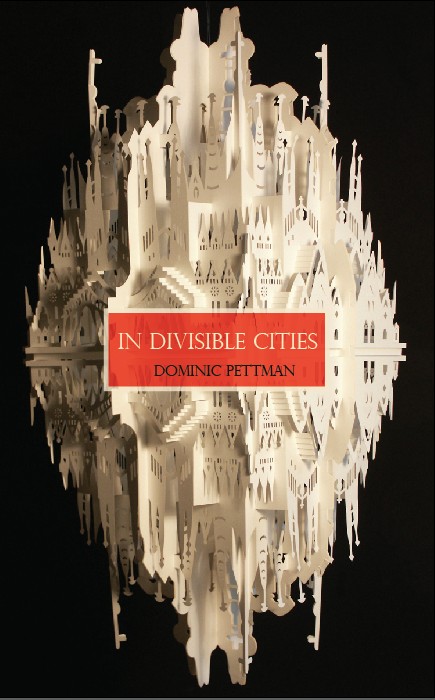
In Divisible Cities: A Phanto-Cartographical Missive
- Dominic Pettman (author)
| Title | In Divisible Cities |
|---|---|
| Subtitle | A Phanto-Cartographical Missive |
| Contributor | Dominic Pettman (author) |
| DOI | https://doi.org/10.21983/P3.0044.1.00 |
| Landing page | https://punctumbooks.com/titles/in-divisible-cities/ |
| License | https://creativecommons.org/licenses/by-nc-sa/3.0/ |
| Copyright | Pettman, Dominic |
| Publisher | punctum books |
| Publication place | Brooklyn, NY |
| Published on | 2013-08-26 |
| ISBN | 978-0-615-85319-2 (Paperback) |
| Long abstract | Italo Calvino rewrites Baudrillard’s America with a more global eye, as edited by Roland Barthes. In Divisible Cities takes Italo Calvino’s classic re-imagining of Venice, viewed in the mind’s eye from many different metaphysical angles, and projects it on to the world at large. Where the Italian saw his favorite city as an impossible metropolis of many moods, shades, and ways of being, this unauthorized sequel unpacks the Escheresque streets in unexpected directions. In Divisible Cities is thus an exercise in cartographic origami: the reflective and poetic result of the narrator’s desire to map hidden cities, secret cities, imaginary cities, impossible cities, and overlapping cities, existing beneath the familiar Atlas of everyday perception. Stitching these different places and spaces together is a “double helix” or “Siamese seduction” between the traveler and his romantic shadow, revealing — step by step — a clandestine itinerary of hidden affinities, nestled within the habitual rhythm of things. Matter matters. That’s what the drone of the city tells us. And yet we dream of something beyond these invisible walls. |
| Print length | 168 pages |
| Language | English (Original) |
| Dimensions | 127 x 203 mm | 5" x 8" (Paperback) |
| THEMA |
|
| BIC |
|
| BISAC |
|
| Keywords |
|
Contributors
Dominic Pettman
(author)Dominic Pettman(opens in new tab) teaches Culture & Media at the New School in New York City. He has held previous positions at the University of Melbourne, the University of Geneva, and the University of Amsterdam. Topics which inspire him include techno-poetic fancies, unexpected libidinal economies, inter-species epiphanies, and transnational culinary possibilities. He is the co-author of Avoiding the Subject: Media, Culture and the Object (AUP, 2004), and the sole author of After the Orgy: Toward a Politics of Exhaustion (SUNY, 2002), Love and Other Technologies: Retrofitting Eros for the Information Age (Fordham, 2006), Human Error: Species-Being and Media Machines (Minnesota, 2011), and Look at the Bunny: Totem, Taboo, Technology (Zero Books, 2013).