Better Publishing Through Open Metadata: Strengthening Open Infrastructure for Open Access Books through the Thoth–OAPEN SWORD Workflow
By Hannah Hillen, Ross Higman, Toby Steiner, Anna Wałek, Wiktor Florian, Vaggelis Theodorakopoulos, and Hanna Varachkina.
—
This blog post is being published jointly by the OAPEN Foundation and Thoth Open Metadata on July 1, 2026. Versions are available from OAPEN's blog) as well as from Thoth Open Metadata’s blog.
—
Open access (OA) books depend on more than open licences. They rely on the infrastructures that move publications across the scholarly communications landscape: from publisher workflows into repositories, catalogues, library systems, discovery services, and preservation platforms. When those infrastructures are open, community-governed, and mission-driven, they help reduce duplication, improve interoperability, and support a more diverse publishing ecosystem.
This is the context for the latest collaboration between Thoth Open Metadata, the OAPEN Foundation, and the Directory of Open Access Books (DOAB).
Together, we have developed a SWORD-based deposit workflow that enables OA book metadata and publication files managed in Thoth to be transferred into the OAPEN Library in a more structured, automated, and sustainable way. The workflow is one outcome of the COPIM (2019–2023) and Open Book Futures (2023–2026) projects, which brought together organisations including OAPEN, DOAB, Thoth, Open Book Collective, the Public Knowledge Project (PKP), and many others to strengthen the open infrastructure ecosystem supporting open access books. Both phases of this work have been generously supported by Arcadia and the Research England Development (RED) Fund / UK Research and Innovation (UKRI).
Building Open Infrastructure Together
Since its emergence through COPIM, Thoth Open Metadata has focused on developing open-source, non-profit infrastructure for OA books. Our aim is to support publishers – particularly small to medium-sized independent scholar-led as well as institutional university and library presses – through high-quality metadata management, dissemination, and broader integration into the wider scholarly supply chain.
At the heart of this work is a simple conviction that we share with the wider Copim Community: there can be no real open access without underlying open infrastructure. Metadata determines whether books can be discovered, cited, preserved, acquired by libraries, and integrated into scholarly systems. Yet many publishers still face fragmented workflows and repeated administrative labour when distributing books across multiple platforms and services.
To address these challenges, Thoth has developed open APIs, dissemination pathways, metadata export tooling, archiving workflows, and integrations with third-party services, aggregators and indices. The platform supports industry-standard formats including ONIX 3, KBART, MARC21, and Crossref XML, while all metadata are made openly available per default under a CC0 dedication to facilitate easy re-use e.g. by libraries. Thoth’s platform also automates the provision of platform-specific configurations of these major formats, and enables publishers to easily export ONIX variants that directly implement the specific requirements of OAPEN, DOAB, JSTOR, Project MUSE, Google Books, EBSCOHost, and ProQuest.
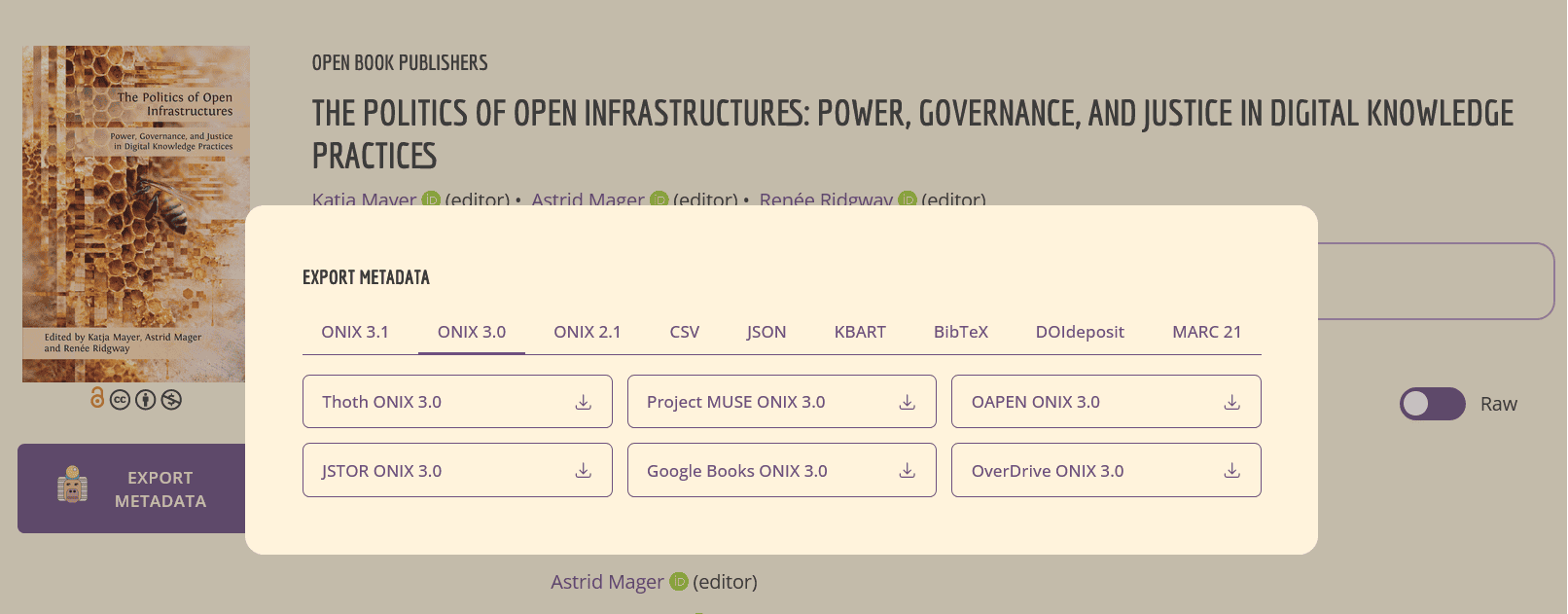 Fig.1: High-quality exports of multiple metadata formats and platform-specific flavours thereof are available for free as open data under a CC0 dedication through the Thoth platform.
The OAPEN Library and DOAB play an equally important role within this ecosystem. The OAPEN Library provides a trusted infrastructure for peer-reviewed OA books, offering hosting, quality assurance, dissemination, and long-term preservation services. In addition, it provides usage statistics via a dedicated dashboard for publishers, libraries, and funders, supporting OA impact assessment. The Directory of Open Access Books (DOAB) functions as a major discovery service for peer-reviewed OA books, covering high-quality titles from a wide range of publishers. DOAB enhances the visibility and discoverability of OA books by making metadata widely available to libraries, aggregators, and indexing services.
Thoth in turn also contributes to this landscape as a core member of the DOAB Trusted Platform Network by providing small-to-medium-sized publishers an easy entry route while also ensuring quality of content and metadata. Doing so, both infrastructures, thus are contributing to a trusted, transparent, and interoperable OA books ecosystem.
 Fig. 2: The DOAB Trusted Platform logo
Why the SWORD Workflow Matters
For many publishers, dissemination remains unnecessarily fragmented. Metadata often needs to be reformatted for different services, files uploaded manually, and a plethora of individual record files maintained across multiple systems (see e.g. Steiner et. al. 2026).
The Thoth–OAPEN workflow aims to reduce that burden. Using the SWORD protocol, metadata and publication files can now be transferred directly from Thoth into the OAPEN Library through a structured and automated workflow. This replaces older ingest approaches and integrates OAPEN deposits into Thoth’s wider dissemination network.
This is the first stage of a broader effort. The next phase will seek to extend the workflow into a dedicated pipeline feeding directly into DOAB, further streamlining the path from metadata management to deposit and discovery.
Technically, the work involved an iterative process of collaboration between the Thoth and OAPEN technical teams, drawing on Thoth’s previous experience using the SWORD protocol to integrate with other repositories. This had been explored in more detail as part of the Archiving & Digital Preservation Group’s work on developing a content submission workflow into the Cambridge University Library’s DSpace instance during the Open Book Futures project (see Higman & Martínez-García, 2025). OAPEN worked to set up and appropriately configure the SWORD v2 server module of the DSpace platform which powers the OAPEN Library, while Thoth implemented a dedicated SWORD v2 uploader within their dissemination tooling.
Both teams supported each other with testing and troubleshooting of their respective components, providing useful feedback on the behaviour of each other’s systems as observed from within their own, and taking advantage of the greenfield nature of the project to tailor the configuration to best serve both parties’ data models. The resulting workflow enables automated transmission of publication files in formats aligned with OAPEN’s metadata requirements and repository specifications, retaining the richness of the original Thoth metadata to the greatest extent possible.
The significance of this work extends beyond technical implementation. Rather than creating isolated systems that compete for control over publisher workflows, Thoth, OAPEN, and DOAB are building interoperable infrastructure that allows open metadata and content to move freely across the OA books landscape.
For publishers, this means simpler dissemination pathways and less duplicated work. For OAPEN, it means more efficient ingest processes and improved metadata consistency. For the wider community, it demonstrates how collaborative infrastructure development can strengthen the ecosystem as a whole.
From COPIM to Open Book Futures
The roots of this work lie in COPIM (2019-23), where partners across the OA books landscape began addressing common challenges faced by small to medium-sized presses (see Stone et. al., 2021), including fragmented dissemination, inconsistent metadata practices, weak preservation pathways, and prevailing dependence on proprietary systems and closed data. Thoth Open Metadata emerged from this context as a practical response to metadata fragmentation that creates a multiplicity of barriers to participation particularly for small-to-medium sized publishers of open access longform scholarship, while OAPEN and DOAB brought longstanding expertise in repository management, discoverability, and preservation.
Open Book Futures (2023-26) has enabled the parties involved to continue and expand these collaborations. Across the project, partners have worked on technical development, governance, collective funding, outreach, metadata research, preservation, and library engagement. A recurring theme throughout both projects has been the importance of building distributed, interoperable infrastructures that remain community-governed while working together efficiently. The Thoth–OAPEN–DOAB workflow is one practical example of this approach in action.
Looking Ahead
Infrastructure work is never finished. Standards evolve, workflows change, and new dissemination environments emerge. The Thoth–OAPEN workflow will continue to develop through testing, refinement, and collaboration with publishers and infrastructure partners. Future work will include the planned DOAB integration as well as ongoing improvements to metadata mappings, dissemination pathways, and repository alignment.
More broadly, this collaboration demonstrates how open-source software, open metadata, repository infrastructure, and non-profit services can work together to reduce barriers for publishers while strengthening the wider scholarly communications ecosystem.
As COPIM and Open Book Futures have shown, the power of community-led infrastructuring lies in its distributed nature: rather than relying on one single platform or organisation, our philosophy of Scaling Small (Barnes & Gatti, 2019; Adema & Moore, 2021) prioritises collective collaboration to nurture the development of a wider ecosystem consisting of specialised open infrastructures. Hence our focus on interoperability, and sustained investment in a community-led ecosystem that treats scholarly communication as a shared public good. The Thoth–OAPEN SWORD workflow is one contribution towards that future.
Further Reading
Adema, J., & Moore, S. A. (2021). Scaling Small; Or How to Envision New Relationalities for Knowledge Production. Westminster Papers in Communication and Culture, 16(1). https://doi.org/10.16997/wpcc.918
Barnes, L., & Gatti, R. (2019). Bibliodiversity in Practice: Developing Community-Owned, Open Infrastructures to Unleash Open Access Publishing. ELPUB 2019 23rd Edition of the International Conference on Electronic Publishing. Jun 2019, Marseille, France. https://doi.org/10.4000/proceedings.elpub.2019.21
Higman, R., & Martínez-García, A. (2025). Archiving with Cambridge University Library. Copim. https://doi.org/10.21428/785a6451.2f972783
Hillen, H., & Steiner, T. (2025). Good metadata practice for Open Access books. Copim. https://doi.org/10.21428/785a6451.ced96be1
Steiner, T., Barnes, L., Fathallah, J., Findanis, J., Gatti, R., Deville, J., Sanders, K., Higman, R., Stern, N., & Stone, G. (2025). Seeding for a not-for-profit community-led OA books ecosystem. Copim. https://doi.org/10.21428/785a6451.d35141ca
Steiner, T., Arias, J., Bennett, M., Booth, E., Edmunds, J., Gatti, R., Higman, R., Hillen, H., Laakso, M., Nason, M., O'Connell, B., Pogačnik, A., Rabar, U., Ramalho, A., Stone, G., van Gerven Oei, V. W. J., & Wake Hyde, Z. (2026). International Metadata Recommendations, and Platform-Specific Requirements for Open Access Books and Chapters (1.0). Thoth Open Metadata. https://doi.org/10.5281/zenodo.18173982
Stone, G., Gatti, R., van Gerven Oei, V. W. J., Arias, J., Steiner, T., & Ferwerda, E. (2021). WP5 Scoping Report: Building an Open Dissemination System. Copim. https://doi.org/10.21428/785a6451.939caeab