
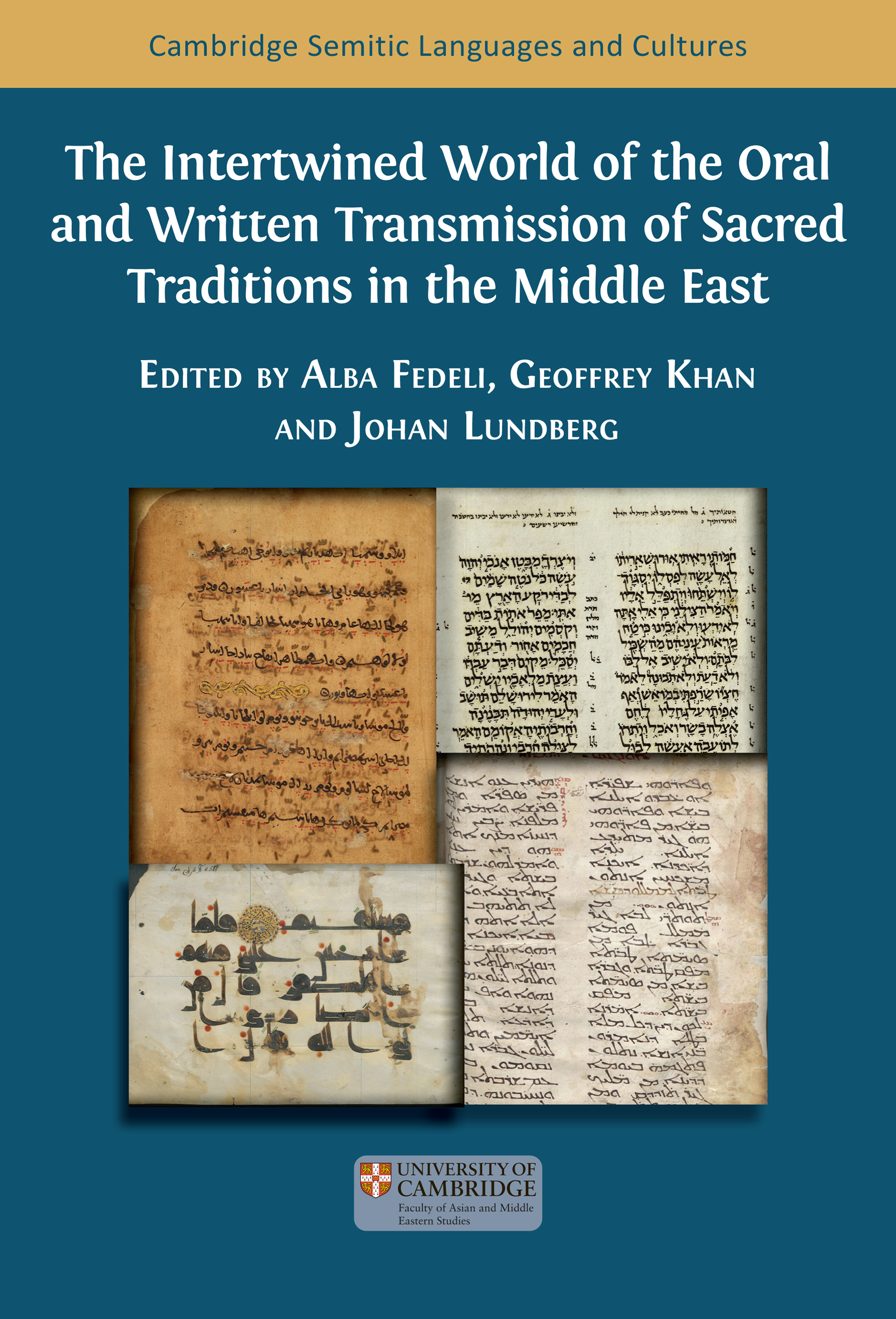
The Intertwined World of the Oral and Written Transmission of Sacred Traditions in the Middle East
- Alba Fedeli (editor)
- Geoffrey Khan(editor)
- Johan Lundberg (editor)
| Title | The Intertwined World of the Oral and Written Transmission of Sacred Traditions in the Middle East |
|---|---|
| Contributor | Alba Fedeli (editor) |
| Geoffrey Khan(editor) | |
| Johan Lundberg (editor) | |
| DOI | https://doi.org/10.11647/OBP.0498 |
| Landing page | https://www.openbookpublishers.com/books/10.11647/OBP.0498 |
| License | https://creativecommons.org/licenses/by-nc/4.0/ |
| Copyright | Alba Fedeli; Geoffrey Khan; Johan Lundberg. Copyright of individual chapters are maintained by the chapter author(s). |
| Publisher | Open Book Publishers |
| Publication place | Cambridge, UK |
| Published on | 2025-11-06 |
| Series |
|
| ISBN | 978-1-80511-740-7 (Paperback) |
| 978-1-80511-741-4 (Hardback) | |
| 978-1-80511-742-1 (PDF) | |
| Short abstract | In the medieval Middle East, the scriptures of Christianity, Judaism and Islam were transmitted in written and oral form. The means of written transmission and the textualisation of the oral reading of these scriptures exhibit many parallels, which reflect cultural contact and convergence across the various religious communities. This volume is the outcome of a project, funded jointly by the Deutsche Forschungsgemeinschaft and the Arts and Humanities Research Council, that aimed to bring together strands of research related to various aspects of the transmission of these sacred texts in order to reach a deeper understanding of the intertwined world of the three major religions of the Middle East at their formative periods of development during the early Islamic centuries. |
| Long abstract | In the medieval Middle East, the scriptures of Christianity, Judaism and Islam were transmitted in written and oral form. The means of written transmission and the textualisation of the oral reading of these scriptures exhibit many parallels, which reflect cultural contact and convergence across the various religious communities. This volume is the outcome of a project, funded jointly by the Deutsche Forschungsgemeinschaft and the Arts and Humanities Research Council, that aimed to bring together strands of research related to various aspects of the transmission of these sacred texts in order to reach a deeper understanding of the intertwined world of the three major religions of the Middle East at their formative periods of development during the early Islamic centuries. |
| Print length | 484 pages (xiv+470) |
| Language | English (Original) |
| Dimensions | 156 x 34 x 234 mm | 6.14" x 1.34" x 9.21" (Paperback) |
| 156 x 37 x 234 mm | 6.14" x 1.46" x 9.21" (Hardback) | |
| Weight | 915g | 32.28oz (Paperback) |
| 1095g | 38.63oz (Hardback) | |
| OCLC Number | 1550791062 |
| LCCN | 2025465571 |
| THEMA |
|
| BISAC |
|
| LCC |
|
| Keywords |
|
Contents
Introduction
(pp. 1–26)- Alba Fedeli
- Geoffrey Khan
- Johan Lundberg
- Jonathan Loopstra
Taxonomies of Dots: The Context and Methodology of the Early Treatises about the Syriac Accent Dots
(pp. 95–128)- Johan Lundberg
Multimodality in Liturgical Expression: The Case of Textuality and Orality in Syriac Orthodox Liturgies
(pp. 129–150)- George Kiraz
Was There Ever an Oral Hebrew Masora?
(pp. 151–172)- Elvira Martín-Contreras
Main Clause Verbs are Prosodically Weaker than Nouns in the Tiberian Cantillation of Biblical Hebrew Prose Books
(pp. 173–228)- Robert S. D. Crellin
- Geoffrey Khan
- Nick Posegay
- Alba Fedeli
- Alba Fedeli
- Carolin Kinne-Wall
- Hythem Sidky
A Computational System to Analyse the Layer of Tajwīd Notation in Contemporary Qurʾānic Orthography
(pp. 437–464)- Alicia González Martínez
Contributors
Alba Fedeli
(editor)Alba Fedeli is a Research Associate at the Cluster of Excellence ‘Understanding Written Artefacts’ (University of Hamburg), where she serves as Principal Investigator of the research project ‘What is in A Scribe’s Mind and Inkwell’. She studied in Italy with Sergio Noja and was an awarded her PhD by the University of Birmingham (2015) on the history of Qurʾānic manuscripts in the Mingana Collection. Her publications reflect her research interests in early Qurʾānic manuscripts and include an edition of the Mingana-Lewis Qurʾān palimpsest. From 2004 to 2012, she taught at the University of Milan, and between 2004 and 2008, she served as Director of the Ferni Noja Noseda Foundation. She has participated in various projects on Qurʾānic manuscripts, such as the digitisation of the Sanaa Palimpsest at Dār al-Makhṭūṭāt in 2007 and the survey of the newly discovered manuscripts of the Great Mosque of Sanaa in 2008.
Geoffrey Khan
(editor)Geoffrey Khan is Regius Professor of Hebrew at the University of Cambridge. He was awarded his PhD by the School of Oriental and African Studies, London (1984). His research publications focus on three main fields: Biblical Hebrew language (especially medieval traditions), Neo-Aramaic dialectology, and medieval Arabic documents. He is the general editor of The Encyclopedia of Hebrew Language and Linguistics and is the senior editor of Journal of Semitic Studies. His most recent books include The Tiberian Pronunciation Tradition of Biblical Hebrew (University of Cambridge and Open Book Publishers, 2020), Language Contact in Sanandaj (with Masoud Mohammadirad as co-author, de Gruyter, 2023), and Arabic Documents from Medieval Nubia (University of Cambridge and Open Book Publishers, 2024).
Johan Lundberg
(editor)Johan Lundberg is a Leverhulme Early Career Fellow at the University of Oxford. He was awarded his PhD by the University of Cambridge (2020). His research focuses on Middle Eastern manuscripts and languages, specifically Syriac manuscripts. He is currently working on a history of Syriac punctuation and a reconstruction of classical Syriac prosody. He has also published on the relationship between punctuation and versification of Syriac Bibles and East Syriac word stress.