
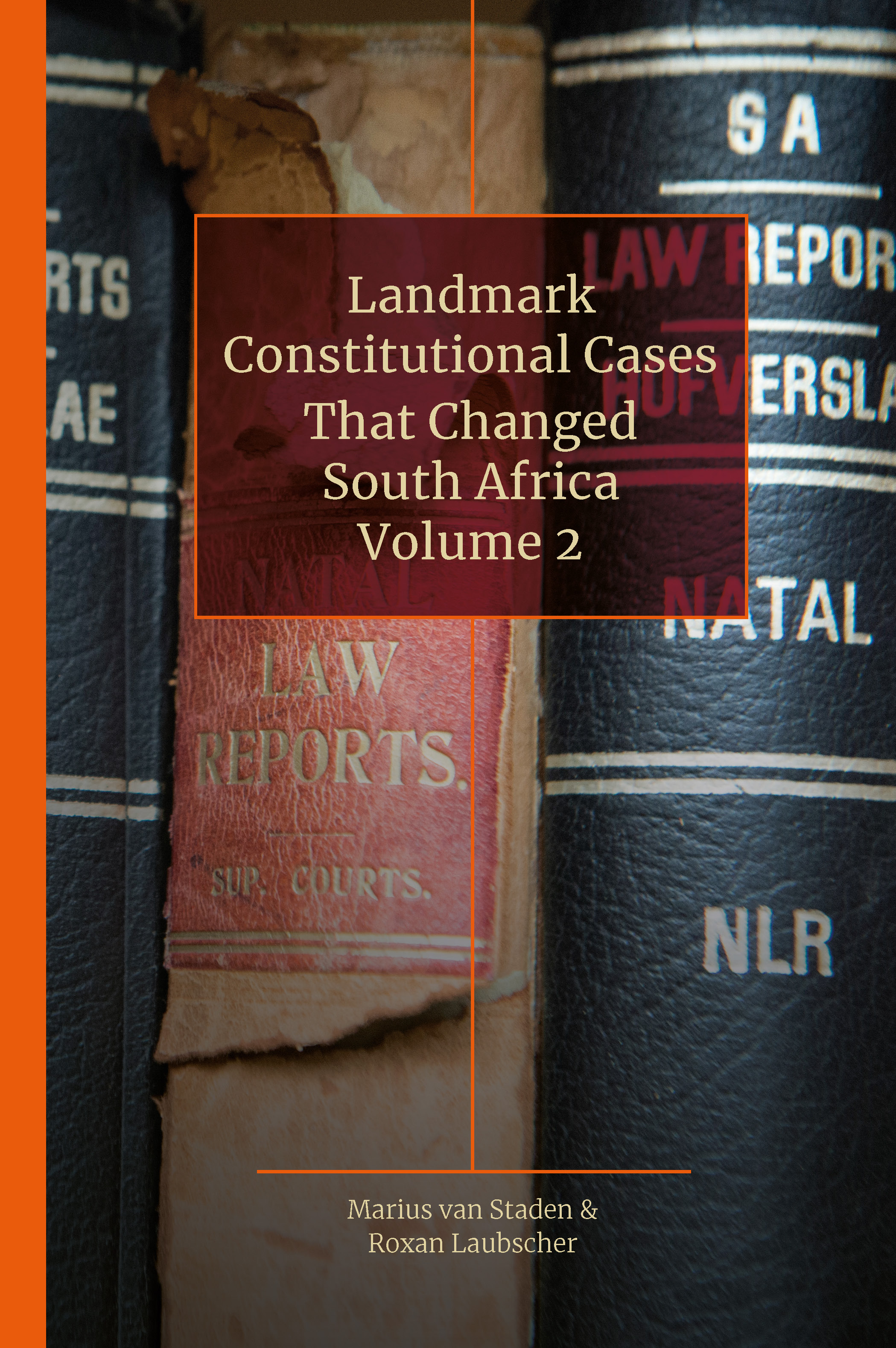
Landmark Constitutional Cases that Changed South Africa: Volume 2
- Marius van Staden(editor)
- Roxan Laubscher(editor)
- Franaaz Khan(author)
- Carika Keulder(author)
- Nicole Deokiram(author)
- Whitney Rosenberg(author)
- Amanda Boniface(author)
| Title | Landmark Constitutional Cases that Changed South Africa |
|---|---|
| Subtitle | Volume 2 |
| Contributor | Marius van Staden(editor) |
| DOI | https://doi.org/10.64449/9781997468912 |
| Landing page | https://ujonlinepress.uj.ac.za/index.php/ujp/catalog/book/420 |
| License | https://creativecommons.org/licenses/by/4.0 |
| Copyright | Marius Van Staden, Roxan Laubscher; Franaaz Khan, Carika Keulder, Nicole Deokiram, Whitney Rosenberg, Amanda Boniface |
| Publisher | UJ Press |
| Publication place | Johannesburg |
| Published on | 2025-12-31 |
| ISBN | 978-1-997468-90-5 (Paperback) |
| 978-1-997468-91-2 (PDF) | |
| 978-1-997468-93-6 (XML) | |
| 978-1-997468-92-9 (EPUB) | |
| Short abstract | This second volume of landmark constitutional cases builds on the success of Volume 1 by analysing ten additional transformative judgments that have shaped South Africa’s constitutional landscape. The book demonstrates how the Constitutional Court has progressively developed fundamental rights jurisprudence through cases addressing corporal punishment of minors, state accountability for gender-based violence, tax collection powers, strike violence, religious freedom, parental rights of unmarried fathers, Muslim marriages, language rights in education, affirmative action, and electoral reform. |
| Long abstract | This second volume of landmark constitutional cases builds on the success of Volume 1 by analysing ten additional transformative judgments that have shaped South Africa’s constitutional landscape. The book demonstrates how the Constitutional Court has progressively developed fundamental rights jurisprudence through cases addressing corporal punishment of minors, state accountability for gender-based violence, tax collection powers, strike violence, religious freedom, parental rights of unmarried fathers, Muslim marriages, language rights in education, affirmative action, and electoral reform. South Africa’s 1996 Constitution represented a dramatic break from the country’s apartheid past, establishing a robust Bill of Rights and empowering the Constitutional Court to enforce these rights. Since then, the Court has delivered numerous landmark judgments that have transformed various areas of law and society. While Volume 1 examined foundational cases establishing core constitutional principles, this second volume explores how these principles have been applied and developed in specific domains affecting everyday South Africans. |
| Print length | 292 pages |
| Language | English (Original) |
| Dimensions | 152 x 16 x 229 mm | 5.98" x 0.63" x 9.02" (Paperback) |
| THEMA |
|
| BISAC |
|
| Keywords |
|
Contents
Introduction
(pp. vii–xviii)- Marius van Staden