Good Metadata Practice, Recognised: Thoth Joins Crossref's Advanced Service Providers

DOI: https://doi.org/10.70950/jier8451
We are delighted to share that Thoth Open Metadata has been accredited as a Crossref Service Provider, at the Advanced tier, with effect from 1 October 2026.
This follows our application to the new Crossref Service Providers programme, announced earlier this year, and a one-to-one consultation with the Crossref team in which we demonstrated how Thoth supports publishers in registering rich, accurate metadata. We are grateful to everyone at Crossref who took the time to look closely at our platform, and happy to say that the outcome was positive.
About the Programme
The programme was set up to enable the registration and maintenance of high-quality, rich metadata by Crossref members, through closer collaboration with the organisations that provide content registration tools. Accreditation comes in two tiers. The Basic tier covers core content registration, management of multiple member prefixes, reliable DOI resolution and compliance with Crossref's display guidelines.
The Advanced tier, which Thoth has been granted, builds on all of this. It additionally asks providers to offer alternative metadata delivery options, to support recommended and optional metadata elements rather than only the required ones, and to remain compatible with the latest versions of the Crossref metadata schema. In Crossref's own words, the decision reflects a dedication to supporting members and their metadata registration needs at the most rigorous level.
Recognising Good Metadata Practice
For us, this accreditation is first and foremost a recognition of work that has been going on for several years. As we set out in our recent reflection, Building the Conditions for Open Access Books to Thrive, open access books do not thrive through openness alone. They also need high-quality, open and reusable metadata that can travel well across publishing platforms, library systems, repositories, catalogues and knowledge bases. Metadata, in other words, is not a technical side issue, but part of the core infrastructure that helps open books circulate.
Much of that work is directly relevant to what Crossref's programme looks for. Thoth's free-to-use open-source platform now serves as a one-stop shop in which a publisher only needs to enter data once, and manages rich metadata from a single open "upstream" source of truth that provides dedicated exports to multiple industry-standard formats, Crossref XML among them. This includes the direct integration of persistent identifiers such as ORCID and ROR, and controlled subject vocabularies such as Thema. With the release of Thoth 1.0 on 1 April 2026, it also includes a natively multilingual data model, accessibility metadata, and improved handling of JATS XML. Next to the platform itself, we have worked to make good practice easier to adopt, for example through the joint International Metadata Recommendations report, which has introduced a metadata framework that distinguishes between essential and desirable metadata elements and easily maps onto the variety of platform-specific requirements that exist in the wider book supply chain.
Seen in that light, Crossref's accreditation on the Advanced level is not a new direction for us, but an external confirmation of one we have been pursuing in a phased, iterative fashion. It is particularly encouraging that the Advanced tier looks beyond required fields, to the support of recommended and optional metadata. That is precisely the ethos behind Thoth: we are putting in the legwork of finding infrastructural solutions, so that individual publishers, and smaller scholar-led and institutional presses working under limited capacity in particular, do not have to. It is also good to see this echoed elsewhere in the community, with Kyle Demes of OpenAlex describing Thoth as providing "DOI minting services to ensure that books have accurate and high quality metadata to make them easier to find" (COMET).
What This Means for Publishers
For publishers who register their books and chapters with Crossref through Thoth, the accreditation offers added assurance. Crossref XML export is available to every publisher through Thoth Oasis, our always-free self-service package, while Thoth Obelisk adds Crossref membership (through Thoth's dedicated role of a Crossref Sponsor) with automated DOI deposit functionality, among other automated dissemination workflows . In both cases, publishers manage their metadata in one place, openly and in a structured way, with confidence that what reaches Crossref reflects current good practice. With more than 100 independent scholar-led and institutional publishers across the globe now using the platform, that confidence matters at scale.
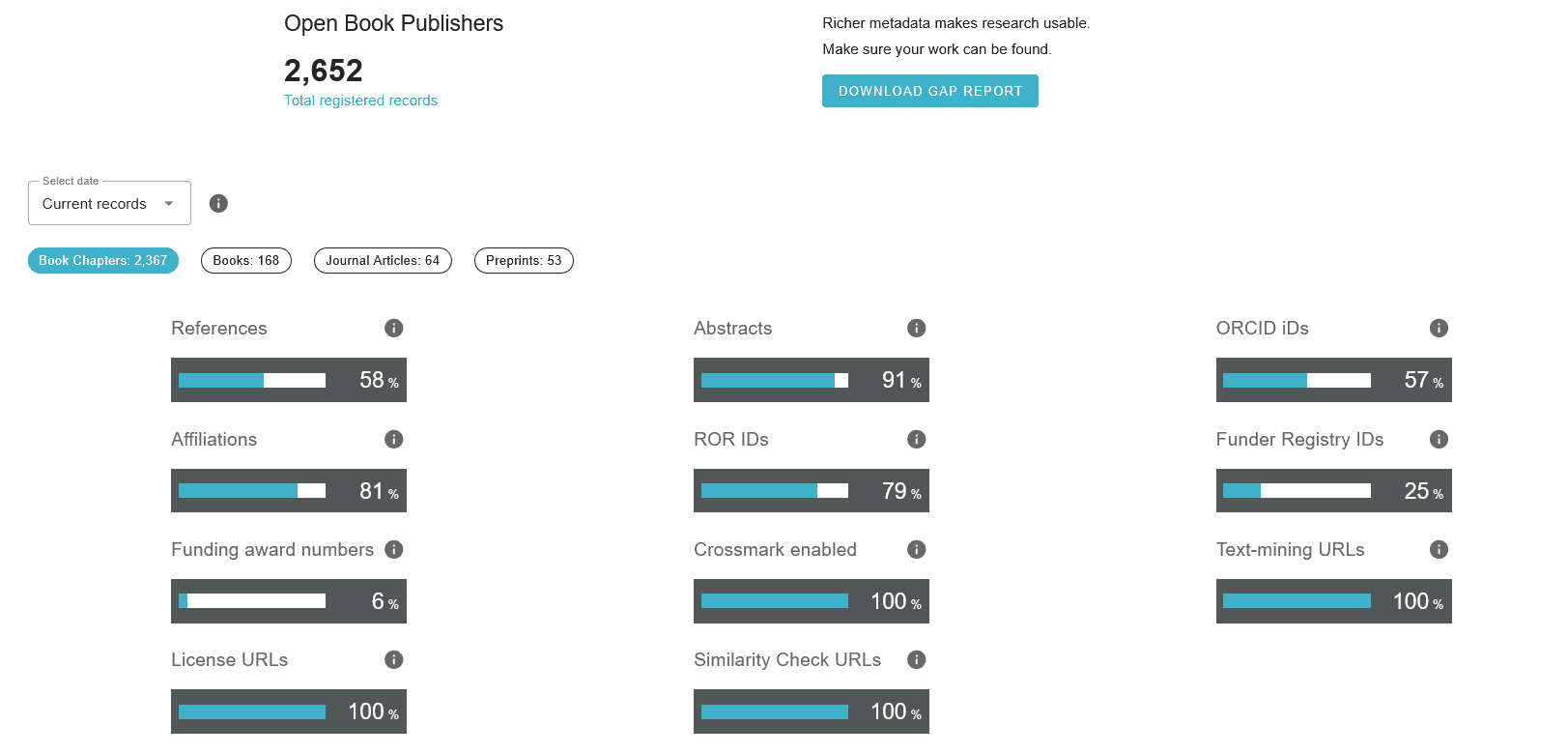
Crossref Participation Report of Open Book Publishers, one of the scholar-led Diamond OA publishers using Thoth to register high-quality DOI metadata with Crossref.
It also means closer contact between Crossref and ourselves. As an accredited Service Provider, we will be invited to group consultations from 2027, which gives us a direct channel for bringing the needs of book publishers, and of smaller and scholar-led presses in particular, into the wider conversations about how Crossref metadata evolves.
Next Steps
We will shortly be adding the Crossref Service Provider (Advanced) badge to our website, and Thoth will be listed on Crossref's Service Providers page. We also look forward to taking part in the group consultations from 2027, and to sharing more about our approach in the blog that Crossref plans to publish about the programme in early 2027.
All in all, this is a milestone that belongs to the whole Thoth community: to the publishers who trust us with their metadata, to our partners, and to the team who have put in the legwork to make good metadata practice achievable for presses of every size. If you are a publisher, library or infrastructure provider who would like to learn more about how Thoth supports Crossref registration, or if this sounds like something you, would like to become engaged in as well, please don't hesitate to get in touch. We look forward to hearing from you!
--
Header image: Photo by Campbell on Unsplash. Remixed by Thoth Open Metadata.